Key takeaways
- The best road bike seat for women starts with width and support. Bikeroo, CDYWD and YLG wide-fit saddles compared, plus how women-specific fit differs.
Women’s saddle problems on a road bike usually trace back to one mismatch: the saddle under them was shaped for a narrower pelvis than theirs. On average, women’s sit bones sit wider apart than men’s, and the stock saddle on many road bikes — and most unisex aftermarket saddles — puts its support where a narrower rider needs it. The result is pressure in exactly the places a saddle should never load, and riders blaming their bodies for a geometry problem.

This guide compares three verified Amazon US listings built around width and support, explains the fit logic that separates a women’s saddle search from a men’s one, and is candid about the verification limits of this corner of the market, including where the specialist women-specific saddles from the big saddle makers are sold instead.
Disclosure: As an Amazon Associate, this site may earn from qualifying purchases made through links in this article, at no additional cost to you.
How women’s fit actually differs
Width is the headline, not a detail. Sit bone spacing is the measurement that sets saddle width, and because the female average is wider, many women need the wide size in a unisex line or a saddle designed wide from the start. The test is simple: sit on corrugated cardboard on a firm chair, measure between the centres of the two depressions, and shop for a saddle whose rear platform is wider than that spacing. A saddle narrower than your sit bones cannot be adjusted into comfort — the support simply is not under you.
Relief has to be real. A central channel or cutout unloads the soft tissue that a road position presses into the nose and middle of the saddle. For many women this matters more than for most men, and a shallow decorative groove is not the same thing as a genuine relief zone. Wide comfort saddles approach the problem with a broad rear, a dipped centre and a shorter, less intrusive nose.
Padding placement beats padding volume. A mountain of soft foam feels kind for ten minutes and then compresses, letting your sit bones sink until the surrounding foam presses upward in the middle — worse than a firm saddle. The better designs put memory foam or gel over a shaped base, so support stays under the bones and the centre stays unloaded.
The honest market note. The famous women-specific performance saddles — Terry’s Butterfly line and Selle Italia’s Diva models among them — are sold mainly through bike shops and cycling retailers, and we could not verify a current Amazon US listing for them to the standard this site requires, so they are named here without links as the specialist benchmark. What Amazon US does verifiably stock is the wide-fit comfort end of the market below: saddles aimed at endurance, leisure and fitness riding rather than racing. For many women returning to riding or building up distance, that is exactly the right end to start at.
The picks
Bikeroo Wide Comfort Saddle — the structured wide pick
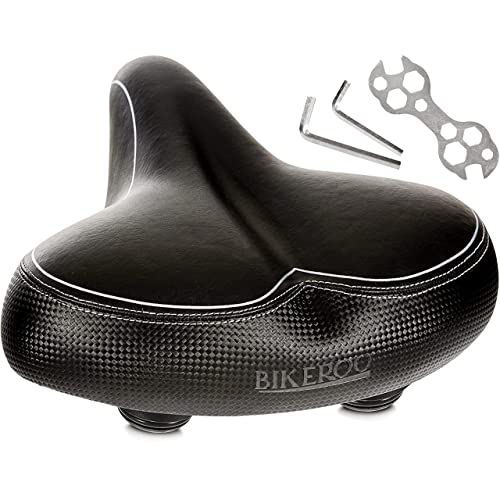
The Bikeroo wide saddle (ASIN B07B646ZZY) is the most deliberately engineered of the three: a wide rear platform over memory foam, a centre relief design, and suspension underneath — sold in spring and elastomer variants — with a stated rider weight limit of 350 lb that tells you how substantially it is built. It suits the rider whose road bike doubles as her fitness and endurance bike and whose complaint is sit-bone ache and pressure on rides past the half hour.
The wide, supported design is the opposite philosophy from a racing saddle, and that is the point of including it first: for the rider whose current saddle is a narrow unisex perch, this is the shape correction that fixes the underlying problem. Check the variant on the live listing — the spring and elastomer versions ride differently, the springs adding bounce over rough pavement and the elastomers giving a tauter feel — and confirm the rail fit for your seatpost before ordering.
CDYWD Extra Wide Gel Saddle — the maximum-cushion pick
The CDYWD extra wide saddle (ASIN B0B68D1H5C) takes width and gel cushioning to the generous end of the market, with dual spring suspension and a broad, short shape aimed squarely at upright and semi-upright comfort. Its listing record notes strong recent demand, and it is the pick for the rider whose priority is simply that the saddle stop hurting: new riders, returning riders, and anyone whose road riding is done at a social pace in an endurance position.
One candour point: this listing’s record is inconsistent — strong demand signals sit alongside a buying-option gap in the same record — so treat the live page as the authority. If it shows the saddle available from a seller you trust, it is a reasonable buy; if it does not, the Bikeroo above is the fallback rather than a substitute listing with a similar name, because copycat versions of popular wide saddles are common in this category.
YLG Oversized Comfort Saddle — the big-and-soft pick
The YLG oversized saddle (ASIN B07QHTZHXD) is the largest of the three, built wide with thick padding and springs for riders who want maximum surface and softness — including riders for whom standard wide saddles still feel like a perch. It has been recommended in fresh saddle roundups for exactly this comfort-first brief, and for gentle road, path and hybrid riding it delivers the sit-on feeling its buyers are looking for.
The same verification candour applies, more strongly: this listing’s own record has shown no active buying option in its summary even as roundups continue to recommend the saddle, which usually means availability comes and goes through marketplace sellers. Buy it only from a live listing you have opened and checked, and understand that the soft, oversized formula suits relaxed riding — at a brisk road pace with a low position, very wide saddles can chafe the inner thigh, which is a shape limit, not a quality judgement.
Setting up a women’s saddle so it can do its job
Level is the starting point, a slight nose-down tilt is the common adjustment. Many women find one or two degrees of nose-down relieves front pressure without sliding them forward. More than that loads the hands and creates a new problem.
Height and setback interact with width. A wider saddle changes where you sit on it. After fitting, re-check that your knee tracks comfortably over the pedal and that you are perched on the rear platform rather than the middle — if you keep sliding forward to the narrow part, the saddle is too wide or tilted wrong, in that order of suspicion.
Judge it over three rides. Sit-bone tenderness on ride one is adaptation. Pressure, numbness or pain that builds during a ride is information: the relief zone is not where your body needs it, or the width is wrong. Comfort saddles bought online earn their keep through the returns window — use it rather than enduring a bad fit.
Saddle, shorts and position: the system around the seat
No saddle works alone, and three companions decide whether a good one gets a fair chance. The first is the pad in your cycling shorts: a women’s-specific pad is shaped and placed differently from a men’s, and pairing a wide women’s saddle with men’s shorts quietly reintroduces the pressure the saddle was bought to remove. The second is bar height. A road position with the bars far below the saddle rotates the pelvis forward onto the saddle’s nose and centre; raising the bars a few millimetres, or shortening the reach, unloads the front of the saddle more than any cushion can. Many “saddle problems” on women’s road bikes are, on inspection, reach problems wearing a disguise.
The third is time. Tissue adapts to a correct saddle over two to three weeks of regular riding, and the wide comfort saddles here ask for less adaptation than most — but a rider returning after years away should build distance gradually on any saddle, because unconditioned sit bones complain about even the right support. What should never be accepted as adaptation is numbness: that is pressure on tissue that must not be loaded, and it means the relief zone or the tilt is wrong, full stop.
A note on the racing end of the market
Because the picks above sit at the comfort end, it is worth saying plainly what they are not. A rider racing, or riding in a sustained aggressive position on a performance road bike, needs a different tool: a firmer, narrower performance saddle with a genuine cutout, sized by the same sit-bone measurement, from the specialist lines named earlier in this guide — Terry, Selle Italia’s Diva range and their competitors — bought through cycling retailers who stock them and can exchange sizes. The width logic in this guide applies there unchanged; only the padding philosophy reverses, because at racing intensity the rider’s weight is carried more by the pedals and bars and the saddle’s job becomes guidance and support rather than cushioning. Choosing the comfort saddles here for that job would chafe and slow you; choosing a racing saddle for relaxed endurance riding does the mirror-image damage. Match the saddle to the riding, and both ends of the market make sense.
When to suspect the saddle is not the problem
One more diagnostic is worth the space, because it saves money. If your discomfort is a burning or chafing at the inner thigh rather than pressure at the sit bones or centre, suspect width overshoot or saddle height before shape — a saddle far wider than your spacing rubs with every pedal stroke. If the pain is in the lower back or the hands, suspect reach and bar height. If it arrives only after ninety minutes on a saddle that feels right at thirty, suspect tissue conditioning and build up gradually. The wide saddles in this guide solve the specific, common problem of support landing in the wrong places on a wider pelvis. Naming your problem precisely is what turns a returns-window experiment into a permanent fix.
The bottom line
For women whose road bike saddle hurts, the fix is width under the sit bones and a real relief zone, and of the verified Amazon US listings the Bikeroo wide saddle is the most structured expression of that formula, the CDYWD the most cushioned, and the YLG the largest and softest — the last two carrying availability caveats that make opening the live listing before ordering essential. Racers and riders who want the specialist women-specific performance saddles should shop Terry’s and Selle Italia’s lines through bike retailers, where those products are properly stocked. Whichever route you take, measure your sit bones first: that number, not the marketing, is what makes a saddle a women’s saddle in any way that matters.