Our Short List of 3


All 5 Picks at a Glance
| Product | Specs | Action |
|---|---|---|
| 1. ecobee Smart Thermostat Premium — the only pick you can talk to directly | Check price on Amazon | |
| 2. ecobee Smart Thermostat Enhanced — ecobee sensing without the built-in speaker | Check price on Amazon | |
| 3. Google Nest Learning Thermostat (4th Gen) — voice through Google Home or Alexa, with a sensor included | Check price on Amazon | |
 4. Amazon Smart Thermostat — the simplest Alexa-only route | Check price on Amazon | |
 5. Honeywell Home T9 — room sensors and voice, from a heating brand | Check price on Amazon |
Key takeaways
- Compare the best voice activated thermostats for Alexa, Google Assistant and Siri: ecobee, Google Nest, Amazon and Honeywell Home picks with C-wire and sensor notes.
As an Amazon Associate we earn from qualifying purchases.
Affiliate Disclosure: This article contains affiliate links. If you buy through a link on this page, we may earn a commission at no extra cost to you. Product names, specifications and compatibility details are taken from the manufacturer and Amazon US listings, and we have not personally tested these thermostats.
Voice activated is a label that hides an important distinction. Some thermostats have a speaker and microphone built into the wall unit itself, so you talk directly to the thermostat. Most, however, are voice controlled through a separate smart speaker or phone: you speak to an Alexa, Google Assistant or Siri device, and the thermostat carries out the command over Wi-Fi. Both approaches give you the same practical result — raising the heat, asking for the indoor temperature or switching modes without walking to the wall — but they suit different homes. If you already own smart speakers, a thermostat that simply works with your assistant is usually the smarter buy. If the hallway where the thermostat sits has no speaker nearby, a built-in voice model earns its place.
Every thermostat in this guide is a Wi-Fi smart thermostat for a low-voltage 24-volt heating and cooling system, and every one supports voice control through at least one major assistant, as stated on its Amazon US listing. We excluded basic programmable thermostats with no voice support, line-voltage thermostats for electric baseboard heat, and proprietary systems that only work with one brand of equipment. Before choosing, check three things on your own system: whether you have a common wire, usually labelled C, at the wall; whether your system is a conventional furnace and air conditioner or a heat pump; and which voice assistant your household already uses, because mixing ecosystems is where most frustration begins.
Quick comparison
| Pick | Voice route | Built-in speaker | Room sensor | C-wire |
|---|---|---|---|---|
| ecobee Smart Thermostat Premium | Alexa built in; also works with Siri and Google Assistant | Yes | One SmartSensor included | Power extender kit included for homes without one |
| ecobee Smart Thermostat Enhanced | Works with Alexa, Google Assistant and Siri through separate devices | No | Supports ecobee sensors, sold separately | Power extender kit included |
| Google Nest Learning Thermostat (4th Gen) | Voice through Alexa or Google smart speakers and the Google Home app | No | Nest Temperature Sensor (2nd gen) included | Not required in most homes, per Google |
| Amazon Smart Thermostat | Voice through Alexa devices and the Alexa app | No | Uses compatible Echo devices as temperature sensors | C-wire or adapter kit required |
| Honeywell Home T9 | Works with Alexa and Google Assistant | No | One Smart Room Sensor included | C-wire adapter included in the box, per Resideo |
How we chose
We looked for thermostats whose listings state voice control plainly rather than implying it, and whose controller type names the assistants supported. We favoured models that publish their wiring requirements, system compatibility and sensor options, because those details decide whether a thermostat works in a given house far more than screen size does. We also balanced the ecosystems: two ecobee models because ecobee is the only mainstream maker with a speaker built into the thermostat, one Google model for Google Home households, one Amazon model for Alexa households that want the simplest setup, and one Honeywell Home model for buyers who want room sensors and a traditional heating brand behind the product.
A note on how voice commands actually work is worth reading before you buy. On the models without a built-in speaker, the thermostat itself never hears you. Your smart speaker hears the command, the assistant’s cloud service interprets it, and the instruction travels back to the thermostat over your home network. That means voice control needs working Wi-Fi and internet, while the thermostat’s own screen and controls keep working locally if the connection drops. It also means the name you give the thermostat in its app — hallway, downstairs, main — becomes part of every voice command, so choose a short, distinct name during setup.
1. ecobee Smart Thermostat Premium — the only pick you can talk to directly
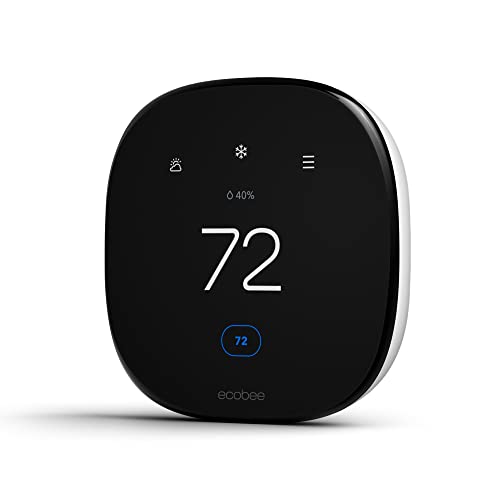
The ecobee Smart Thermostat Premium, model EB-STATE6-01, is the strongest answer to this keyword in its literal sense: the listing states that it works with Siri, Alexa and Google Assistant, and uniquely in this guide it has Alexa built into the thermostat itself, with a speaker and microphone in the wall unit. You can ask the thermostat to set the temperature, play music or answer a question without any other device in the room. For a hallway or landing with no smart speaker, that is a genuine functional difference, not a novelty.
The rest of the specification is equally complete. The box includes one ecobee SmartSensor, a wireless room sensor that reports temperature and occupancy from another room, so the system can average out a cold bedroom or prioritise the room you are actually in. The thermostat includes an indoor air quality monitor, a colour touchscreen, and a power extender kit for homes that lack a C-wire, according to the listing’s included components. ecobee describes the thermostat as ENERGY STAR certified and publishes a heating and cooling saving claim for its scheduling and eco features; treat any such figure as a manufacturer estimate that depends on your previous settings, not a guarantee.
Choose the Premium if you want voice control at the thermostat itself, a room sensor in the box and the widest assistant compatibility on this page — it is the one model here that fits Alexa, Google Assistant and Apple HomeKit households alike. Its compromises are complexity and dependence on the ecobee account and app for the advanced features. If you only ever intend to speak through speakers you already own, the Enhanced model below covers the same heating job for a simpler brief.
2. ecobee Smart Thermostat Enhanced — ecobee sensing without the built-in speaker
The ecobee Smart Thermostat Enhanced, model EB-STATE6L-01, covers the same core ground as the Premium — Wi-Fi control, occupancy-aware scheduling through ecobee’s eco features, ENERGY STAR certification and compatibility with ecobee room sensors — while leaving the speaker out. Its Amazon US listing states that it works with Siri, Alexa and Google Assistant, which in practice means voice commands are spoken to a separate assistant device: an Echo, a Google speaker, a HomePod or your phone.
For many homes that is the better arrangement. The thermostat stays a thermostat, the speakers you already own handle listening, and there is one less microphone in the house to think about. The Enhanced retains the colour touchscreen and the larger, radar-based occupancy sensing ecobee builds into this generation, and the listing includes a power extender kit, which matters in older homes where the thermostat cable has no spare wire to serve as a C-wire. Room sensors are supported but not included, so budget for at least one sensor if evening out a hot or cold room is part of your reason for upgrading.
Pick the Enhanced if you like ecobee’s sensor approach and multi-assistant support but do not need the thermostat itself to answer back. Check your system type during setup carefully: ecobee supports most 24-volt conventional and heat pump systems, but homes with high-voltage heating, some millivolt systems and certain proprietary communicating systems fall outside its compatibility, and the maker’s compatibility checker is worth the few minutes it takes before you order.
3. Google Nest Learning Thermostat (4th Gen) — voice through Google Home or Alexa, with a sensor included
Google’s Nest Learning Thermostat (4th Gen) takes the opposite design approach: a minimalist round thermostat with a large borderless display, controlled primarily through the Google Home app and by voice through a Google smart speaker or Alexa. The Amazon US listing for the Polished Silver version states that it works with Alexa and the Google Home app, that you can adjust it by voice with Alexa or a Nest smart speaker, and that it is Matter compatible, which helps it sit alongside devices from other ecosystems. This listing includes the Nest Temperature Sensor (2nd gen), which you place in another room so the thermostat can work toward that room’s temperature at scheduled times.
Two published details make this model easy to live with. Google states that it works with most 24-volt systems, including gas, electric, oil, forced air, heat pump and radiant, and that no C-wire is required for installation in most homes — a real advantage in older houses, and one to verify with the Nest compatibility checker rather than assume. Its learning features also differ from a fixed schedule: the Smart Schedule asks permission before adopting suggested changes, and Adaptive Eco finds an energy-saving temperature while you are away and aims to return the house to comfort around your arrival, per the listing.
Choose the Nest if your home already runs on Google Home, you want the included room sensor, or your wiring lacks a C-wire and checks out as compatible. Be aware that control lives in the Google Home app rather than the older Nest app for this generation, and that voice control depends entirely on separate speakers or your phone, since the thermostat has no microphone of its own. Google publishes average heating and cooling saving estimates for this model; as with every maker claim in this guide, your result depends on the schedule you started from.
4. Amazon Smart Thermostat — the simplest Alexa-only route
The Amazon Smart Thermostat is the focused option: it does one ecosystem, Alexa, and it does the setup through the Alexa app you may already have. The listing states that it works with Alexa and Ring, that linking it to an Alexa-enabled device lets you control your heating and cooling with your voice, and that Alexa can switch automatically between your preferred home, away and sleep temperatures. It is ENERGY STAR certified, and Amazon notes that it is built with Honeywell Home thermostat technology. The thermostat itself is a plain white square with a simple display, model S6ED3R, measuring 3.56 by 3.56 inches according to Amazon’s technical details.
Its limitations are stated just as plainly, which makes choosing easier. It requires a C-wire, or a separately sold power adapter kit, and Amazon lists compatibility with most 24-volt systems — conventional forced air, heat pump and radiant boiler among them — while excluding 110 to 240-volt systems such as electric baseboard heat. It has no room sensor of its own in the box, although the listing notes that compatible Echo devices, including certain Echo Dot generations, can serve as temperature sensors to address hot and cold spots. Voice control is Alexa only: there is no Google Assistant or Siri route, so Google Home households should look at the ecobee or Nest picks instead.
Pick this thermostat if your home is already Alexa-based, your wiring has a C-wire or you are willing to fit the adapter, and you want guided installation through the Alexa app rather than a feature-heavy thermostat app of its own. It is also the natural choice for a second zone or a rental property you manage, where simple schedules, remote control from the Alexa app and voice commands through existing Echo devices cover everything the occupants actually use.
5. Honeywell Home T9 — room sensors and voice, from a heating brand
The Honeywell Home T9, model RCHT9610WFSW2003, approaches voice control from the heating industry’s side. Its Amazon US listing gives the controller type as Amazon Alexa and Google Assistant among others, lists voice as a control method, and includes one Smart Room Sensor in the box. Those sensors report temperature, humidity and occupancy from the rooms where you place them, with a stated range of up to 200 feet, and the T9 can focus on the rooms you choose on a schedule, average several rooms, or follow occupancy — the listing’s example is asking Alexa to check the temperature of the bedroom, which captures exactly how sensor and voice features combine in daily use.
The T9’s published details suit a straightforward installation: a colour touchscreen measuring 3.7 by 4.92 inches, dual-band Wi-Fi on both common bands, geofencing through the Resideo app so the system knows when you are coming and going, monthly energy reports, and ENERGY STAR specification listed on the product page. Resideo includes a C-wire adapter for this model, which softens the most common wiring obstacle in older homes; confirm the current box contents on the listing before relying on that, since bundles can change.
Choose the T9 if room-by-room comfort is your main complaint — a nursery, a home office or a bedroom that never matches the hallway reading — and you want sensors included rather than added later. It suits Alexa and Google Assistant homes; Apple households should note that Siri and HomeKit are not in this listing’s controller list, and pick an ecobee instead. As with the other sensor systems here, one sensor is a start: large or multi-storey homes may need additional sensors, sold separately, to make the averaging feature meaningful.
Voice control, wiring and compatibility: what to check before you buy
Assistant first, thermostat second. Decide whether your household speaks to Alexa, Google Assistant or Siri, then shortlist only the models whose listings name that assistant. The ecobee pair cover all three. The Nest covers Google and Alexa voice through separate speakers. The Amazon thermostat is Alexa only, and the T9 covers Alexa and Google Assistant. Buying outside your ecosystem and hoping a workaround appears is the most common cause of a returned smart thermostat.
Next, the C-wire. A smart thermostat needs continuous power, and most draw it from a common wire. Photograph your existing thermostat’s wiring before removing it — carefully, with the heating system power off — and count the wires and their terminal letters. If there is no C terminal in use, choose a model with an included power extender or adapter kit, such as the ecobee models or the T9, a model that states no C-wire is needed in most homes, such as the Nest, or plan to buy the adapter the Amazon thermostat requires. Never guess by wire colour alone; terminal letters at both the thermostat and the furnace control board are the evidence that counts.
Finally, system type. All five picks target 24-volt systems, but heat pumps with auxiliary heat, dual-fuel systems, zoned systems with a zone panel, and proprietary communicating systems each have wiring and configuration requirements that a headline compatibility statement does not settle. Use the manufacturer’s compatibility checker with your exact equipment, and if your system has more wires than the checker expects, a heating technician is a better spend than a second thermostat. Once installed, test voice control with the exact phrases your household will use — set a temperature, ask for the current temperature, and switch between heating and cooling — while you are still within the return window.
Bottom line
For voice control at the thermostat itself, the ecobee Smart Thermostat Premium stands alone here, with a built-in Alexa speaker, a room sensor and an air quality monitor in one unit. For the same ecobee platform without the speaker, choose the Smart Thermostat Enhanced and speak through the assistants you already own. Google Home households and homes without a C-wire should look first at the Nest Learning Thermostat (4th Gen) with its included sensor. Alexa households wanting the simplest setup should choose the Amazon Smart Thermostat, provided the C-wire requirement is met. And households whose real problem is uneven rooms should choose the Honeywell Home T9 and its included Smart Room Sensor. Match the assistant, confirm the wiring, and any of these five will let you run the heating and cooling by voice with confidence.