Key takeaways
- Find the best 80mm ED refractor telescopes for family stargazing, with sharp lunar and planetary views, simple setup tips, and two proven 80mm ED picks.
The best 80mm ED refractor telescopes for family stargazing are compact, sharp, and forgiving enough for a first night under the stars, yet capable enough to keep older children and adults interested for years. An 80mm aperture gathers enough light for detailed views of the Moon, the rings of Saturn, the cloud bands of Jupiter, bright star clusters, and the glowing core of the Orion Nebula, while extra-low dispersion glass keeps those views clean, with far less purple fringing than a basic achromatic refractor of the same size.

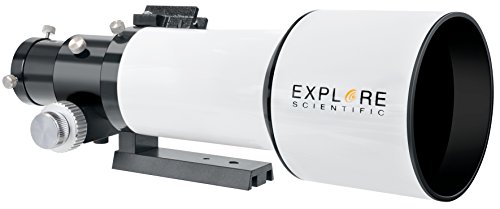
Quick answer: For most families, the SVBONY SV503 80ED is the most practical starting point, because its longer focal length suits lunar and planetary viewing and it includes a field flattener for wider deep-sky views. The Explore Scientific ED80 Essential is the more compact, wide-field alternative, with a shorter focal length that frames large star fields and nebulae in a single view. Both are optical tubes only, so plan for a steady mount, a diagonal, and at least one eyepiece before your first observing night.
An 80mm ED refractor is a sensible family size. It is light enough for one adult to carry outside in a single trip, quick enough to set up before younger children lose patience, and strong enough optically that the first views feel rewarding. Larger telescopes show more, but they weigh more and take longer to set up. Smaller telescopes are easier still, but they give up light and detail that make the Moon and planets memorable.
This guide explains what ED glass does, how to choose a mount and eyepieces, and how the two telescopes below compare. Every telescope reviewed is an 80mm ED refractor, with its focal length, focal ratio, mount situation, and included eyepieces stated plainly.
Quick Picks
| Telescope | Aperture and Focal Length | Focal Ratio | Mount and Eyepieces | Best For |
|---|---|---|---|---|
| SVBONY SV503 80ED | 80mm, 560mm | f/7 | Optical tube only; no mount and no eyepieces included | Families who want lunar and planetary detail plus wide-field deep-sky views |
| Explore Scientific ED80 Essential | 80mm, 480mm | f/6 | Optical tube only; no mount and no eyepieces included | Families who want the most portable wide-field 80mm ED tube |
How to Choose
Aperture and Why 80mm Works for Families
At 80mm, a refractor shows hundreds of craters along the terminator of the Moon, the rings of Saturn on a steady night, two main cloud bands on Jupiter, and the four Galilean moons as small points of light beside the planet. It also resolves bright open clusters such as the Pleiades into individual stars, and it shows the Orion Nebula as a glowing cloud with a bright central region.
An 80mm telescope will not show faint galaxies in the same detail as a much larger instrument. What it does well is deliver bright, high-contrast views of the objects that are easiest to find and most exciting for children: the Moon, the planets, double stars, and the brightest nebulae and clusters.
ED Glass and Colour Correction
ED glass brings different colours of light to nearly the same focus. In a basic achromatic refractor, bright objects such as the Moon and Venus often show a violet fringe around their edges. That fringe is chromatic aberration, and it softens fine detail and lowers contrast. An ED doublet or triplet reduces that fringe sharply, so lunar craters look crisper, planetary bands look cleaner, and bright stars look like tight points rather than coloured smudges.
For families, colour correction matters because children notice at once when the Moon looks sharp and white rather than edged in purple, and adults notice it when Jupiter keeps its bands at higher magnification instead of turning into a bright, fuzzy disc. ED glass is the single optical feature that most improves the view in this size class.
Focal Length, Focal Ratio, and Field of View
Focal length and focal ratio shape what a telescope shows best. The SVBONY SV503 80ED has a 560mm focal length at f/7, while the Explore Scientific ED80 Essential has a 480mm focal length at f/6. Both gather the same amount of light, but the longer tube gives slightly higher magnification with the same eyepiece and a slightly narrower field of view, while the shorter tube gives a wider field and slightly lower magnification.
For the Moon and planets, the longer focal length is a small advantage, because it reaches useful planetary magnifications with comfortable eyepieces. For large nebulae and sweeping star fields, the shorter focal length is a small advantage, because it fits more sky into one view. If your family wants both, either tube works, and the eyepiece choice matters more than the difference in focal length.
Mount Type and Stability
The mount is the part of the system that most often decides whether a family evening succeeds or fails. A shaky mount turns every touch of the focuser into a wobbling image, and a mount that is too light for the tube will vibrate in a light breeze and frustrate children who are trying to centre the Moon. Both telescopes in this guide are sold as optical tubes only, which means no mount or tripod is included, and you must budget for one separately.
For family visual use, a sturdy alt-azimuth mount is usually the simplest choice. It moves up and down and left and right, which matches how people naturally point, and it sets up in minutes with no polar alignment. A manual equatorial mount can track the sky with a single slow-motion control once aligned, which helps at higher magnification, but it takes longer to learn. Whichever type you choose, pick a mount rated comfortably above the weight of the tube plus diagonal and eyepiece, with slow-motion controls, and a tripod that reaches a comfortable height for both adults and children.
Eyepieces, Diagonal, and Magnification
An eyepiece decides magnification, and the diagonal decides viewing comfort. A 10mm eyepiece gives 56x on the longer tube and 48x on the shorter tube. The practical ceiling for an 80mm telescope on a steady night is around 160x, and the most useful family magnifications are usually between 25x and 120x.
Start with two eyepieces: a low-power eyepiece around 20mm to 25mm for finding objects and wide star fields, and a medium-power eyepiece around 9mm to 12mm for the Moon and planets. Add a 2x Barlow lens later for higher magnification. You will also need a star diagonal, which bends the light path so you can look into the eyepiece comfortably when the telescope points high in the sky. Neither telescope in this guide includes eyepieces or a diagonal, so treat those as required accessories.
Portability, Setup Time, and Storage
A family telescope earns its place by being used, and use depends on portability and setup time. An 80mm refractor tube is short and light enough to carry in one hand, and it needs almost no cool-down time before observing, unlike larger mirrored telescopes that need time to match the outdoor temperature. That means you can decide to observe on a clear evening, carry the tube and mount outside, and be looking at the Moon within ten minutes.
Check the assembled length and weight before you buy a mount, and think about where the telescope will live between sessions. A tube that fits in a hallway cupboard is far more likely to be used than one that needs a dedicated room. Keep the dust caps on, store the tube in a dry place, and keep eyepieces in a small padded case. Keep the whole kit — tube, mount, diagonal, two eyepieces, a red torch, and a star chart or sky app — together in one place, so a spontaneous clear night becomes an observing night instead of a search for missing parts.
What Children Actually See and How to Keep It Fun
Children enjoy telescopes most when they can find something quickly, see it clearly, and take a turn without a long wait. Start every session with the Moon when it is visible, because it is bright, easy to find, and full of detail at low power. Move to Jupiter or Saturn when they are up, then to a bright star cluster or the Orion Nebula. Keep each object in view for a few minutes and let everyone look, rather than rushing through a long list.
Keep sessions short, especially for younger children. Thirty to forty-five minutes is a good length for a first night, with warm clothes, a drink, and a chair for waiting turns. Let children help with simple jobs, such as carrying the eyepiece case or turning the slow-motion control while an adult keeps the object centred. Avoid maximum magnification on every object, because a smaller, sharper image is more enjoyable than a larger, dimmer, shaky one.
The Best 80mm ED Refractor Telescopes for Family Stargazing Reviewed
SVBONY SV503 80ED
Specifications: 80mm aperture, 560mm focal length, f/7 ED doublet, optical tube only, no mount included, no eyepieces included, 2-inch dual-speed rack-and-pinion focuser, 0.8x field flattener included in this listing variant.
The SVBONY SV503 80ED is the most balanced 80mm ED refractor in this guide, because its 560mm focal length at f/7 sits between a wide-field short tube and a long planetary tube. It gives a little more magnification with each eyepiece than the shorter Explore Scientific tube, which helps on the Moon and planets, while still framing the Pleiades, the Orion Nebula, and the Andromeda Galaxy core in a satisfying low-power view. The ED doublet keeps lunar detail crisp, and the dual-speed focuser makes fine focus easier at higher power.
The included 0.8x field flattener is useful for families who may later try simple photography, because it flattens the field and widens the effective view for large nebulae. For purely visual use it is not essential, but it adds flexibility without much weight. The tube is solid and compact for its focal length, and it rides well on a mid-sized alt-azimuth or equatorial mount.
Partial fit to flag: This is an optical tube only. No mount, no diagonal, and no eyepieces are included, so a family buying only this listing cannot observe on the first night without those accessories. There is also no GoTo system, so finding objects depends on a star chart, a sky app, or a finder. The 80mm aperture sets a real limit on faint deep-sky objects, so galaxies beyond the brightest few will look like faint smudges rather than detailed spirals.
Explore Scientific ED80 Essential
Specifications: 80mm aperture, 480mm focal length, f/6 ED triplet, optical tube only, no mount included, no eyepieces included, retractable dew shield, 2-inch rack-and-pinion focuser.
The Explore Scientific ED80 Essential is the most portable wide-field choice in this guide. Its 480mm focal length at f/6 gives the widest views of the two telescopes here, which suits sweeping views of the Milky Way, large open clusters, and big nebulae that do not fit comfortably in a longer tube. The triplet design uses HOYA FCD1 ED glass, with three lens elements instead of two, and that extra element helps control colour across the field, so bright stars stay tight and the Moon stays clean at the edge of the view.
The retractable dew shield shortens the tube for storage and transport, and it extends in use to block stray light and slow dew on the front lens on damp evenings. The tube is light enough to carry with one hand, and it pairs well with a light alt-azimuth mount for quick sessions in the garden or on a short drive to darker skies. Its shorter focal length also means lower magnification with the same eyepiece, which can be kinder for younger observers, because the image stays brighter and the target stays in view longer.
Partial fit to flag: This is also an optical tube only, with no mount, no diagonal, and no eyepieces included, so the same accessory budget applies as with the SVBONY tube. There is no GoTo system and no finder included, so families need a plan for finding objects. The shorter focal length means planetary observers will want a shorter eyepiece or a Barlow lens to reach the same magnification as the longer SVBONY tube, and the 80mm aperture carries the same faint-object limits.
What to Check Before You Buy
Before you buy any 80mm ED refractor, check the listing carefully and confirm exactly what is included. Many ED refractors are sold as optical tubes only, and the listing title can make that easy to miss. Look for the words optical tube, OTA only, or tube only, and check the included items list for a mount, a tripod, a diagonal, eyepieces, and a finder. If those items are missing, add them to your budget before you compare telescopes, because a cheaper tube that needs a mount and eyepieces can cost more in total.
Check the mount rating and the dovetail type as well. The tube should fit the mount without an adapter you did not expect, and the mount should hold the tube plus diagonal and eyepiece without vibration. Check the focuser size, because a 2-inch focuser accepts both 2-inch and 1.25-inch accessories with an adapter. Check the weight and length against your storage space and your car, and check the warranty and return policy. Finally, check the availability of the exact listing you plan to buy, because ED refractor listings change and bundles vary.
Frequently Asked Questions
Is an 80mm ED refractor good enough for family stargazing?
Yes, for the objects families observe most. An 80mm ED refractor shows the Moon in fine detail, the rings of Saturn, the bands of Jupiter, bright star clusters, and the brightest nebulae with good contrast and little colour fringing. It will not show faint galaxies in detail, but it covers the bright, easy-to-find targets that make family observing enjoyable.
What is the difference between an ED refractor and an achromatic refractor?
An ED refractor uses extra-low dispersion glass to bring colours to nearly the same focus, which reduces the violet fringe and softening seen around bright objects in a basic achromatic refractor. An achromatic refractor can still give pleasant low-power views, but it shows more false colour on the Moon and planets, especially at higher magnification.
Do these 80mm ED telescopes come with a mount and eyepieces?
No, not in the listings in this guide. Both telescopes are sold as optical tubes only, with no mount, no diagonal, and no eyepieces included. Plan for a steady alt-azimuth or equatorial mount, a star diagonal, and at least a low-power and a medium-power eyepiece.
What magnification should families use with an 80mm telescope?
Start low, around 25x to 35x, for finding objects and viewing star fields, then move to 50x to 100x for the Moon and planets. The practical ceiling for an 80mm telescope is around 160x on a steady night, and going beyond that usually makes the image dimmer and softer. A 20mm to 25mm eyepiece and a 9mm to 12mm eyepiece cover most family observing.
Can children use an 80mm ED refractor on their own?
Older children can learn to point and focus an 80mm refractor on a sturdy mount with adult help, but younger children need an adult to set up, aim, and focus the telescope. The front lens should never be touched or pointed at the Sun without a proper solar filter made for the front of the telescope. Treat the telescope as shared family equipment, with adults handling setup and children helping with observing.
Bottom Line
The best 80mm ED refractor telescopes for family stargazing are the ones that get used, and both telescopes here earn that description in different ways. Choose the SVBONY SV503 80ED for the most balanced family tube, with a longer focal length for lunar and planetary detail, a dual-speed focuser, and a field flattener for wider deep-sky views. Choose the Explore Scientific ED80 Essential for the most portable wide-field tube, with a shorter focal length, triplet ED optics, and a retractable dew shield.
Whichever tube you choose, budget for the same essentials: a steady mount, a diagonal, and two good eyepieces. Keep first sessions short, start with the Moon, and let everyone take a turn. An 80mm ED refractor will not show everything in the sky, but it shows the brightest and most memorable objects well, in a package a family can carry outside without a long setup.
Disclosure: As an Amazon Associate, we may earn from qualifying purchases.