Key takeaways
- Rechargeable CR2032 batteries explained: true LIR2032 cells at 3.6 volts, how they differ from disposable 3 volt CR2032 cells, charger rules, and two Amazon US picks.
As an Amazon Associate we earn from qualifying purchases.
Affiliate Disclosure: This article contains affiliate links to products sold on Amazon US. If you buy through those links, we may earn a commission from qualifying purchases at no additional cost to you. Product specifications are taken from the manufacturer and listing information cited for each model, not from detailed research by this site.
Scope of This Guide: Only True Rechargeable LIR2032 Cells
This guide covers one thing only: genuinely rechargeable coin cells in the 2032 size, sold as LIR2032. Every product below is a lithium-ion rechargeable cell with a nominal voltage of 3.6 or 3.7 volts. No disposable CR2032 cell appears in this guide, and no product is included merely because its listing uses the words rechargeable loosely. That distinction is the entire point of this article, and it is worth stating plainly before anything else.
A standard disposable CR2032 is a 3 volt lithium manganese dioxide cell. It is not rechargeable. Attempting to recharge one can cause it to leak, overheat, or rupture, and it should never be put in a charger. An LIR2032 is a different chemistry: a rechargeable lithium-ion cell in the same 20 millimetre diameter and 3.2 millimetre thickness, with a nominal voltage of 3.6 volts and a fully charged voltage of about 4.2 volts. The two cells share a size and a shape. They do not share a voltage, a chemistry, or a charging rule, and treating them as interchangeable is how devices get damaged.
That voltage difference is the single most important fact in this guide. A device designed for a 3 volt CR2032 may not tolerate 3.6 volts, and it will certainly not tolerate 4.2 volts from a freshly charged LIR2032. Some devices are built to accept rechargeable cells, and their manuals say so, naming LIR2032 or ML2032 as acceptable. Others are not, and putting a higher-voltage cell in them risks erratic behaviour or permanent damage. Before buying any battery in this guide, check the device manual for the exact battery type it specifies. If the manual names only CR2032 and says nothing about rechargeable cells, do not substitute an LIR2032. If the manual names LIR2032, ML2032, or a rechargeable 2032 cell, then the products below are the right kind.
Only two products cleared the filters for this guide with a listing that could be identified on Amazon US at the time of writing: both are named LIR2032 cells, both state their voltage and capacity on their listings, and both are sold as rechargeable lithium-ion coin cells rather than as disposable cells. Rather than pad the list with disposable CR2032 cells or with cells whose chemistry is unclear, this guide covers those two in depth and then explains the charger rules and the compatibility checks that matter more than brand choice. Both listings should be re-checked on the live product page before purchase, because Amazon listings, configurations, and availability in this category change frequently.
What an LIR2032 Cell Actually Is
An LIR2032 is a rechargeable lithium-ion button cell. Its standard dimensions are 20.0 millimetres in diameter and 3.2 millimetres in height, identical to a disposable CR2032, which is why the two are so often confused. Its nominal voltage is 3.6 volts, with some makers stating 3.7 volts for the same chemistry, and its maximum charging voltage is 4.2 volts. Typical capacity for a standard LIR2032 is around 40 to 45 milliamp-hours, which is far lower than the capacity of a disposable CR2032, because the rechargeable chemistry stores less energy per cell. That is a normal trade-off, not a defect: the cell is designed to be recharged hundreds of times, and its value comes from reuse, not from a single long run.
Published cycle life for standard LIR2032 cells is typically more than 500 charge and discharge cycles with capacity remaining above 80 percent of the original figure, when charged correctly. Correct charging matters more here than with larger rechargeable batteries. An LIR2032 must be charged with a charger designed for lithium-ion coin cells, at a low current, up to a 4.2 volt limit. Charging one in a charger made for another chemistry, or in a device that is not a charger at all, is not safe. Many bare LIR2032 cells also have no built-in protection circuit, which means the charger and the device provide the only protection against overcharge and over-discharge. That is not a reason to avoid the chemistry, but it is a reason to buy the right charger and to follow the maker’s charging instructions exactly.
The cut-off discharge voltage for a standard LIR2032 is about 2.75 volts, and the maximum charge and discharge currents are low, typically around 40 milliamps. These are small cells for small devices: car key fobs, remote controls, watches and small sensors that were designed for rechargeable cells, solar-powered lights, and small electronic devices with a coin-cell holder wired for a rechargeable cell. They are not a general replacement for disposable CR2032 cells in every device that takes a 2032, and this guide does not present them that way.
Pick 1: CT-ENERGY LIR2032 Rechargeable Batteries, 6-Pack
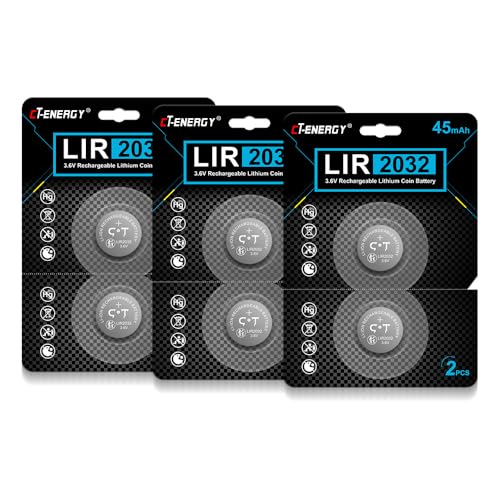
- ASIN: B08LN21K5Y (Amazon US listing, candidate — see the verification note at the end of this guide)
- Type: LIR2032 rechargeable lithium-ion coin cell
- Voltage: 3.6 volts nominal
- Pack: 6 cells
The CT-ENERGY LIR2032 is the pick in this guide for the buyer who wants a straightforward multi-pack of standard-capacity rechargeable 2032 cells. It is a 6-pack of 3.6 volt lithium-ion coin cells, sold for use in devices that accept LIR2032 cells, such as car key fobs, watches, and small remotes that were designed for rechargeable cells. The user manual for this product states the model as LIR2032, the chemistry as rechargeable lithium-ion, and the pack contents as six cells, and the listing names the product as a replacement for 3 volt CR2032 cells in devices that accept the rechargeable type.
The practical advantage of a 6-pack is rotation. With six cells, a buyer can keep charged spares ready while others are in use, which matters because a rechargeable coin cell has a much lower capacity than a disposable one and will need recharging more often. A single cell bought alone leaves no spare when it runs flat; a 6-pack means the device can be back in service immediately while the flat cell charges. For a household with several key fobs, remotes, or sensors that use this cell type, that rotation is the difference between rechargeable cells being convenient and being a nuisance.
The standard LIR2032 capacity of around 40 milliamp-hours applies here, and the cell dimensions are the standard 20 by 3.2 millimetres, so it fits any holder made for a 2032 cell. The warning that applies to every cell in this guide applies here too: these cells must be charged with a charger made for LIR2032 lithium-ion coin cells, and they must only be used in devices whose manual allows a rechargeable 2032 cell. Do not charge them in a charger made for disposable cells, because no such charger should exist, and do not put them in a device that specifies only a disposable CR2032.
Choose the CT-ENERGY 6-pack if you have several devices that accept LIR2032 cells, if you want spares on hand for rotation, and if a standard-capacity cell suits your devices.
Pick 2: EEMB LIR2032H Rechargeable Batteries, 4-Pack
- ASIN: B08GYGSVKY (Amazon US listing, candidate — see the verification note at the end of this guide)
- Type: LIR2032H high-capacity rechargeable lithium-ion coin cell
- Voltage: 3.7 volts nominal
- Capacity: 70 milliamp-hours
- Pack: 4 cells
The EEMB LIR2032H is the pick in this guide for the buyer who wants more capacity per cell and is willing to buy a smaller pack to get it. The H in the model name marks a high-capacity version of the standard cell: 70 milliamp-hours instead of the usual 40 to 45, in the same 20 by 3.2 millimetre size. That extra capacity means longer time between charges in the same device, which is useful for key fobs and remotes that are used many times a day and for sensors that draw current continuously.
EEMB states that this cell can replace the ML2032, a rechargeable manganese lithium cell used in some devices, and lists compatible uses including car remote key fobs, watches, and sensors. The listing also states that the cells should be charged with an EEMB dedicated charger, which is an important detail rather than a marketing line. A high-capacity lithium-ion coin cell needs the correct charging voltage and current limit, and using the maker’s own charger removes the guesswork about whether a generic charger is suitable. Buyers should treat the dedicated charger as part of the cost of using these cells, not as an optional extra.
The 4-pack size suits a buyer with one or two devices rather than a household full of them. With four cells, there are still spares for rotation, but the pack is aimed at the user who wants the higher capacity rather than the largest number of cells. The 3.7 volt nominal figure is the same chemistry as the 3.6 volt figure used by other makers; the difference is a matter of how the nominal voltage is stated, not a different cell. The fully charged voltage is still about 4.2 volts, and the same compatibility warning applies: only use this cell in a device whose manual allows a rechargeable 2032 cell.
Choose the EEMB LIR2032H 4-pack if your devices run flat quickly on standard-capacity cells, if you want the longest time between charges, and if you will use the maker’s dedicated charger.
Head to Head: Standard Capacity or High Capacity
The two cells solve the same problem in different ways. The CT-ENERGY 6-pack gives more cells at standard capacity, which suits rotation across several devices. The EEMB LIR2032H 4-pack gives fewer cells at higher capacity, which suits one or two hard-working devices that need the longest possible run between charges. Neither is the wrong choice for a device that accepts LIR2032 cells, and the deciding factor should be how many devices you have and how often they need charging.
If you have several key fobs, remotes, or sensors that accept LIR2032 cells, the 6-pack is the more practical buy, because the spare cells keep every device running while others charge. If you have one key fob that you use constantly and it runs flat often, the higher-capacity EEMB cell is the better tool, because it stretches the time between charges. If you are unsure which capacity your device needs, the standard-capacity cell is the safer starting point, because it matches the capacity the device was most likely designed around.
One thing the two picks share is the charger rule. Neither cell should be charged in a charger that was not designed for lithium-ion coin cells, and neither should be used in a device that specifies only a disposable CR2032. That rule does not change with capacity or brand.
The Charger Rules That Matter Most
A rechargeable coin cell is only as safe as its charger. Buy a charger that is explicitly made for LIR2032 lithium-ion coin cells, with a stated charging voltage limit of 4.2 volts, and follow its instructions. Do not improvise a charger, do not charge the cells in a device that is not a charger, and do not leave charging cells unattended for long periods. Store charged spares away from metal objects such as keys and coins, because a short circuit across the cell terminals can cause overheating.
Never attempt to recharge a disposable CR2032 cell. Disposable cells are not built to be recharged, and trying to do so can cause leaking, overheating, or rupture. If a cell is marked CR2032 without an L in front of the model number, and without the word rechargeable on the cell and its packaging, treat it as disposable and replace it rather than charging it. The same applies to any coin cell you find in a drawer without clear markings: if you cannot confirm it is a rechargeable LIR2032, do not put it in a charger.
Also check the device before the first use. Put the charged LIR2032 in the device, confirm the device works normally, and watch for anything unusual such as excess heat, erratic behaviour, or a device that runs far hotter than it did on a disposable cell. If anything seems wrong, remove the cell and go back to the disposable type the manual specifies. A device that was designed for 3 volts may not tolerate 3.6 volts, and no saving on batteries is worth a damaged device.
Where LIR2032 Cells Fit, and Where They Do Not
LIR2032 cells fit devices whose manuals name LIR2032 or ML2032 as an acceptable battery, and devices with a built-in charging circuit designed for rechargeable coin cells, such as some solar-powered lights and sensors. They are commonly used in car key fobs, remote controls, and small electronic devices that were designed around a rechargeable cell from the start.
They do not fit every device that takes a 2032. A device whose manual specifies only a disposable CR2032 should keep using disposable cells. That includes most household devices such as kitchen scales, thermometers, and calculators, and it includes the Apple AirTag, which specifies a disposable CR2032 and is designed around a 3 volt cell. Putting a 3.6 volt rechargeable cell in a device built for 3 volts risks damaging the device, and it is not a saving if the device has to be replaced. Medical devices, including glucose monitors, should only ever use the exact battery type their manual specifies, and no substitution should be made without checking that manual first.
When in doubt, the manual decides. If the manual is lost, look up the device model on the maker’s website and check the battery specification there. If neither source names a rechargeable cell, use a disposable CR2032. The products in this guide are for the cases where the manual does name a rechargeable cell, and that boundary is part of the recommendation, not a footnote to it.
Buying Checklist Before You Order
Run through this list before buying either pick. First, confirm the device manual names LIR2032, ML2032, or a rechargeable 2032 cell. Second, confirm you have, or will buy, a charger made for LIR2032 lithium-ion coin cells, with a 4.2 volt charging limit. Third, check the pack size against the number of devices you have, so you have spares for rotation. Fourth, confirm the listing names the exact model, LIR2032 or LIR2032H, and states the voltage and capacity, and be suspicious of any listing that claims a far higher capacity than the standard range, because inflated capacity claims are common in this category. Fifth, confirm the item is in stock and sold for delivery in the United States, and re-check the live listing before you pay, because listings, configurations, and availability change frequently.
Verification Note and Buying Caution
The two ASINs in this guide were identified from published index and manual sources that reference the Amazon US listings for these exact models. The CT-ENERGY LIR2032 listing recorded as B08LN21K5Y is identified from the product user manual for the CT-ENERGY LIR2032 6-pack, which states the model as LIR2032, the voltage as 3.6 volts, and the pack contents as six rechargeable lithium-ion coin cells. The EEMB LIR2032H listing recorded as B08GYGSVKY is identified from the product manual for the EEMB LIR2032H and from a current listing record that confirms the brand as EEMB, the model as LIR2032H, the voltage as 3.7 volts, the capacity as 70 milliamp-hours, and the pack contents as four cells. A direct re-read of the live Amazon product pages could not be completed at the time of writing because Amazon’s page service returned access-denied errors, so both ASINs are recorded as candidate rather than verified. Before buying, open the live listing, confirm the model name and configuration match this guide, confirm the voltage and capacity match the values stated here, confirm the item is in stock and sold for delivery in the United States, and confirm your device manual allows a rechargeable 2032 cell. Do not substitute a disposable CR2032 for either pick, and do not substitute a different model of the same brand without re-checking its voltage and capacity.
Bottom Line
A rechargeable CR2032 battery is really an LIR2032: a 3.6 volt lithium-ion coin cell in the same size as a disposable 3 volt CR2032, with a different chemistry, a different voltage, and a different set of rules. The CT-ENERGY 6-pack suits households with several devices that accept LIR2032 cells. The EEMB LIR2032H 4-pack suits one or two hard-working devices that benefit from higher capacity. Whichever you choose, use the correct charger, check the device manual first, and never recharge a disposable cell. The saving from rechargeable cells only counts when the device is built for them.