Key takeaways
- Three low-volume snorkel masks that work for scuba diving, compared on fit, ear equalizing, lens clarity and durability, with specs from their listings.
A mask that behaves on the surface can turn into the whole dive once you descend. Scuba adds pressure, a regulator in your mouth and gauges you actually need to read, so the real decision is not color or styling. It is whether the skirt seals on your face without cranking the strap, whether the nose pocket lets you equalize the mask as you go down, and whether the lenses are tempered glass in a low-volume body that clears with one small exhale instead of a flood-and-struggle routine.
This roundup covers three kinds of buyer: divers whose ears complain on every descent, divers who want one durable mask that survives years of boat decks and gear bags, and divers with narrower faces or constant gauge checks. Every pick is a low-volume dive mask its listing presents for scuba as well as snorkeling, and each name, feature and specification below comes from the product names and specification fields on the Amazon pages.
Quick Picks
As an Amazon Associate we earn from qualifying purchases.
| Product | Best for | Key spec from title |
|---|---|---|
| IST ProEar Dive Mask with Ear Covers (Black Silicone) | Divers who struggle to equalize or get sore, infected ears | Tempered Glass Twin Lens |
| Atomic Aquatics SubFrame Scuba Diving Mask (Regular Fit, Black/Black) | Divers who want one mask that lasts for years | UltraClear Lenses |
| Cressi Big Eyes Evolution (Clear/Black/Blue) | Divers who check gauges and computers all dive long | Inclined Inverted Teardrop Lenses |
How to Choose
Fit and Skirt Seal Come First
Every other feature is decoration if the skirt does not seal on your face. Look for a soft silicone skirt with a wide contact edge, because that edge does the sealing while the strap only holds position. A mask should stay put with a gentle inhale through the nose and no strap at all. Facial hair, a narrow bridge or a broad forehead all change which skirt shape works, so treat any claim of a universal fit as marketing. If a listing names a specific fit size, match it to your face rather than defaulting to the standard size.
Low Volume and Easy Clearing
Low-volume masks sit closer to the eyes, which leaves less air inside to manage. That smaller airspace needs gentler equalizing on the way down and clears with a short exhale through the nose instead of repeated flooding and blowing. It also brings the glass nearer, which usually widens what you can see without turning your head. The tradeoff is fit sensitivity: a close mask can touch lashes or press the brow on some faces. For scuba, low volume is the practical default, and each mask here follows it, but the close fit still has to suit your face shape.
Lens Layout and Glass Quality
Tempered glass is non-negotiable for scuba, because it handles pressure changes and resists the scratches that plastic picks up from sand and gear bags. Twin-lens designs put a bridge over the nose and let makers offer replacement prescription lenses for each eye. Single-lens designs remove the center bar for an open view. Raked or inclined lenses tilt the bottom of the glass toward your cheeks, which improves the downward view toward a chest console or wrist computer. Decide which you actually use: reading instruments every few minutes argues for raked twin lenses, while wide scenic viewing argues for an unobstructed single window.
Extras That Solve a Real Problem
Useful extras answer a specific complaint. Ear covers with equalization tubes help divers whose ears hurt or stay wet and infection-prone. A reinforced internal frame helps divers whose masks get crushed in bags and dropped on decks. Prescription lens support helps divers who would otherwise dive half-blind or pay for a custom mask. None of these is automatically better; each adds parts, care or cost. Start from the problem you actually have on your own dives, then let that problem pick the extra, instead of paying for features that solve somebody else’s complaint.
The 3 Best Options
IST ProEar Dive Mask with Ear Covers (Black Silicone)
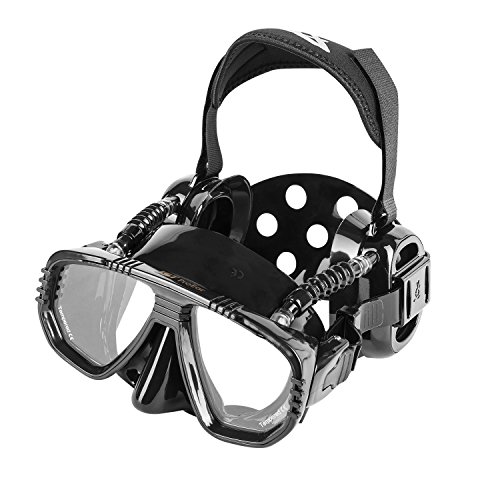
Most masks leave your ears exposed to the water and leave equalizing entirely to your technique. The ProEar takes a different route: soft silicone ear covers seal over the ears, and tubes with one-way valves carry each nose exhale to the covers, keeping the pressure inside the covers matched to the mask. The twin tempered-glass lenses and hypoallergenic silicone skirt handle the normal mask duties, and the wide strap spreads pressure so the seal does not need to be cranked tight. For divers whose descents stall at ear pain, this is the specialist pick in the roundup.
Specs
- Lens: Tempered glass, twin lens, 2 windows
- Frame material: Silicone, framed design
- Special feature: Silicone ear covers with equalization tubes and one-way valves
- Skirt: Hypoallergenic silicone with nose pocket
- Strap: Adjustable wide head strap with extra fabric fastener strap
- Part number: ME-ProEar-Mask-ME55-BS
- Item dimensions: 6.75 x 6.75 x 3 inches
- Package weight: 0.45 kilograms
- Sizes: Adult and junior
- Prescription lenses: Available separately, from -1.0 to -8.0 in -0.5 steps
- Warranty: Full manufacturer warranty
Best for: Divers who equalize slowly, get ear aches on descents, or want their ears kept dry against repeated infections.
Watch out for: The covers and tubes are extra parts to rinse, dry and inspect, and a hood has to sit outside the covers, so check the combination before a trip.
Atomic Aquatics SubFrame Scuba Diving Mask (Regular Fit, Black/Black)

The SubFrame is built around a simple promise: the frame should never be the part that fails. Instead of a bulky external plastic frame, an internal subframe is molded directly beneath the silicone skirt, and a stainless steel retainer locks the lenses and reinforces the nose bridge. The UltraClear lenses are the other half of the design, using low-iron glass for a clearer, less tinted view than standard float glass. It comes in Regular, Medium and Slim fits, which is rare honesty about face sizes in a category full of one-size claims, and it carries a limited lifetime warranty against frame breakage.
Specs
- Lens: UltraClear glass, 2 windows
- Frame: Internal subframe molded beneath the silicone skirt, stainless steel retainer
- Frame material: Silicone
- Item weight: 16 ounces
- Part number: 04-0130-00
- UPC: 882689083532
- Fits: Regular, Medium and Slim
- Strap: Adjustable
- Package dimensions: 8.3 x 5 x 3.5 inches
- Warranty: Limited lifetime, against frame breakage
Best for: Divers who travel with their mask, drop it, lend it and generally want the durability question settled once.
Watch out for: This listing keys the Regular fit in Black/Black, so confirm the fit size and color on the page before ordering instead of assuming the Medium or Slim variant is selected.
Cressi Big Eyes Evolution (Clear/Black/Blue)

The Big Eyes Evolution attacks the downward-view problem. Its twin lenses are raked and shaped as inverted teardrops, sitting close to the pupils, so a glance down reaches your console, computer and clips without a full head dip. The High Seal silicone skirt uses varied rigidity to hold a broad, soft contact patch, and the low internal volume keeps clearing quick. At well under half the weight of many framed masks, it also packs flat and light for travel. Quick-adjust buckles sit on the frame, and the lenses can be swapped for prescription lenses with a small screwdriver, which keeps the mask useful if your eyes change.
Specs
- Model: DS336020
- Type: Two lens, framed
- Skirt material: High Seal silicone
- Lens: Glass, raked, inverted teardrop shape, inclined 15 degrees
- Internal volume: Low
- Weight: 5.64 ounces
- Dimensions: 6.5 x 4 x 3.5 inches
- Buckles: Quick-adjust, frame mounted
- Included: Plastic mask case
- Country of origin: Italy
- Warranty: not stated
- EAN: 802298304134
Best for: Divers who read a console or wrist computer constantly and want the downward view built into the lens angle.
Watch out for: Several colorways share this model name, so confirm the Clear/Black/Blue version on the listing, and note the clear silicone can yellow over time where black silicone would not show it.
Which One Fits Your Situation
You Dread the First Few Meters of Every Descent
If ear pain, slow equalizing or another ear infection is what limits your diving, start with the IST ProEar. Its covers and valved tubes are the only design here aimed at the ears themselves, keeping them dry and feeding them mask air with each exhale. The rest of the mask is conventional twin-lens equipment, so you are not trading away normal mask function to get the ear help.
You Want to Buy One Mask and Stop Shopping
Choose the Atomic Aquatics SubFrame if your masks die from handling rather than from diving. The internal frame, steel retainer and limited lifetime warranty against frame breakage target exactly that failure pattern. Pick the fit honestly: the Regular suits average faces, while the Medium and Slim exist for narrower ones, and the wrong fit will leak no matter how strong the frame is.
You Spend the Dive Reading Instruments
The Cressi Big Eyes Evolution suits divers whose eyes keep dropping to a console, computer or camera screen. The raked, inverted-teardrop lenses were shaped for that downward glance, and the low volume makes the inevitable mid-dive clear a small event. It is also the lightest mask here, which matters on travel days when the mask rides in a carry-on rather than a checked gear bag.
You Have a Narrower Face
Narrow faces leak in standard masks because the skirt is simply too wide to land evenly. Two routes work here. The SubFrame comes in Medium and Slim fits with the same reinforced build, while the Cressi’s close-set raked lenses and compact frame suit smaller faces that find big panoramic masks sloppy. Either way, judge the seal with the strap loose; a narrow-face fit should hold from skirt contact alone.
Common Mistakes
- Buying the colorway you like before confirming the exact variant, when several colors and fits share one model name and one listing family.
- Cranking the strap tighter to stop a leak, which folds the skirt edge and usually makes the leak worse instead of sealing it.
- Choosing a mask with no proper nose pocket, then discovering at depth that you cannot reach your nose to equalize your ears or your mask.
- Assuming a snorkel-only mask is fine for scuba, when its lenses may not be tempered glass and its volume makes clearing at depth a struggle.
- Diving a brand-new mask without preparing the glass first, so the factory film fogs within minutes no matter how good the mask is.
Frequently Asked Questions
Can a snorkel mask actually be used for scuba diving?
Yes, when it is a true dive mask rather than a surface toy. The requirements are tempered glass lenses, a skirt that seals under pressure, and a nose pocket you can pinch to equalize. Every mask in this roundup is a dive mask its listing presents for scuba as well as snorkeling. Plain swim goggles fail because they cover only the eyes and offer no way to equalize.
What does low volume change in practice?
A low-volume mask holds less air against your face. Descending, that airspace needs smaller, gentler nose exhales to stay equalized, so squeeze is easier to avoid. Clearing takes one short exhale instead of several. The glass also sits closer, which widens the view. The cost is fit tolerance: the closer the mask, the sooner a mismatched skirt touches lashes or presses the brow, so fit checking matters more, not less.
How can I check the fit before getting in the water?
Hold the mask to your face without the strap, inhale through your nose, and let go with your hands. A seal holds the mask in place for seconds while you look up, down and side to side. Repeat with a regulator or snorkel mouthpiece in, since your upper lip moves the skirt. If it drops, shifts or needs strap pressure to stay, that skirt shape is not your fit.
Can I get prescription lenses in these masks?
Two of the three support it. The IST ProEar takes separate prescription lenses across a negative range in half-diopter steps, and the Cressi Big Eyes Evolution accepts optical lenses that swap in with a small screwdriver. The Atomic SubFrame listing does not state prescription support, so treat it as plano-only unless the seller confirms otherwise. Order lenses for your exact mask model, because lens shapes are not interchangeable between brands.