Key takeaways
- Compare laboratory drying ovens for quality-control labs: forced-air uniformity, temperature range, chamber size and calibration support for QC records.
As an Amazon Associate we earn from qualifying purchases
A drying oven in a quality-control lab does more than get hot. It dries samples to constant weight for moisture and loss-on-drying checks, cures coatings and adhesives before testing, dries glassware between runs, and holds materials at a documented temperature for a documented time. When a result is questioned, the lab has to show that the oven actually held the setpoint, everywhere in the chamber, for the full cycle. That is why choosing the best laboratory drying ovens for quality-control labs is mostly about temperature range, uniformity, control resolution and how easily the unit fits into a calibration and record-keeping routine.
This guide explains what separates a QC-ready drying oven from a general heating box, then walks through three forced-air laboratory drying ovens currently sold on Amazon US, with the specifications that matter for controlled drying work.
Quick Picks
| Product | Best for | Key spec |
|---|---|---|
| sertheha 101-0AB Digital Forced Air Drying Oven (45L) | General QC drying with stated control figures | RT+10°C to 300°C range, ±1°C fluctuation, 0.1°C resolution |
| WEIZIIA Constant Temperature Blast Drying Oven (16L) | Small batches and single-analyst benches | 50°C to 280°C range, stated uniformity of ±3°C or better, 1 to 9,999 minute timer |
| VAZHSOD 101-0AB Horizontal Electric Blast Drying Oven (45L) | Larger loads on two trays | 45L chamber, two adjustable trays rated at 33 lbs each, up to 572°F |
How to Choose a Laboratory Drying Oven for a QC Lab
Temperature range and what your methods actually need
Most QC drying methods sit in a narrow band: moisture and loss-on-drying work commonly runs around 105°C, glassware drying is lower, and curing or dry-heat steps can push toward 160°C to 200°C. An oven that reaches 300°C covers all of that with headroom, which matters because an oven run near its maximum tends to work harder and recover more slowly after the door opens. Check the bottom of the range as well. Ovens specified as room temperature plus 10°C cannot hold a setpoint below that offset, so a method calling for a gentle 40°C dry in a warm room may be out of reach.
Temperature uniformity and fluctuation
Two different numbers describe how trustworthy the heat is. Fluctuation is how much the temperature at the sensor moves over time around the setpoint. Uniformity is how much the temperature differs between points in the chamber at the same moment. A QC lab cares about both: a sample in the corner should see the same conditions as a sample next to the sensor, and the setpoint should not wander during a long dry. Forced-air (blast) ovens use a fan to circulate air, which generally evens out hot and cold spots compared with still air, and the listings below state fluctuation of ±1°C, with the compact model also stating a uniformity figure. Whatever the stated figures, a lab that reports results should verify them with its own mapping: a calibrated multi-point logger run at the working setpoint gives evidence that belongs in the QC file.
Forced-air vs gravity convection
In a forced-air oven, a fan moves heated air through the chamber, giving faster recovery after loading and tighter uniformity, at the cost of constant airflow over the samples. In a gravity convection oven, warm air rises naturally with no fan, so there is no air current to disturb light powders, loose granules or open containers of fine material, but temperature layers can form and recovery is slower. For moisture determinations, curing and general sample drying, forced air is the usual QC choice. For drying fine powders that would blow around, or for long, gentle heating where airflow is a problem, gravity convection is the safer pattern. All three picks in this guide are forced-air blast designs, which is the configuration most QC drying methods assume.
Chamber size, shelves and loading
Match the chamber to the largest routine load, not the average one. A 45L chamber with two trays handles rows of sample dishes, several beakers or a full set of crucibles in one run; a 16L chamber suits a single analyst drying a handful of samples. Check tray load ratings as well as volume: wet samples, sand baths and filled drying dishes are heavy, and the picks below carry tray ratings of 15 kg. Leave space between containers in use, because a tightly packed chamber blocks the airflow the uniformity figures depend on.
Controls, timers and documentation for QC records
A digital controller with 0.1°C display resolution makes setpoints repeatable between operators and between runs, and a long-range timer (the compact pick below runs from 1 to 9,999 minutes) lets a cycle end on schedule instead of whenever someone walks past. For the record itself, the oven is only half the system: QC labs typically log the method, setpoint, start and finish times, and the oven’s identity in the batch record, and support that with periodic calibration checks using an independent, calibrated thermometer or logger. An oven with a viewing window helps here, since an operator can confirm a load is in place without opening the door and dumping heat mid-cycle.
Chamber materials and cleaning
Drying ovens see spilled samples, boiled-over residues and corrosive vapours. Stainless steel chamber surfaces, as used in the 45L picks below, clean down more easily and resist staining better than plain galvanized linings, which are common on compact units. Smooth interiors with removable trays shorten the clean between incompatible sample types, which matters in a QC lab that may dry food, polymer and soil samples in the same week.
The Picks in Detail
sertheha 101-0AB Digital Forced Air Drying Oven, 45L

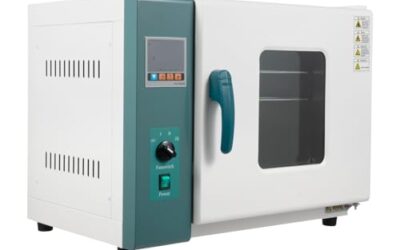
This is a horizontal forced-air (blast) drying oven built around the widely used 101-0AB platform, sized for a working QC bench. The stated temperature range runs from room temperature plus 10°C up to 300°C, with a temperature resolution of 0.1°C and a stated fluctuation of ±1°C, which are the control figures a QC lab needs when a method specifies a tight drying temperature. The chamber measures 34 x 34 x 35 cm (45L), takes two trays of 32.5 x 33.5 cm, and each tray is rated to a maximum load of 15 kg, enough for dense loads of filled sample dishes. The unit runs at 1000W on 110V, uses button controls with a digital display, and has a 19 x 24.5 cm viewing window in the side-opening door so a load can be checked without opening the chamber. Construction is cold plate with stainless steel, and the oven weighs 32.25 kg net, so it is a fixed bench installation rather than something to move between rooms.
- Strength: Stated ±1°C fluctuation and 0.1°C resolution give a documented starting point for method setup, and the 45L chamber with two 15 kg trays covers most routine QC drying loads.
- Strength: The viewing window supports mid-cycle checks without the temperature loss that opening the door causes.
- Trade-off: The range starts at room temperature plus 10°C, so very low-temperature drying close to ambient is not available.
- Trade-off: At over 32 kg, it needs a permanent, level bench position with clearance for heat.
Skip it if your work is mostly small, occasional batches that do not justify a 45L chamber on the bench.
WEIZIIA Constant Temperature Blast Drying Oven, 16L

The compact option in this guide is a 16L forced-air drying oven for small QC workloads: a few sample dishes, a set of crucibles, or glassware for one analyst. Its stated temperature control range is 50°C to 280°C, with fluctuation of ±1°C and a stated temperature uniformity of ±3°C or better across the chamber when empty, plus a display accuracy of 0.1. That published uniformity figure is useful for QC purposes, because uniformity is the specification that decides whether samples in different positions dry under equivalent conditions. The chamber measures 25 x 25 x 25 cm, the oven includes two trays each rated to a maximum load of 15 kg, and the timer runs from 1 to 9,999 minutes, which covers long, slow drying cycles as easily as short ones. The 16L configuration is rated at 500W, the lining is galvanized, and the unit weighs 15 kg net, light enough to reposition when bench layouts change. The same listing also covers a larger 43L configuration, so confirm which size is selected before ordering.
- Strength: A stated uniformity figure and a very wide timer range make it easy to run and document long, controlled drying cycles.
- Strength: The 16L footprint and 15 kg weight fit benches where a full-size oven will not.
- Trade-off: The temperature range starts at 50°C, so methods below that cannot be run.
- Trade-off: The galvanized lining is less resistant to staining and corrosion than a stainless chamber.
Skip it if your routine loads are large, or if your methods call for setpoints below 50°C.
VAZHSOD 101-0AB Horizontal Electric Blast Drying Oven, 45L

This 45L forced-air oven is the load-carrying pick: two adjustable trays, each stated to bear 33 lbs, in a 12-gallon chamber driven by a 1000W, 110V heating system with an intelligent temperature controller. The stated maximum temperature is 572°F (300°C), with a minimum of 18°F above room temperature, which spans the full span of common QC drying, baking and heat-treatment methods. The horizontal format suits rows of dishes and trays of samples that need to sit level, and the hot air circulation system is the design the listing specifies for drying, baking, wax melting and heat treatment work in laboratories, schools and research institutes. The exterior measures 46.5 x 65 x 49.5 cm and the unit weighs 71 lbs, so plan the bench space before it arrives. Materials are cold plate and stainless steel, matching the construction of the other 45L pick in this guide.
- Strength: Tray capacity is the headline: two adjustable trays rated at 33 lbs each handle heavy, wet loads that would overload lighter shelves.
- Strength: Full 300°C ceiling covers high-temperature curing and dry-heat steps as well as routine 105°C moisture work.
- Trade-off: The listing does not state a fluctuation or uniformity figure, so a QC lab should map this oven with its own logger before relying on it for reported results.
- Trade-off: It is the joint-largest footprint here and, at 71 lbs, effectively a permanent installation.
Skip it if bench space is tight, or if you need a manufacturer-stated uniformity figure in the product documentation before purchase approval.
Which One Fits Your Situation
Routine moisture and loss-on-drying work
Choose the sertheha 101-0AB. Its stated ±1°C fluctuation, 0.1°C resolution and 300°C ceiling line up with standard drying-to-constant-weight methods, and the viewing window lets an operator confirm the load without breaking the cycle.
A small lab or a single QC bench
Choose the WEIZIIA 16L. It covers the core drying workload in a fraction of the bench space, states a uniformity figure for the record file, and its 1 to 9,999 minute timer handles overnight cycles without supervision tricks.
Heavy loads and mixed sample types
Choose the VAZHSOD 101-0AB. The two 33 lb trays and 45L chamber take dense, wet loads in one run, and the stainless and cold-plate construction cleans down between different sample types. Budget time for an initial temperature mapping run, since the listing does not publish uniformity figures.
Drying fine powders
None of these forced-air models is the ideal tool, because fan airflow can disturb loose material. Either dry powders in covered containers inside one of the picks above, or look at a gravity convection oven for that specific method, accepting slower recovery and weaker uniformity as the trade.
Common Mistakes
- Judging an oven by its maximum temperature alone. A 300°C ceiling says nothing about uniformity at 105°C, which is where most QC drying actually happens.
- Skipping temperature mapping. Stated figures are a starting point; a calibrated logger run at the working setpoint is the evidence a QC system needs.
- Overloading the chamber. Packed trays block airflow, destroy uniformity and stretch drying times, whatever the specification sheet says.
- Opening the door to check progress. Every opening dumps heat and resets recovery; use the viewing window or a timer-based process instead.
- Ignoring the bottom of the range. Ovens specified as room temperature plus an offset, or with a 50°C floor, cannot run low-temperature methods.
- Drying solvents or flammables in a standard oven. These general-purpose drying ovens are not rated for flammable vapours; that work needs a purpose-built safety oven.
- Recording the setpoint instead of the run. QC records should show the actual cycle: oven identity, setpoint, load, start and finish, backed by calibration checks.
FAQ
What temperature range does a QC drying oven need?
Enough to cover the lab’s methods with headroom. Moisture and loss-on-drying methods commonly run near 105°C, curing and dry-heat steps can reach 160°C to 200°C, so a range extending to 280°C or 300°C, as on the picks above, covers routine QC work. Also check the low end: a floor of 50°C or a room-temperature-plus-10°C minimum rules out gentle low-temperature drying.
Is forced air or gravity convection better for quality-control work?
For most QC drying, forced air is the better default because the fan evens out chamber temperature and speeds recovery after loading, which supports repeatable results. Gravity convection suits fine powders and loose materials that airflow would disturb, but it gives weaker uniformity and slower recovery, which must be reflected in the method.
How should a QC lab document oven performance?
Keep the oven on a calibration schedule: check the displayed temperature against an independent calibrated thermometer or data logger at the working setpoints, and map uniformity across the chamber with multiple sensors. File those records with the oven’s identity, and log setpoint, load and cycle times in each batch record so any result can be traced back to the run that produced it.
Can these ovens be used for sterilization?
They reach temperatures used in dry-heat processes, and the listings describe heat treatment and sterilizing-style work among their applications. However, validated sterilization is a regulated process with its own equipment and documentation requirements; a general-purpose drying oven should not be substituted for a validated sterilizer where a standard demands one.
What size oven should a small QC lab buy?
Size to the largest routine load. A 16L chamber handles a single analyst’s samples and small glassware loads, while a 45L chamber with two trays covers rows of dishes and full batch runs. Oversizing wastes bench space and energy on every run; undersizing forces split batches, which complicates the record.