Key takeaways
- Compare magnetic hotplate stirrers by plate size, max temperature, stirring capacity and probe control to pick the right unit for your bench work.
A hotplate stirrer purchase usually goes wrong in one of two places: the plate tops out below the temperature a protocol actually needs, or the stirring motor gives up once a flask gets large or the liquid thickens. The real decision is matching three numbers on the listing — maximum plate temperature, maximum stirring quantity, and speed range — to the vessels and reactions you run most often, then checking whether temperature is controlled from the plate surface or from a probe inside the liquid.
This guide is for teaching-lab instructors, research technicians, quality-control staff and serious home experimenters who heat and mix in the same vessel. Every pick below is a combined heating and stirring unit chosen from its Amazon product title and listing details, with the stated temperature ceiling, capacity and included accessories checked against the manufacturer’s own records.
Quick Picks
As an Amazon Associate we earn from qualifying purchases
| Product | Best for | Key spec from title |
|---|---|---|
| ONiLAB MS-H280-Pro 5 Inch | Small-volume daily bench work | 280°C max, 200-1500 rpm |
| Four E’s Scientific 5 Inch (MI0102003) | Precise heating up to 5L | 280°C max, 600W heating |
| Four E’s Scientific 7 Inch (MI0102005) | Large batches and high heat | 510°C max, 20L capacity |
| Slendor SH-2 | Simple analog heating and mixing | 520°F max, 100-2000 rpm |
How to Choose
Match the temperature ceiling to your protocols
The maximum plate temperature printed in a listing title is a hard ceiling, not a suggestion. Units in the 280°C class cover boiling, reflux with common solvents, media preparation and most teaching work, while 510°C-class plates exist for high-temperature synthesis and materials tasks. Remember that the liquid inside a flask runs cooler than the plate surface, especially in larger volumes, so a protocol that must hold a solution near the top of a unit’s range leaves no headroom. Buy the ceiling your hardest routine job requires, with margin to spare.
Decide how temperature will be controlled
Some stirrers regulate heat from a sensor built into the plate, which means the display reports plate temperature while the liquid lags behind by an amount that changes with volume and vessel thickness. Listings that include an external PT1000 probe let the unit regulate the liquid itself, which matters for overnight digestions, crystallisations and anything that must sit at one temperature for hours. Check the listing for a bundled probe and a support stand to hold it; if the probe is an optional extra, factor that into the comparison before choosing.
Size the plate and stirring capacity to your glassware
Stirring quantity in a title is stated for water, and it falls as viscosity rises — one listing here notes that its 5L maximum drops to 3L at full speed. Plate diameter decides which vessels sit flat and stable: a 5 inch plate suits flasks and beakers up to a few litres, while a 7 inch plate gives wide vessels a proper footprint. Measure your largest flask base, compare it with the plate size in the listing, and leave room for the support stand behind the vessel.
Compare speed range, plate material and safety details
A wide speed range, typically up to 1500 rpm on digital units, lets you start viscous mixtures gently and still form a strong vortex in thin ones. Plate material affects both cleaning and chemical resistance: ceramic coated stainless steel and glass ceramic surfaces shrug off spills and wipe clean, while plain aluminium marks more easily. Finally, look for the safety details listings state plainly, such as a residual-heat warning that flags a hot surface after switch-off, a flame-retardant housing, and a brushless motor that avoids wear during long runs.
The 4 Best Options
ONiLAB MS-H280-Pro 5 Inch LED Digital Hotplate Magnetic Stirrer

This is the straightforward pick for a bench that heats and stirs small volumes every day. The listing bundles the support stand, a PT1000 probe and nine stirring bars, so the unit arrives ready for probe-controlled work without a second order for accessories. Its 280°C ceiling and 200-1500 rpm range cover routine solution preparation, media work and gentle reflux, and the ceramic coated stainless steel plate cleans up quickly after spills. The LED display keeps temperature and speed readable at a glance, which suits shared benches where several people use the same unit across a week.
Specs
- Max. heating temperature: 280°C
- Speed range: 200-1500 rpm
- Work plate: 5 inch, ceramic coated stainless steel
- Max. stirring quantity: 5L (H2O)
- External PT1000 temperature probe sensor included
- Support stand and 9 stirring bars included
- Voltage: 110V
- Manufacturer: DLAB Scientific Inc.
Best for: Daily small-volume heating and stirring with probe control, straight out of the box.
Watch out for: The 280°C ceiling rules out high-temperature synthesis, and bundle contents differ between listing variants, so confirm the stand and bars are in the variant you select.
ASIN: B087CYZVNF
Four E’s Scientific 5 Inch LED Digital Hotplate Magnetic Stirrer (MI0102003)

Four E’s builds this 5 inch unit around a 600W heater and a PT1000 probe, and the listing is unusually honest about capacity: 5L maximum, dropping to 3L when the stirrer runs at its full 1500 rpm. That makes it a good fit for buyers who heat mid-size batches and want the liquid temperature, not just the plate, held steady. The ceramic coated plate heats quickly and cools down fast between runs, and the LED display reports settings clearly. A stir bar and the probe come in the box, though the support stand is left to the buyer on this variant.
Specs
- Model: MI0102003
- Max. heating temperature: 280°C (536°F)
- Heating power: 600W
- Speed range: 100-1500 rpm
- Max. stirring quantity: 5L (3L at 1500 rpm)
- Work plate: 5 inch, ceramic coated stainless steel
- PT1000 temperature probe sensor and stir bar included
- Voltage: 110V
Best for: Mid-size batches where holding the liquid at a set temperature matters more than raw heat.
Watch out for: The support stand is not included with this variant, and the 5L headline capacity only applies below maximum stirring speed.
ASIN: B01HQ0JPOI
Four E’s Scientific 7 Inch Magnetic Stirrer Hot Plate with Timer (MI0102005)

When the work involves big volumes or genuinely high temperatures, this 7 inch model is the step up. Its listing states a 510°C ceiling and a 20L maximum stirring quantity, with stable stirring of 5L even at the full 1500 rpm, and a digital timer that runs from 0 to 99 hours 59 minutes for unattended work. The bundle is complete: stand, stir bar retriever, PT1000 probe and four stir bars. The larger plate gives wide flasks and stock pots a stable base that a 5 inch plate cannot, at the cost of considerably more bench space.
Specs
- Model: MI0102005
- Max. heating temperature: 510°C (950°F)
- Speed range: 50-1500 rpm
- Max. stirring quantity: 20L (H2O)
- Work plate: 7 inch, ceramic coated
- Timer: 0 to 99h 59m
- PT1000 temperature probe sensor included
- Stand, stir bar retriever and 4 stir bars included
- Voltage: 110V
Best for: Large batches, long timed runs and protocols that need temperatures a 280°C unit cannot reach.
Watch out for: The footprint is much larger than the 5 inch models, so measure your bench first; it is also more unit than small teaching flasks require.
ASIN: B08ZN8WDXD
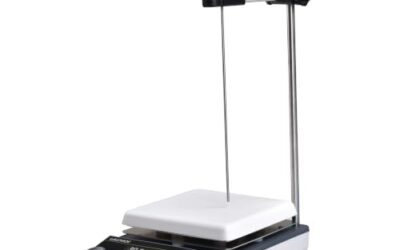
Slendor SH-2 Magnetic Stirrer Hot Plate Mixer

The SH-2 takes the opposite approach to the digital units above: two analog dials, one for heat and one for stirring, and nothing else to configure. Its listing states a 520°F maximum hotplate temperature, a 100-2000 rpm stirring range and a 1000ml stirring capacity on a 5 x 5 inch surface, with a stir bar and support stand in the box. That simplicity suits demonstrations, field kits and occasional small jobs where the operator stays nearby and adjusts by eye. In exchange, you give up the digital readout, the timer and the in-liquid probe control the other picks provide.
Specs
- Model: SH-2
- Max. hotplate temperature: 520°F
- Speed range: 100-2000 rpm
- Stirring capacity: 1000ml
- Heating surface: 5 x 5 inch
- Stirring bar and support stand included
Best for: Small, supervised jobs where simple dial control is enough and batch size stays near a litre.
Watch out for: There is no digital display or probe input, so temperature is set by dial position rather than a measured liquid readout; the 1000ml capacity is the smallest here.
ASIN: B07FP8J8YV
Which One Fits Your Situation
You run routine solutions and media every day
Pick the ONiLAB MS-H280-Pro. The bundled stand, probe and stir bars mean it works as a complete station from the first day, and its 280°C ceiling plus 5L capacity cover the ordinary run of beakers and flasks on a teaching or service bench without paying for temperature range you will never use.
You hold liquids at one temperature for hours
Choose the Four E’s Scientific 5 Inch. Probe-based control keeps the liquid itself at the set point during long digestions and slow reactions, and the listing’s clear 5L-to-3L capacity note helps you plan batch sizes honestly. Add a support stand to hold the probe if your bench does not already have one spare.
You heat large volumes or run high-temperature work
The Four E’s Scientific 7 Inch is the only pick here built for that combination, pairing a 510°C ceiling with a 20L stirring capacity and a timer for unattended runs. Confirm the bench can take its footprint, and use the included retriever rather than fishing for stir bars in hot liquid.
You need a simple unit for occasional small jobs
Take the Slendor SH-2. For demonstrations, quick dissolutions and small supervised batches, its dial controls are fast to set and there is no menu to learn. Keep batches close to its stated 1000ml capacity and stay nearby throughout, since there is no probe or timer watching the run for you.
Common Mistakes
- Buying by plate temperature alone, then discovering the liquid in a large flask never reaches the protocol temperature because the unit has no probe control.
- Treating the headline stirring capacity as universal, when listings state it for water and reduce it at full speed or with viscous mixtures.
- Placing a wide flask on a small plate so it overhangs the edge, which makes the setup unstable and the heating uneven.
- Assuming every variant of a listing includes the same accessories, when stands, probes and stir bars are bundled differently across variants.
- Leaving a hot plate unmarked after a run; a surface that still holds heat looks identical to a cold one, so use the unit’s warning indicator or a bench sign.
Frequently Asked Questions
Can a magnetic hotplate stirrer replace a separate hotplate and stirrer?
Yes, that is exactly what these units combine: a heated plate with a magnetic drive beneath it that spins a coated bar inside the vessel. A combined unit saves bench space and keeps the vessel centred over both the heat and the stirring field, which separate appliances cannot guarantee once glassware gets moved.
Why does the listing capacity drop at maximum speed?
Stirring capacity figures are measured with water, and holding a stable vortex in a full vessel at top speed asks more of the magnetic coupling than the same volume at moderate speed. One listing here states the drop directly, from 5L to 3L at 1500 rpm. Treat the lower figure as the working limit for fast stirring.
Do I need the external temperature probe?
If your work only needs approximate heat, plate control is enough. If a protocol names a liquid temperature — an extraction held at one point for hours, for example — the probe is what lets the unit regulate the liquid itself instead of guessing from the plate. Two picks here bundle the probe; the analog SH-2 has no probe input at all.
What size stir bar should I use?
The bar needs to sit shorter than the vessel’s base diameter and long enough to couple firmly with the drive magnet; the listings here include bars sized for their plates, and the 7 inch unit accepts bars up to 80mm. A bar that rattles or spins out is usually too small, too large, or running faster than the liquid can follow.