Key takeaways
- Best magnetic hotplate stirrers with programmable speed: compare digital speed control, plate size, temperature range and stirring capacity for the lab bench.
A magnetic hotplate stirrer with programmable speed removes one of the most common sources of variation in a routine protocol: the stirring rate. When speed is set on a digital display in exact increments, the same flask can be stirred at the same rate run after run, instead of relying on the position of an analog dial. Add a timer or stored program and a long dissolution, extraction or warming step can proceed without constant attention.
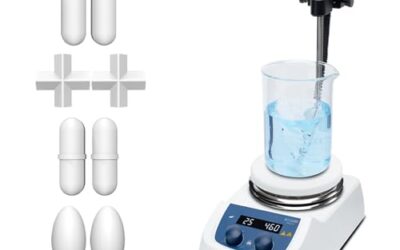
This guide compares published specifications only: plate size and coating, maximum temperature, stirring speed range, stirring capacity, temperature sensing and the way each unit handles speed and time settings. Every product below is a magnetic hotplate stirrer with digital speed control, so the stirring rate is entered and displayed as a number rather than guessed from a knob position. One of the four also stores complete programs for repeat runs.
Our top pick: LACHOI 5.9 Inch LCD Magnetic Stirrer Hot Plate. Runner-up: FOUR E’S SCIENTIFIC 7 Inch Magnetic Stirrer Hot Plate.
At a Glance
| Product | Best for | Key specification |
|---|---|---|
| LACHOI 5.9 Inch LCD Magnetic Stirrer Hot Plate | Programmable repeat runs | 6 stored programs; 100–1600 RPM; 300°C max; 5L capacity |
| FOUR E’S SCIENTIFIC 7 Inch Magnetic Stirrer Hot Plate | Large volumes and high heat | 50–1500 RPM; 510°C max; 20L capacity; 99h 59m timer |
| ONiLAB MS-H280-Pro LED Digital Hotplate Magnetic Stirrer | Compact daily bench work | 200–1500 RPM; 280°C max; 5L capacity; PT1000 probe |
| Slendor SH-2 Magnetic Stirrer Hot Plate Mixer | Small batches and simple setups | 100–2000 RPM; 520°F max; 1000ml capacity; LED display |
How to Choose
1. Match the speed range to the liquids you stir
Stirring speed is listed in revolutions per minute, and the range matters more than the maximum alone. A unit that starts at 50 or 100 RPM can turn a stir bar gently in a low-viscosity solution without splashing, while a unit whose lowest setting is 200 RPM may be too fast for a small or shallow vessel. At the other end, viscous liquids and larger volumes need enough top-end speed to keep the bar coupled to the rotating magnet. The four units in this guide span 50 to 2000 RPM across their ranges, so check both ends of the range against the volumes and viscosities in your protocols.
2. Decide how much programmability you actually need
Programmable speed takes several forms. The simplest is a digital display where the speed is entered as a number and held at that value. A timer adds unattended operation for a set duration. Stored programs go further: the unit remembers a complete set of speed, time and temperature values so a repeated protocol starts with a single selection. If the same procedure runs every day, stored programs reduce setup time and variation. If every run is different, a clear digital display and a timer may be all that is required.
3. Check the maximum plate temperature against the work
Maximum plate temperature is the temperature of the hotplate surface, not necessarily the temperature of the liquid. Units in this guide list maximum plate temperatures from 280°C to 510°C. A higher maximum is useful for high-boiling solvents and for work that needs fast heat-up, but it also demands more care around the bench. For routine aqueous work, a 280°C or 300°C ceiling is usually ample, and the accuracy of the temperature control matters more than the ceiling.
4. Use the temperature probe when the liquid temperature matters
Several units in this guide ship with an external temperature sensor, usually a PT1000 probe, that sits in the liquid. When the probe is connected, the unit regulates to the temperature of the liquid rather than the temperature of the plate surface, which is the value that actually governs a reaction or dissolution. A probe also protects against overshoot when a vessel is placed on an already-hot plate. If a protocol specifies a liquid temperature, a probe is worth having.
5. Size the plate and the capacity to the vessel
Plate size determines the largest flask or beaker that sits stably on the unit, and stirring capacity determines the largest volume the magnet can keep moving. A 5-inch plate suits beakers up to about 5 litres, while a 7-inch plate supports larger vessels and up to 20 litres on the largest unit here. A plate that is too small for the vessel is unstable, and a unit asked to stir beyond its stated capacity will lose coupling between the magnet and the stir bar. Match both figures to the largest vessel the unit will carry.
6. Look at the plate coating and the motor
Ceramic-coated plates resist corrosion, spread heat evenly and cool down quickly, and all four units here use a ceramic-coated surface. The motor type affects longevity and noise: brushless DC motors run with less maintenance than brushed motors and are listed on two of the units below. A unit that will run for hours at a time benefits from a motor and a housing built for continuous duty, so check the listing for continuous running time.
7. Read the safety features before the first run
Hotplate stirrers combine heat, electricity and glassware, so safety features deserve attention. A hot-surface warning that stays lit while the plate is above 50°C is listed on the ONiLAB unit, and overheating protection is listed on the FOUR E’S SCIENTIFIC and ONiLAB units. A support stand for the temperature probe keeps the sensor in place without a hand near the plate. Keep flammable solvents away from an open hotplate and confirm the unit’s voltage matches the bench supply before ordering.
8. Count the accessories in the box
The listing for each unit states what ships with it, and the contents differ. Stir bars, a temperature probe, a support stand and a stir bar retriever are the usual inclusions. A unit that ships without a probe or a stand will need those items ordered separately before the first run. Check the listing for the number and size of stir bars included, since a bar that is too short for the vessel will not couple reliably.
Our Picks
LACHOI 5.9 Inch LCD Magnetic Stirrer Hot Plate — ASIN B0B5TLG446

The LACHOI unit is the most programmable stirrer in this guide. Its LCD display shows speed, time and temperature together, and it stores up to 6 programs, each holding custom speed, time and temperature values for repeat protocols. The speed range runs from 100 to 1600 RPM with forward and reverse rotation, and the timer runs from 1 minute to 99 hours 59 minutes. The 5.9 by 5.9 inch ceramic-coated plate heats to a maximum of 300°C with 550W of heating power, and the stated stirring capacity is 5 litres.
A PT1000 external temperature sensor is included, so the unit can regulate to the temperature of the liquid rather than the plate surface. A support stand and a stir bar are included as well, and the listing states a temperature accuracy of plus or minus 3°C. The unit remembers its previous settings, which shortens setup for a repeated run.
Best for: laboratories that run the same stirring and heating protocol repeatedly and want the settings stored on the unit.
Consideration: the 1600 RPM ceiling is lower than the 2000 RPM ceiling of the Slendor SH-2, so it is not the fastest unit in this guide.
FOUR E’S SCIENTIFIC 7 Inch Magnetic Stirrer Hot Plate — ASIN B0C7YY3ZWQ
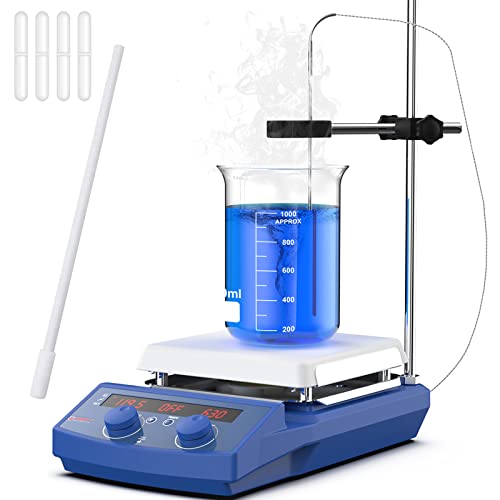
The FOUR E’S SCIENTIFIC unit is built for the largest volumes in this guide. Its 7-inch ceramic-coated plate heats to a maximum of 510°C with 1000W of heating power, and the stated stirring capacity is 20 litres. The stirring speed range runs from 50 to 1500 RPM, and the digital timer runs to 99 hours 59 minutes for long unattended runs. A PT1000 temperature sensor is included, and the listing states temperature accuracy of plus or minus 0.1°C when the probe is in use.
The kit includes a support stand, a stir bar retriever and four stir bars, so the unit arrives ready for large-vessel work. Overheating protection is listed, and the digital display shows the set values for speed and temperature. The 50 RPM lower end of the speed range allows gentle stirring of low-viscosity liquids without splashing.
Best for: large-volume work and high-temperature heating where a wide plate and a long timer matter most.
Consideration: the 20-litre capacity and 510°C ceiling come in a larger and heavier unit, so it takes more bench space than the compact models in this guide.
ONiLAB MS-H280-Pro LED Digital Hotplate Magnetic Stirrer — ASIN B087CYZVNF

The ONiLAB MS-H280-Pro is the compact daily-work unit in this guide. Its 5-inch ceramic-coated stainless steel plate heats to a maximum of 280°C with 500W of heating power, and the digital speed control runs from 200 to 1500 RPM with a display resolution of plus or minus 1 RPM. The stated maximum stirring quantity is 5 litres, or 3 litres at the maximum speed, and the maximum magnetic bar length is 50 mm.
A PT1000 external temperature probe is included, and the unit switches to probe mode automatically when the probe is connected, regulating to the liquid temperature with a stated accuracy of plus or minus 0.5°C. A hot-surface warning flashes while the plate temperature is above 50°C, even if the hotplate is turned off. The brushless DC motor is listed as maintenance free, and a support stand and nine stir bars are included in the package listing.
Best for: small to medium daily bench work where a compact footprint and precise digital speed control matter more than maximum heat.
Consideration: the 200 RPM minimum speed is the highest starting speed in this guide, so it is less suited to very gentle stirring of small volumes.
Slendor SH-2 Magnetic Stirrer Hot Plate Mixer — ASIN B07FP8J8YV

The Slendor SH-2 is the simplest unit in this guide and the fastest at the top end. Its LED digital display shows temperature and stirring speed, and the stirring speed is adjustable up to 2000 RPM from a minimum of 100 RPM. The 5 by 5 inch plate heats to a maximum of 520°F with 180W of heating power, and the stated stirring capacity is 1000ml. A temperature sensor is included, with a stated accuracy of plus or minus 0.1°C, and the display shows the temperature of the liquid when the sensor is in use.
A stir bar and a support stand are included. The stainless steel housing carries a ceramic coating that resists corrosion, and the unit is listed as not discontinued by the manufacturer. Its compact dimensions suit a crowded bench or a small teaching setup.
Best for: small batches, teaching setups and simple heating and stirring work where the highest top speed matters more than stored programs.
Consideration: the 1000ml capacity and 180W heating power are the smallest in this guide, so it is not suited to large volumes or fast heat-up of big vessels.
Which One Is Right for You?
Choose the LACHOI unit when the same protocol runs repeatedly and stored programs will remove setup variation. Its combination of a 6-program memory, a timer to 99 hours 59 minutes and a PT1000 probe makes it the most control-oriented unit here, and its 5-litre capacity covers most routine bench vessels.
Choose the FOUR E’S SCIENTIFIC unit when volume or temperature is the limiting factor. Its 20-litre capacity and 510°C ceiling are far above the other three, and its 99-hour timer suits long runs. Accept the larger footprint in exchange for that headroom.
Choose the ONiLAB MS-H280-Pro when bench space is tight and the work is daily and routine. Its 5-inch plate, brushless motor and automatic probe switching suit a compact bench, and its digital speed control in 1 RPM steps gives precise stirring for small to medium volumes.
Choose the Slendor SH-2 when the batches are small and the setup should stay simple. Its 2000 RPM top speed is the highest here, and its 1000ml capacity and compact plate suit teaching benches and small-scale work. Do not choose it for large vessels, where its capacity and heating power are the limiting factors.
Frequently Asked Questions
What does programmable speed mean on a magnetic hotplate stirrer?
It means the stirring rate is set and held digitally rather than by an analog dial. On the units in this guide the speed is entered as a number on a digital display, so the same rate can be repeated exactly. The LACHOI unit goes further and stores complete programs of speed, time and temperature, while the others use a digital speed setting with a timer or a digital display.
How do I choose the right stirring speed?
Start low and increase the speed until the stir bar turns steadily without splashing or losing coupling. Low-viscosity liquids need less speed, while viscous liquids and larger volumes need more. A unit with a low minimum speed, such as the 50 RPM lower end of the FOUR E’S SCIENTIFIC unit, gives more room for gentle stirring.
Why does the plate temperature differ from the liquid temperature?
The plate surface heats first and the liquid follows, so the two values differ while the system is warming up and whenever heat is lost from the vessel. A PT1000 probe placed in the liquid lets the unit regulate to the liquid temperature directly, which is the value a protocol usually specifies.
What size stir bar should I use?
The listing for each unit states a maximum magnetic bar length. The ONiLAB MS-H280-Pro lists a maximum bar length of 50 mm. A bar that is too short for the vessel will not couple reliably, while a bar that is too long will strike the vessel wall. Use the bar size the listing recommends for the vessel in use.
Can a magnetic hotplate stirrer run unattended?
The units in this guide with timers are designed for timed runs: the LACHOI and FOUR E’S SCIENTIFIC units list timers to 99 hours 59 minutes. Even so, a running hotplate should only be left unattended where local laboratory rules allow it, with overheating protection in place and flammable materials kept away from the plate.
Do I need a temperature probe?
A probe is needed when a protocol specifies the temperature of the liquid rather than the temperature of the plate. Without a probe, the unit controls the plate surface and the liquid temperature must be checked separately. The LACHOI, FOUR E’S SCIENTIFIC and ONiLAB units in this guide include a PT1000 probe, and the Slendor SH-2 includes a temperature sensor.
Bottom Line
A magnetic hotplate stirrer with programmable speed is worth choosing on the strength of its speed control, its temperature sensing and its capacity, in that order. The LACHOI unit leads this guide because its stored programs make repeat protocols consistent, with a 5-litre capacity and a 300°C ceiling that cover most routine work. The FOUR E’S SCIENTIFIC unit is the choice for large volumes and high heat, the ONiLAB MS-H280-Pro is the compact daily-work unit, and the Slendor SH-2 is the simple high-speed option for small batches. Match the speed range and the capacity to the largest vessel on the bench, and let the probe do the temperature work.
Disclosure: As an Amazon Associate, this site earns from qualifying purchases.