Key takeaways
- Find the best laptop CPU coolers for gaming, from sealed turbofan pads to quiet multi-fan stands, with fit, noise and airflow guidance for hot laptops.
Gaming laptops pack powerful processors into thin chassis, and that combination produces heat that has nowhere to go. When a laptop CPU gets too hot during a long session, it protects itself by slowing down, which shows up as frame rate drops, stuttering and fans screaming at full speed. A good laptop CPU cooler sits underneath the machine and pushes cool air into the intake vents on the base, helping the processor hold higher speeds for longer. Some use a single powerful turbofan sealed against the base with foam, while others spread the work across several smaller fans on a mesh surface. Some need a wall adapter for full power, while others run entirely from a USB port. This guide compares four coolers made for gaming laptops, explains how each design works, and walks through the fit, noise and airflow questions that matter before you buy. Every link goes to its Amazon US listing so you can confirm the current version, fit and availability before ordering.


As an Amazon Associate, we earn from qualifying purchases.
Quick Picks
Our Short List of 3
All 4 Picks at a Glance
| Product | Specs | Action |
|---|---|---|
| llano V12 RGB | Check price on Amazon | |
| IETS GT500 | Check price on Amazon | |
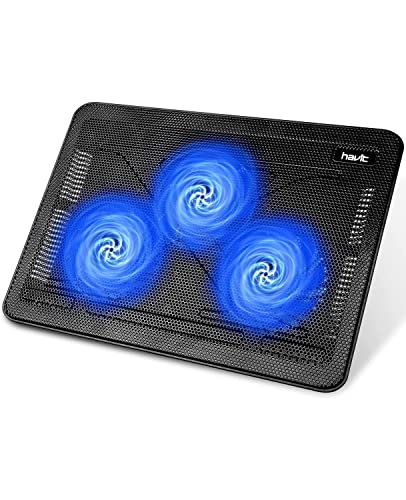 havit HV-F2056 | Check price on Amazon | |
 Kootek Chill Mat 5 | Check price on Amazon |
llano V12 RGB
The llano V12 RGB is the strongest cooling option in this guide for a large gaming laptop. It uses a single 5.5 inch turbofan, which the maker describes as a 14 cm external blower, mounted in a sealed chamber with memory foam around the edges. The foam presses against the base of the laptop and forces the fan air into the intake vents instead of letting it escape around the sides. That sealed design is the main reason this style of cooler outperforms open mesh pads on machines with large bottom grilles, because the air has only one place to go. The listing states a fit for laptops from 15 to 19 inches, which covers most 15.6, 16, 17.3 and 18 inch gaming machines, including thick models that smaller pads struggle to support.
Touch controls and an LCD screen on the front edge show the fan speed, so you can raise it for a demanding game and lower it for lighter work without software. The V12 RGB version includes a three-port USB hub, useful because the cooler itself occupies a USB connection. RGB lighting runs along the edge and can be switched off, a removable dust filter helps keep dust out of the laptop vents, and a dedicated adapter powers the unit rather than the laptop USB port, so the fan can draw full power.
There are trade-offs. The maker lists a noise range of 40 to 70 decibels depending on speed, so at maximum the V12 is loud, and that is the price of moving this much air through a sealed chamber. It is also heavy, wide and needs its adapter, so it suits a fixed gaming setup far better than a bag. The V12 comes in more than one version, including a no-RGB model, so confirm the exact listing before ordering, because fan, hub and lighting details differ between versions.
View the llano V12 RGB on Amazon
IETS GT500
The IETS GT500 is the long-running benchmark for sealed turbofan laptop coolers, and it remains one of the most recommended options for gaming laptops that throttle under sustained load. Like the llano V12, it uses a single industrial turbofan with a foam seal that creates a pressurised chamber under the laptop, forcing cool air through the intake vents. The GT500 is built for laptops from 13 to 17.3 inches, which makes it the better choice of the two sealed coolers for smaller gaming laptops, including 14 and 15.6 inch machines that are too small for the llano V12. Its bottom air intake design is aimed at laptops with rear exhaust vents, a common layout on gaming machines.
Fan speed is infinitely variable, so you can dial in just enough airflow for the game you are playing, and the version linked here includes a removable dust filter and a three-port USB hub. Height adjustment is available in seven levels, and the metal construction feels solid under a heavy laptop. The maker is upfront that the fan reaches around 55 decibels at its highest speed, comparable to normal conversation level but clearly audible in a quiet room.
The most important thing to know about the GT500 is that the name covers several different versions, and they are not interchangeable. IETS lists versions with different maximum fan speeds, airflow, power adapters and USB or RGB features, so a listing titled GT500 on its own does not tell you which one you are buying. The listing linked here has shown conflicting fan speed figures in different places, with the title stating one speed and the body text stating another, so treat the exact speed as unconfirmed until you read the live product page. Confirm the version, the adapter wattage and the hub details on the live listing before ordering, and expect a loud fan at full speed in exchange for the cooling headroom.
havit HV-F2056
The havit HV-F2056 is the budget pick in this guide and the most portable of the four. It is a slim pad with three 110 mm fans set into a metal mesh surface, powered entirely by USB, so there is no wall adapter to carry and no extra cable clutter on the desk. It fits laptops from 15.6 to 17 inches, which covers the most common gaming laptop sizes, and the mesh top lets air pass through freely while the fans push it upward into the base. Blue LED lighting sits under the fans and can be switched on or off, and the pad includes two USB ports so you can pass the connection through to another device.
This is an open design rather than a sealed chamber, so it will not match the llano V12 or the IETS GT500 for raw cooling. What it does well is raise the laptop off the desk, keep air moving across the whole base, and run quietly enough for everyday use. It is light and slim enough to slip into a bag with a laptop, which makes it a good companion for gaming on the move. Adjustable height feet tilt the keyboard to a comfortable angle, and the anti-skid front edge keeps the laptop from sliding forward.
Because the HV-F2056 has been sold for many years, there are several listings and colour variants under the same model name. The listing linked here is the black and blue version, and a separate listing exists for other colours, so check that the listing you open matches the colour and fan layout you expect. A recent third-party buying guide recorded an active US offer for this model sold by HavitDirect and shipped by Amazon, but stock and seller can change, so confirm the seller and availability on the live listing before buying.
View the havit HV-F2056 on Amazon
Kootek Chill Mat 5
The Kootek Chill Mat 5 takes the multi-fan approach further than the havit pad, with five quiet fans spread across the surface to cover the whole base of the laptop rather than concentrating airflow in one spot. That layout suits gaming laptops whose intake vents are spread out, because every part of the base gets some airflow instead of only the centre. It fits laptops from 12 to 17 inches, the widest size range in this guide at the small end, and it offers six height settings so you can find a comfortable angle for long sessions. Two USB ports are built in, and the pad is USB powered, so it runs from the laptop itself with no wall adapter.
The five fans are one larger central fan and four smaller fans, all with LED lighting, and the mesh surface lets air through while supporting the laptop. Front stoppers hold the machine in place when the pad is tilted, and the design is light enough to move around the house or pack for travel. It is quieter and gentler than the sealed turbofan pads, so it suits gaming laptops that run warm rather than ones that hit their thermal limit within minutes.
As with the havit pad, colour variants of the Kootek exist under different listings, including purple and green versions, so open the listing linked here and confirm the colour and fan count before ordering. A recent marketplace mirror recorded this model as in stock and fulfilled by Amazon, but that is not a live confirmation, so check the current seller, stock and delivery details on the live Amazon listing before buying.
View the Kootek Chill Mat 5 on Amazon
Buying Guide
Match the cooler to your laptop vents
The single most important factor is where your laptop takes in air. Most gaming laptops draw air through grilles on the base, and a cooler only helps if its fans push air into those grilles. A sealed foam cooler works best when the laptop has large bottom intakes, because the foam traps the air and forces it through the vents. An open multi-fan pad works better when the vents are spread across the base or when the laptop also draws air from the sides. Before buying, turn the laptop over, note where the grilles sit, and compare that layout with the fan positions on the cooler. If your laptop has almost no bottom vents and draws air mainly from the keyboard deck or the sides, a cooling pad will help far less, and raising the rear of the laptop for airflow may matter more than fan power.
Size and weight limits matter more than the headline range
Every cooler in this guide states a laptop size range, but those ranges describe the screen size the pad can physically hold, not a guarantee of a good fit. Measure your laptop base and compare it with the pad dimensions on the live listing. A thick, heavy 17.3 inch gaming laptop needs a wide, sturdy pad, and the llano V12 is built for that, while a 14 inch machine can sit awkwardly on a pad designed for 19 inch laptops, with the foam seal missing the vents entirely. Check the stated weight support and prefer metal construction for heavy machines.
Sealed turbofan versus open multi-fan
Sealed turbofan coolers, represented here by the llano V12 and the IETS GT500, move the most air into the vents and give the biggest temperature improvement on laptops that throttle. They are louder, heavier, need a wall adapter and cost more, and they only reach their potential on laptops with bottom intakes. Open multi-fan pads, represented by the havit HV-F2056 and the Kootek Chill Mat 5, are quieter, lighter, cheaper and USB powered, but they spread their airflow and lose much of it around the edges. Choose a sealed cooler if your laptop throttles during games and you play at a desk. Choose an open pad if your laptop runs warm but does not throttle, if you travel with it, or if low noise matters more than maximum cooling.
Noise, power and desk space
Turbofan coolers are loud at full speed, and the makers of both sealed models in this guide publish noise figures that confirm it. If you play with headphones, that may not matter, but if you play in a shared room or record audio, plan to run the fan below maximum or choose a quieter multi-fan pad. Power is the other practical question: sealed coolers need a wall adapter, which adds a cable and a socket, while USB powered pads draw from the laptop and can shorten battery life when you are away from the wall. Finally, measure your desk. Sealed coolers are wide and deep, and they need clearance behind the laptop for the exhaust air to escape. A pad that overhangs a small desk is a daily annoyance.
Features worth paying for, and ones to ignore
A USB hub is genuinely useful, because a cooler occupies a port and gaming setups are often short of them. Height adjustment matters for comfort during long sessions and for airflow under the chassis. A removable dust filter helps in dusty rooms and is easy to clean. Touch controls and an LCD display are convenient but do not change cooling performance. RGB lighting is purely cosmetic and can be switched off. Do not choose a cooler based on a headline temperature drop figure in a listing, because those figures come from the maker, use different test conditions and cannot be compared between brands. Focus instead on fan design, seal, fit and noise, and confirm the exact version on the live listing.
FAQ
Do laptop CPU coolers actually help gaming laptops?
Yes, when the laptop has bottom intake vents and the cooler pushes air into them. A cooler gives the internal fans cooler air to work with, which can help the CPU and graphics processor hold higher speeds for longer before thermal limits kick in. The improvement is biggest on laptops that throttle under sustained load. A cooler will not fix blocked vents, dried thermal paste or a failing internal fan, so clean the vents and check the internal fans first if temperatures suddenly get worse.
Is a cooling pad better than a laptop stand?
A cooling pad and a stand solve different problems. A stand lifts the laptop and improves passive airflow, which helps a little and improves ergonomics, but it adds no airflow of its own. A cooling pad adds active fans, so it can move more air into the vents. If your laptop only needs a small improvement, a stand may be enough. If it throttles during games, an active cooler is the better choice. Some gamers use both, with a cooler doing the work and the height adjustment providing the typing angle.
How loud are turbofan laptop coolers?
Loud at full speed. The IETS GT500 maker compares its maximum noise to normal conversation level, and the llano V12 lists a range that reaches well above that at maximum speed. In practice you will usually run a turbofan below maximum, where it is much quieter, and raise it only for demanding games. Multi-fan pads such as the havit and Kootek models are noticeably quieter, because their smaller fans spin more slowly. If you play without headphones in a quiet room, factor noise into your choice as much as cooling power.
Will a cooling pad fit any gaming laptop?
No. Fit depends on the physical size of the laptop base, the position of its intake vents and the weight of the machine. Check the stated size range, measure your laptop, and compare the pad dimensions on the live listing. A pad that is too small leaves part of the laptop unsupported, while a pad that is too large may place its foam seal or fans in the wrong place relative to your vents. Thick gaming laptops also need a sturdy pad, so prefer metal construction and a stated weight limit that covers your machine.
Should I choose a sealed cooler or a multi-fan pad?
Choose a sealed cooler, such as the llano V12 or the IETS GT500, if your laptop throttles during games, has large bottom intake vents and stays on a desk. Choose a multi-fan pad, such as the havit HV-F2056 or the Kootek Chill Mat 5, if your laptop runs warm but does not throttle, if you travel with it, if you want quiet operation, or if you prefer a lighter and cheaper option. If you are unsure, check your vent layout first: large bottom grilles point to a sealed cooler, while spread-out vents suit a multi-fan pad.
Conclusion
The best laptop CPU cooler for gaming depends on your laptop and how you play. For maximum cooling on a large gaming laptop at a desk, the llano V12 RGB leads this guide, with its sealed foam chamber, large turbofan and touch controls, while the IETS GT500 is the proven alternative for smaller gaming laptops from 13 to 17.3 inches. If you want something slim, portable and affordable, the havit HV-F2056 covers the most common gaming laptop sizes with three quiet fans and no wall adapter, and the Kootek Chill Mat 5 spreads five fans across the whole base for even airflow and a comfortable tilt. Whichever you choose, match the cooler to your vent layout, measure your laptop against the stated fit, and confirm the exact version, seller and availability on the live Amazon listing before ordering, because versions, stock and listings for these models change often.