Key takeaways
- Yes, with limits. How image orientation, focal length, mounts and weather sealing differ between telescopes and spotting scopes, and when each tool works for land viewing.
Disclosure: As an Amazon Associate, I earn from qualifying purchases. If you buy through links in this article, the site may earn a commission at no extra cost to you.
The short answer is yes, a telescope can be pointed at a bird, a ship or a mountainside, and many people do exactly that. The longer answer is that a telescope and a spotting scope are built around different assumptions about what will be viewed, from where, and in what weather, and those assumptions show up in the image the moment the eyepiece goes in. This article explains the differences in plain terms: why the view through a typical astronomical telescope is upside down or mirrored, why magnification behaves differently on land than it does under the stars, why the mount matters more than most beginners expect, and where the practical limits of the substitution sit. It is an explainer rather than a shopping guide, because the right conclusion for most readers is not a product but an understanding of when the telescope already in the closet is good enough and when a purpose-built spotting scope earns its place.
The Core Difference: What Each Instrument Assumes
An astronomical telescope assumes a dark sky, a stationary observer and targets that do not care which way is up. There is no up in space, so telescope designers feel no obligation to make the image match the orientation of the world. A spotting scope assumes daylight, a moving observer and targets on land, where an upside-down view is genuinely confusing: a bird that hops left appears to hop right, and following anything in motion becomes a small cognitive workout.
That single assumption cascades through the whole design. Spotting scopes build image correction into the instrument itself, using prism systems that deliver an erect, correctly oriented view through a fixed eyepiece. Telescopes leave orientation to whatever diagonal or eyepiece the user installs, and the standard accessories sold for astronomy do not correct it. Everything else in this article, from mounts to weather sealing, follows from the same split: one instrument is optimized for the night sky from a fixed spot, the other for the landscape from wherever the observer happens to stand.
Image Orientation: Upside Down, Mirrored, or Erect
A basic refractor telescope with no diagonal shows an image that is rotated 180 degrees: upside down and reversed left to right. Add the star diagonal that most refractors and Cassegrain-style telescopes ship with, the accessory that bends the light path 90 degrees for comfortable sky viewing, and the image becomes upright but mirror-reversed. Text reads backwards, and a bird facing left appears to face right. For looking at the Moon, none of this matters. For reading a boat name, following a bird in flight or scanning a ridgeline, it ranges from annoying to genuinely obstructive.
Three fixes exist, and each has a cost. An erect-image diagonal, sometimes sold as a terrestrial or 45-degree diagonal, contains a prism that corrects both axes and delivers a properly oriented view. It is the standard solution and works well at low and moderate magnifications, though inexpensive versions narrow the field of view and can soften the image slightly at high power. A Porro-prism erecting eyepiece does the same job inside the eyepiece itself, usually at modest magnification. Finally, reflector telescopes of the Newtonian type, the classic tube-on-a-rocking-base design, produce an image whose orientation depends on how the tube is rotated, and they have no simple erect-image accessory path at all, which makes them the least practical telescopes for land viewing.
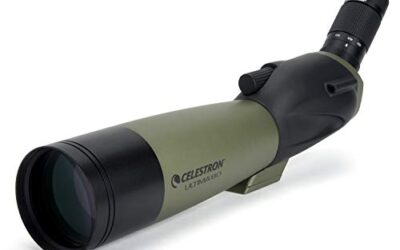
Spotting scopes, by contrast, settle the question at the factory. Their internal prisms, whether Porro or roof designs, present an erect image through an eyepiece angled at 45 degrees or set straight through the body, and the user never thinks about orientation again.
Magnification, Focal Length and Field of View
Telescopes and spotting scopes also differ in the magnifications they are designed around. A spotting scope typically works between about 15x and 60x, delivered by a zoom eyepiece, with a wide field of view at the low end for finding and following subjects. An astronomical telescope is specified by focal length rather than magnification, and its magnification depends entirely on which eyepiece is fitted: a telescope with a 900mm focal length and a 25mm eyepiece gives 36x, while a 10mm eyepiece gives 90x.
That flexibility cuts both ways on land. A telescope can certainly operate in the spotting scope’s working range with a long-focal-length eyepiece fitted. But pushing a telescope to the high magnifications it happily uses on the Moon runs into a terrestrial wall: heat shimmer rising off ground, water and rooftops scrambles fine detail in daylight, and the practical ceiling for land viewing on most days sits somewhere around 60x to 80x regardless of the instrument. The telescope’s high-power advantage is real but mostly unusable across a valley at noon.
Field of view is the subtler issue. Telescope eyepieces are chosen for framing planets and star fields, and many deliver a narrower apparent field than a spotting scope’s zoom eyepiece. A narrow field makes acquiring a bird or following a moving animal noticeably harder. Wide-field, low-power eyepieces exist for telescopes and improve land viewing a great deal, but they are an additional purchase the spotting scope buyer never has to make, because the wide zoom is built in.
Focus, Close Range and Handling
Birds and wildlife do not always stay at scenic distances. Spotting scopes focus down to a few meters, so the same instrument that resolves a distant eagle also frames a warbler in a nearby bush or a butterfly on a close flower. Many astronomical telescopes cannot focus that closely at all; their focusers are designed around infinity, and a subject at twenty meters may sit stubbornly outside the available focus travel. Maksutov-Cassegrain telescopes are the honorable exception among astronomical designs, which is one reason compact Maksutovs have a long second career as improvised spotting scopes.
Handling differs too. A spotting scope is a sealed tube with a single focus knob or ring, designed to be grabbed, mounted and used within seconds. A telescope is an assembly: tube, finder scope, diagonal, eyepiece and mount, each aligned and balanced for a session rather than a moment. For a planned hour on a terrace, the assembly time is trivial. For a bird that will be gone in ninety seconds, it is the whole story.
Mounts: The Difference Nobody Warns About
Astronomical mounts are engineered to track the sky. Equatorial mounts tilt at the observer’s latitude and move along celestial axes, which feels deeply unnatural when panning across a landscape. Computerized tracking mounts add motors and alignment routines that are pointless in daylight. Even a simple alt-azimuth telescope mount, which moves up-down and left-right in the intuitive way, is usually paired with slow-motion controls tuned for nudging a planet, not for swinging after a flying heron.
A spotting scope sits on a photo or video tripod with a smooth pan head, the same hardware used for cameras, and it points the way a camera points: loosen, aim, lock. The whole system is lighter, faster and cheaper to support. This is also where telescope substitution quietly accumulates cost and bulk, because a telescope adequate for land viewing still needs its full mount, while the spotting scope’s tripod doubles for binocular support and photography. Anyone who has carried both up a hill understands the difference without further explanation.
Durability and Weather
Daylight observing happens in daylight weather. Spotting scopes are built as sealed, rubber-armored instruments, typically filled with dry nitrogen or argon and rated to shrug off rain, spray and internal fogging when moving between a warm car and cold air. They are expected to live in packs, get knocked against railings and keep working.
Most astronomical telescopes are open or lightly closed optical systems that assume a dry night and careful handling. The corrector plate of a Cassegrain or the open tube of a Newtonian collects dew readily, the mirrors and lenses are not sealed against driven rain, and the mounts contain electronics and bearings that dislike moisture. A telescope can absolutely be used outdoors on a fine day for land viewing, and thousands are. It should not be left set up by a coastal viewpoint in passing showers the way a spotting scope routinely is, and it will fog and dew over in conditions a sealed spotting scope ignores.
When Using a Telescope on Land Works Well
There are situations where the substitution is not a compromise at all. A small refractor or a compact Maksutov on a simple alt-azimuth mount, fitted with an erect-image diagonal and a low-power eyepiece, makes a perfectly good terrace, balcony and harbor-view instrument. Fixed viewpoints forgive the assembly time and the mount’s habits, distances are usually generous enough to avoid the close-focus problem, and the large apertures of even modest telescopes deliver bright, detailed views of ships, surfers, distant architecture and roosting birds.
The same setup serves well for casual shorebird and waterfowl watching from a single spot, for watching a known nest or perch, and for the Moon itself, which remains a legitimate daylight-adjacent target at dawn and dusk. Homeowners with a view often find that the telescope they bought for astronomy spends most of its life doing exactly this job, and there is nothing wrong with that outcome. The key ingredients are always the same three: an erect-image accessory so the world reads correctly, an eyepiece that keeps magnification in the terrestrial working range, and a mount that can pan smoothly.
Where the Substitution Breaks Down
Field birding is where the gaps compound. Walking between viewpoints with an assembled telescope and mount is slow and awkward. Rain, spray and rough handling threaten an instrument never sealed against them. Birds at close range fall inside the telescope’s minimum focus distance. Fast-moving subjects defeat narrow fields of view and sky-tracking mounts. And the mirrored or inverted image, if the erect-image accessory was skipped, turns every quick identification into a translation exercise.
Professional and serious amateur uses draw the line in the same place. Reading color bands on a bird’s leg, scoring antlers at distance, calling shot placement at a range or identifying a distant vessel all demand an erect image, instant setup and optics that stay clear in bad weather, which is the exact specification sheet of a spotting scope. It is also worth noting the reverse substitution is worse: a spotting scope can be pointed at the Moon and planets and will show something pleasant, but its fixed zoom eyepiece, modest aperture options and camera-tripod mount make it a poor astronomy instrument beyond casual lunar viewing.
The Verdict
A telescope can be used as a spotting scope, and for stationary viewing from home, a vehicle or a fixed viewpoint, a small refractor or Maksutov with an erect-image diagonal and a sensible eyepiece does the job well. The substitution fails gradually rather than suddenly: the more the viewing involves walking, weather, close subjects, fast movement and instant readiness, the more the telescope’s sky-first design choices accumulate against it. A spotting scope is not a different kind of magic; it is the same optics re-optimized around an erect image, a zoom eyepiece, close focus, a camera-style mount and a sealed body. Readers who already own a suitable telescope should try it on land with the right accessories before buying anything. Readers who know their viewing is mobile, wet and spontaneous already know which instrument was designed for them.