Our Short List of 3
All 4 Picks at a Glance
| Product | Specs | Action |
|---|---|---|
 1. Celestron Ultima 80: The Established All-Rounder | Check price on Amazon | |
 2. Gosky 20-60×80 DiamondEdge: The Complete Kit | Check price on Amazon | |
 3. Emarth 20-60x60AE: The Lightweight Option | Check price on Amazon | |
 4. Celestron LandScout 12-36×60: The Modest Zoom Done Right | Check price on Amazon |
Key takeaways
- Four budget spotting scopes for birding compared by objective size, zoom range, weight and weather sealing, with honest notes on what the entry-level tier gives up.
Disclosure: As an Amazon Associate, I earn from qualifying purchases. If you buy through links in this article, the site may earn a commission at no extra cost to you.
A spotting scope changes what birding feels like. Shorebirds that sit as grey smudges through handheld optics resolve into leg bands, bill shapes and eye stripes. A distant raptor becomes identifiable instead of arguable. The problem is that the scopes most often photographed on tripods at famous hawkwatches belong to a completely different spending tier, and a new birder can easily conclude that serious scope birding starts only after a serious outlay. It does not. The entry-level tier has matured into a set of genuinely usable instruments, provided the buyer understands exactly which corners get cut at this level and chooses the scope whose compromises hurt the least for the birding they actually do.
This guide compares four budget spotting scopes that stay in the affordable end of the market: the Celestron Ultima 80, the Gosky 20-60×80 DiamondEdge, the Emarth 20-60x60AE and the Celestron LandScout 12-36×60. Every one of them is a true spotting scope with a zoom eyepiece, an angled or straight-through viewing body and a standard tripod thread. None of them is a substitute dressed up as something else. All specifications in this article come from the manufacturer listings and published product information rather than from practical measurement, and the descriptions below focus on what those specifications mean in the field.
What “Budget” Actually Buys in a Birding Scope
Before the individual models, it helps to know where the money goes in any spotting scope, because the budget tier is defined by a handful of consistent trade-offs.
The objective lens, the big front element, is the single most expensive piece of glass in the instrument. Budget scopes use achromatic doublets rather than extra-low dispersion glass. An achromat brings most colors to a shared focus but not all of them, which is why entry-level scopes show a violet or yellow fringe around high-contrast edges, such as a dark bird against a bright sky, especially at the top of the zoom range. The fringe rarely prevents identification, but it does soften fine detail and it is the clearest optical difference between this tier and the premium one.
Coatings are the second place costs are trimmed. Better scopes coat every air-to-glass surface with multiple anti-reflective layers. Budget scopes range from fully coated to fully multi-coated depending on the model, and the difference shows up as image brightness and contrast in flat, overcast light, which is precisely the light birders get at dawn on a marsh.
The third compromise is the eyepiece. Premium scopes accept interchangeable eyepieces; budget scopes almost always fix the zoom eyepiece in place. That is not necessarily a hardship, because a 20-60x zoom covers nearly every birding situation, but it does mean the scope lives or dies by the quality of that one eyepiece, particularly its eye relief for glasses wearers.
Finally, build quality varies. Rubber armor, sealed and nitrogen-filled bodies, and metal focus mechanisms all appear at this level, but tolerances are looser. A budget scope rewards gentle handling and a decent tripod far more than a premium one does.
How to Read the Numbers
Spotting scopes are described with two numbers, such as 20-60×80. The first pair is the magnification range delivered by the zoom eyepiece. The second number is the objective diameter in millimeters. A bigger objective gathers more light, which supports higher usable magnification and brighter images at dawn and dusk. It also adds weight and bulk.
For birding, 20x at the low end matters as much as 60x at the top. Low magnification gives a wide field of view for finding and following birds, and most identification work happens between 20x and 40x. The top of the zoom range is for stationary birds at long range in good light. On hazy, hot or windy days, atmospheric shimmer and tripod vibration cap the useful magnification well below the number printed on the eyepiece, no matter what the scope cost.
Angled bodies, where the eyepiece sits at 45 degrees to the barrel, suit birding best for most people. They allow a shorter, lighter tripod, they are easier to share between viewers of different heights, and they make looking up at canopy birds and raptors far more comfortable. Straight bodies aim like a rifle and can feel natural for scanning water from a car window, but they demand a taller tripod for standing use.
1. Celestron Ultima 80: The Established All-Rounder
The Ultima 80 has been the default recommendation in this tier for many years, and the specifications explain why. According to Celestron, the scope pairs an 80mm achromatic refractor objective with a 20-60x zoom eyepiece in an angled body. The optics are multi-coated, the housing is waterproof and fogproof, and the whole instrument weighs about 3.6 pounds. A soft carrying case and an extended tripod mounting plate are included, along with a T-adapter built into the eyepiece for attaching a camera body with the appropriate ring.
The 80mm objective is the headline. It gathers noticeably more light than the 60mm and 65mm scopes that populate the lower end of the budget tier, and that advantage is practical rather than theoretical. Early-morning birding, overcast days and the last hour of light are when an 80mm scope keeps delivering identifiable views after a smaller scope has gone dim. Celestron lists a field of view of about 105 feet at 1,000 yards at 20x, narrowing considerably at full zoom, which is typical for this class.
The honest limitations follow the budget pattern. The achromatic objective shows color fringing on high-contrast subjects at higher magnifications, a trait noted in the manufacturer’s own product literature. Eye relief is on the snug side, so glasses wearers should expect to fold the eyecup down and may still lose a little of the field edge. The scope also ships without a tripod, so the true starting cost includes a stand, and at just over 18 inches long it is the bulkiest instrument in this roundup.
For a birder who mostly works from boardwalks, blinds, lakeshores and set viewpoints, and who wants one scope to keep for years, the Ultima 80 is the strongest fit here.
2. Gosky 20-60×80 DiamondEdge: The Complete Kit
Gosky approaches the budget problem differently: instead of selling a bare scope, it bundles nearly everything a beginner needs into one box. Per the manufacturer listing, the DiamondEdge pairs a 20-60x zoom with an 80mm fully multi-coated objective and a BAK4 Porro prism. The body is nitrogen-filled, sealed against water and fog, and covered in rubber armor. The listed field of view runs from about 82.9 feet at 1,000 yards at 20x down to the high 40s at 60x. The scope itself weighs about 2.41 pounds.
The bundle is the story. A metal tabletop tripod, a smartphone adapter, a carrying case, lens covers and a cleaning cloth are all included, which makes this the fastest route from unboxing to watching birds for someone who owns no support gear at all. The phone adapter matters more than it might seem: digiscoping through a scope with a phone is how many new birders document sightings, share identifications for confirmation and build a personal record, and having the adapter in the box removes a fiddly aftermarket purchase.
The trade-offs are equally clear. The included tabletop tripod is a starting point, not a destination; it works on a railing, a car roof or a picnic table, but standing-height viewing needs a full tripod the buyer supplies. Optical expectations should stay calibrated to the tier: the fully multi-coated optics and large objective promise bright views, while fine contrast at maximum zoom will not match premium glass. The stretchable eyepiece shield and armor make it a forgiving scope to learn on, and its relatively light weight for an 80mm instrument suits birders who walk between viewpoints.
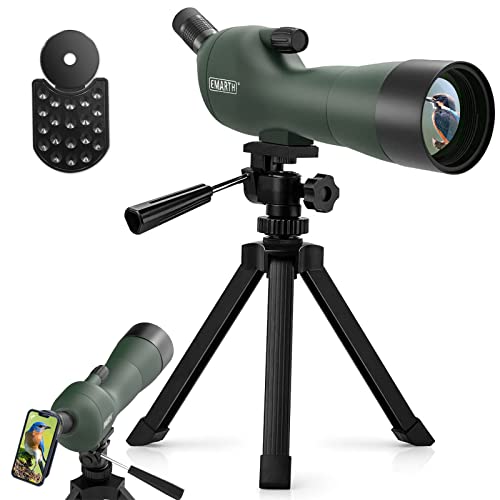
3. Emarth 20-60x60AE: The Lightweight Option
The Emarth 20-60x60AE shrinks the formula. Per the manufacturer, it combines a 20-60x zoom with a 60mm objective in an angled body with a BAK4 prism and fully multi-coated lenses. The body is waterproof and nitrogen-filled for fog resistance, eye relief is listed at about 17 millimeters, and the field of view is specified at roughly 39 to 19 meters at 1,000 meters across the zoom range. The scope body is notably light, and the package includes a 14-inch tabletop tripod and a carry bag.
That lighter, smaller build is a real birding feature rather than a consolation. A scope only helps if it is present, and a compact 60mm instrument is far more likely to ride along on a hike, a bike ride or a trip where luggage space is contested. For near and mid-range birding, the kind done at feeders, ponds, park lakes and coastal overlooks, a 60mm objective at 20x to 40x delivers perfectly serviceable views, and the generous eye relief makes it one of the friendlier options here for glasses wearers.
The limits arrive with distance and darkness. A 60mm objective collects meaningfully less light than an 80mm, so the image dims sooner at high zoom and in low light, and the top of the 60x range is best treated as a fair-weather tool. The small tabletop tripod shares the same caveat as the Gosky’s. Buyers should also note that listings for this long-running model have described its prism configuration in different ways over the years, so the current product page is the reference that counts. For birders who prize portability and a gentle entry point, it earns its place.
4. Celestron LandScout 12-36×60: The Modest Zoom Done Right
The LandScout makes an unfashionable choice that deserves respect: it zooms less. Celestron specifies a 12-36x eyepiece on a 60mm objective, with fully coated optics, a rubber-armored angled body and a rotating tripod mount that lets the eyepiece position adjust to the viewing situation. A tabletop tripod, a soft case and, on the current kit version, a basic smartphone adapter are included.
A 12x low end is genuinely useful for birding. It produces a wide, bright view that is easy to aim, forgiving of tripod shake and well suited to scanning flocks, following birds moving across a shoreline and watching active species that never sit still. Because the zoom range is modest, the image stays comparatively bright and clean across the whole range, and the scope avoids the dim, shimmery disappointment that budget scopes deliver when pushed to 60x in poor conditions. For backyard birding, nature-center volunteering, scout groups and younger birders, that honesty about range is a feature.
The ceiling is obvious. A distant shorebird flock, a raptor on a far snag or a duck raft across a reservoir will outrun 36x, and the birder who regularly works those distances should choose one of the 80mm options above. The LandScout is best understood as a near-to-mid-range instrument that does its job without pretending otherwise, and as a first scope for someone still deciding how scope birding fits their routine.
Side-by-Side Summary
All four scopes share the same basic architecture: an angled body, a fixed zoom eyepiece, a standard tripod thread and weather sealing of some degree. They divide cleanly by objective size and intent. The Ultima 80 and the Gosky DiamondEdge are the distance tools, built around 80mm objectives and 20-60x zooms, suited to wetlands, reservoirs, hawkwatches and shorebird flats. The Emarth trades objective size for portability while keeping the full zoom range. The LandScout trades zoom range for brightness, simplicity and a wide low-power view.
Tripod planning deserves a sentence of its own, because no scope in this tier performs well on a wobbly stand. The two bundled tabletop tripods are best viewed as starter accessories for seated or vehicle-based viewing. Any birder planning to stand and watch for extended periods should budget attention, if not money, for a stable full-height tripod with a smooth pan head, since at 40x and above the tripod influences the view as much as the glass does.
Buying Advice for the Budget Tier
Match the scope to the birding, not to the specification sheet. Birders who watch distant waterbirds and shorebirds need objective diameter and should start with the 80mm pair. Birders who walk far, travel light or watch at modest ranges will use a compact 60mm scope more often and miss the big glass less than they expect. New birders who are unsure whether scope birding suits them at all get the gentlest introduction from the LandScout’s wide, bright, low-power view.
Set expectations about maximum magnification. Every scope here will show its best image somewhere in the middle of its zoom range. Treat the highest setting as a bonus for still air and bright light rather than the working setting, and judge any budget scope by its 20x to 40x performance, because that is where it will spend its life.
Finally, handle the purchase practically. Check that the listing matches the model described here, since long-running budget models accumulate variations and kit versions. Confirm the return window, keep the packaging until the scope has been outside at least once, and do the first session in good light at moderate range, which is the fairest test of any optic in this class.
The Bottom Line
A budget birding scope is not a compromised imitation of a premium one; it is a different balance of the same physics. The Celestron Ultima 80 offers the most light and the longest track record. The Gosky DiamondEdge offers the most complete starter kit around the same 80mm formula. The Emarth 20-60x60AE offers the easiest carry. The Celestron LandScout offers the most forgiving view for close and mid-range work. Any of the four will show a new birder birds they simply could not identify before, and that, rather than any specification, is the point of the purchase.