Our Short List of 3

- Strong 6,000 Pa suction with dual rubber brushes for pet hair
- LiDAR navigation with 3D obstacle avoidance in light and dark
- RockDock Ultra empties, washes, dries, and refills automatically
- Sonic mopping with automatic mop lifting over carpet

- 8,000 Pa suction, the joint strongest in this guide
- FlexiArm side brush reaches corners and edges
- Hot-water mop washing with smart dirt detection
- 20 mm mop lift protects carpets while mopping
- Base station empties, washes, dries, and refills automatically
- Up to 60 days of hands-free dust capacity
- Longest rated runtime in this guide at up to 210 minutes
- Mop pads lift automatically over carpet
All 5 Picks at a Glance
| Product | Specs | Action |
|---|---|---|
| Roborock S8 Pro Ultra |
| Check price on Amazon |
| Roborock S8 Max Ultra |
| Check price on Amazon |
| Dreame L10s Ultra |
| Check price on Amazon |
 Shark AV2501AE AI Ultra |
| Check price on Amazon |
 Ecovacs Deebot X2 Omni |
| Check price on Amazon |
Key takeaways
- Discover the best lidar robotic vacuums for hands-free cleaning, with precise LiDAR mapping, strong suction, self-emptying docks and smart mopping compared.
Introduction
The best lidar robotic vacuums take the guesswork out of keeping floors clean. Instead of bumping around a room at random, a LiDAR-equipped robot spins a laser sensor to measure distances, build an accurate map of the home, and clean in neat, methodical rows. That map is the difference between a robot that covers every corner and one that keeps missing the same patch of floor behind the sofa.
LiDAR navigation matters most in homes with several rooms, mixed flooring, furniture that moves, and pets that shed. A mapped robot can clean one room on demand, avoid a rug while mopping, steer around shoes and cables, and return to its dock to recharge before resuming exactly where it left off. Many of the strongest models also pair LiDAR with a self-emptying dock, a mopping system, and app controls for schedules, no-go zones, and room-by-room routines.
This guide covers five LiDAR robotic vacuums available on Amazon US, from a value-focused vacuum-only model to fully automated flagship vacuum and mop combinations. Each pick below uses LiDAR navigation, and each one suits a different kind of home. The sections that follow explain what to look for before buying, review each model, compare them side by side, and answer common questions about LiDAR robot vacuums.
At a Glance
| Product | Best For | Key Spec |
|---|---|---|
| Roborock S8 Pro Ultra | Best overall hands-free cleaning | 6,000 Pa suction, LiDAR, RockDock Ultra |
| Roborock S8 Max Ultra | Best for corners and deep mopping | 8,000 Pa suction, PreciSense LiDAR, FlexiArm |
| Dreame L10s Ultra | Best all-in-one automation value | 5,300 Pa suction, AI navigation, 60-day base |
| Shark AV2501AE AI Ultra | Best vacuum-only value for pet hair | 360-degree LiDAR, bagless 60-day HEPA base |
| Ecovacs Deebot X2 Omni | Best square design and obstacle avoidance | 8,000 Pa suction, dual-laser LiDAR, Omni Station |
How to Choose the Best LiDAR Robotic Vacuum
Mapping accuracy and navigation
LiDAR is the core feature in this category, but not every implementation is equal. Look for a robot that stores maps for more than one floor, supports room naming, virtual walls, and no-go zones, and can navigate in the dark, since laser-based mapping does not depend on room lighting. Models that combine LiDAR with structured light or a camera add obstacle recognition, so the robot can identify shoes, cables, and pet waste rather than simply bumping into them.
Suction power and brush design
Suction is usually stated in pascals, and the models in this guide range from 5,300 Pa to 8,000 Pa. Higher suction helps on carpet and with fine dust, but brush design matters just as much. Dual rubber brushes resist hair tangles better than a single bristle brush, which is a real advantage in homes with pets or long hair. A brush that lifts over carpet while mopping, or a mop that lifts off carpet entirely, prevents damp streaks on rugs.
Mopping capability
Some LiDAR robots vacuum only, while others vacuum and mop in one pass. Mopping systems vary widely. Basic models drag a damp pad, while stronger systems vibrate or rotate the pads, apply downward pressure, and wash the pads at the dock. If most of the home is hard flooring, a robot with sonic or rotating mops and automatic mop washing is worth the extra cost. If the home is mostly carpet, a vacuum-only model may be the smarter buy.
The dock and how hands-free it really is
The dock determines how often the owner has to intervene. A basic charging dock means emptying the dustbin and washing mop pads by hand after every run. A self-emptying dock can hold weeks of dust in a bag or a bagless bin. The most advanced docks also wash and dry the mop pads, refill the water tank, and clean themselves. Buyers should check whether the dock uses disposable bags or a bagless bin, how long the dust capacity lasts, and how much floor space the dock needs, since flagship docks are large.
Battery life and home size
Runtime figures are usually quoted for quiet mode on hard floors, so treat them as a maximum rather than a promise. A robot with around 120 minutes of runtime suits a small apartment, while larger homes benefit from 180 minutes or more, plus a recharge-and-resume feature that lets the robot top up its battery and finish the job.
App control and smart home support
A good companion app turns a capable robot into a genuinely useful one. Look for scheduled cleaning, room-specific routines, adjustable suction and water flow per room, cleaning history, and voice control through Alexa or Google Assistant. Before buying, confirm that the robot works with the smart home system already in use, and that the app supports the number of maps and no-go zones the home needs.
Product Reviews
Roborock S8 Pro Ultra
- Strong 6,000 Pa suction with dual rubber brushes for pet hair
- LiDAR navigation with 3D obstacle avoidance in light and dark
- RockDock Ultra empties, washes, dries, and refills automatically
- Sonic mopping with automatic mop lifting over carpet
The Roborock S8 Pro Ultra is the most complete hands-free cleaning package in this guide. It combines LiDAR navigation with Reactive 3D obstacle avoidance, using structured light and infrared imaging to identify objects on the floor and steer around them in bright or dark rooms. The result is a robot that builds detailed maps and follows them with very little intervention from the owner.
Suction reaches 6,000 Pa, and the DuoRoller dual rubber brush system is designed to pick up pet hair and dust while resisting tangles. The VibraRise 2.0 sonic mopping system scrubs hard floors, and the mop lifts when the robot crosses carpet, so rugs stay dry. The RockDock Ultra empties the dustbin, washes the mop pads, dries them with warm air, refills the water tank, and cleans itself. The robot measures about 350 by 353 by 97 millimetres, with a 350 ml dustbin, a 200 ml water tank, and a 5,200 mAh battery rated for up to 180 minutes in quiet mode.
This model suits busy households and pet owners who want vacuuming and mopping handled with minimal daily effort. The main limitations are its size, since the dock needs generous floor space, and the fact that newer Roborock models have since arrived with higher suction and newer obstacle recognition. Buyers should also confirm they are ordering the new unit rather than a renewed listing, since renewed versions of this model are also sold under a different ASIN.
Pros:
Cons:
Roborock S8 Max Ultra
- 8,000 Pa suction, the joint strongest in this guide
- FlexiArm side brush reaches corners and edges
- Hot-water mop washing with smart dirt detection
- 20 mm mop lift protects carpets while mopping
The Roborock S8 Max Ultra builds on the S8 Pro Ultra with stronger suction and smarter edge cleaning. Its 8,000 Pa suction is the joint highest in this guide, and the FlexiArm design extends the side brush into corners and concave edges that round robots usually miss. The upgraded mop uses dual vibration modules scrubbing at high speed, and the mop module lifts by 20 mm over carpet, a larger clearance than the lift on the earlier model.
Navigation uses PreciSense LiDAR paired with Reactive 3D obstacle avoidance, so the robot creates detailed maps and steers around objects using structured light. Smart dirt detection adjusts mop washing time and sends the robot back to re-clean heavily soiled areas. The all-in-one RockDock Ultra washes the mop with hot water, dries it, empties the dustbin, and refills the water tank. Runtime is rated at up to 180 minutes.
This model is best for homes with lots of hard flooring and visible corners, where the FlexiArm brush and the stronger mopping system make a noticeable difference. It is also a strong choice for households that want the most automated dock in the Roborock range without stepping up to the camera-equipped MaxV variant. The trade-off is the same as with other flagship docks: the station is large, and the robot is a premium purchase with ongoing costs for dust bags and replacement mop cloths.
Pros:
Cons:
Dreame L10s Ultra
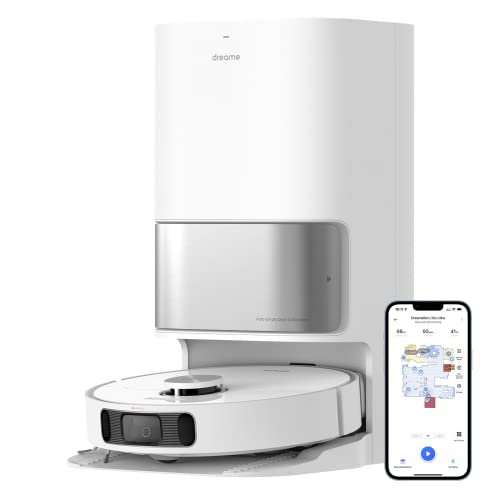
- Base station empties, washes, dries, and refills automatically
- Up to 60 days of hands-free dust capacity
- Longest rated runtime in this guide at up to 210 minutes
- Mop pads lift automatically over carpet
The Dreame L10s Ultra is a full-featured vacuum and mop combination that leans heavily into automation. Its AI Action system uses an RGB camera and 3D structured light to learn the layout of the home, tailor cleaning strategies to the type of obstacle and flooring, and generate efficient cleaning paths. LiDAR-based mapping supports room-by-room cleaning and no-go zones through the app.
Suction is rated at 5,300 Pa, and the dual rotating mop pads lift automatically when the robot detects carpet, so vacuuming and mopping can happen in a single pass without dampening rugs. The base station empties the dustbin, washes and dries the mop pads, and refills the water tank, with the dust capacity rated for up to 60 days of hands-free cleaning. Battery life is rated at up to 210 minutes, the longest in this guide. Voice control works with Alexa, Google Assistant, and Siri.
This model suits owners who want flagship-level automation at a step below the highest suction figures, particularly in homes with a mix of hard floors and low-pile rugs. The 5,300 Pa suction is lower than the Roborock flagships, so homes with thick carpet and heavy pet hair may prefer a stronger model. Availability can also vary, and buyers should check the current listing before ordering, since the manufacturer page has shown this model as sold out at times.
Pros:
Cons:
Shark AV2501AE AI Ultra
- 360-degree LiDAR mapping with Matrix Clean multi-pass cleaning
- Bagless XL HEPA base holds up to 60 days of debris
- No dust bags to buy, which lowers running costs
- Strong fit for pet hair and carpeted homes
The Shark AV2501AE AI Ultra is the only vacuum-only model in this guide, and that focus is its strength. Instead of splitting its design between vacuuming and mopping, it concentrates on suction, navigation, and a large self-emptying base. Its 360-degree LiDAR vision maps the home quickly and accurately, and Matrix Clean Navigation makes multiple passes over dirt in a precise grid pattern rather than a single sweep. The bagless XL HEPA base holds up to 60 days of debris, so there are no dust bags to buy, and the robot runs for up to 120 minutes per charge with voice control through Alexa and Google Assistant.
This model is best for pet owners and carpet-heavy homes that do not need mopping. The bagless base is a genuine long-term saving, and the LiDAR mapping is accurate enough for room-specific cleaning. The limitations are clear: there is no mopping function at all, Shark does not publish a suction figure in pascals, so direct power comparisons are not possible, and the 120-minute runtime is the shortest in this guide. Buyers should also confirm the exact model, since the similar AV2501S uses a smaller 30-day base.
Pros:
Cons:
Ecovacs Deebot X2 Omni
- Dual-laser LiDAR detects objects up to 10 metres away
- Square front improves corner and edge cleaning
- 8,000 Pa suction with a long roller brush
- Omni Station washes, dries, empties, and refills
The Ecovacs Deebot X2 Omni stands out immediately because of its square front, a shape that helps it clean corners and edges more effectively than a round robot. It uses dual-laser LiDAR, the first fully integrated LiDAR sensor of its kind in a robot vacuum, which can detect objects up to 10 metres away across a 210-degree angle. That wide sensing range supports accurate mapping and confident obstacle avoidance, backed by AIVI 3D 2.0 obstacle recognition and TrueMapping 3.0 path planning. Suction reaches 8,000 Pa, the rotating mop pads lift by 15 mm over carpet, and the Omni Station washes the mop pads with hot water, dries them with hot air, empties the dustbin, and refills the water tank.
This model is best for homes where edge and corner cleaning matters, and for owners who want a flagship vacuum and mop combination with a distinctive design. The square body can be slightly less nimble in very tight spaces than a round robot, and the Omni Station is large, so buyers should measure the space where the dock will sit. As with other flagships, replacement mop pads and dust bags add to the long-term cost.
Pros:
Cons:
Comparison: Which One Fits Your Home
The five models split neatly into three groups. The Roborock S8 Pro Ultra and S8 Max Ultra are the most complete hands-free packages, with the Max Ultra adding stronger suction, the FlexiArm corner brush, and hot-water mop washing. Either one suits a busy household that wants vacuuming and mopping handled by the dock.
The Dreame L10s Ultra and the Ecovacs Deebot X2 Omni sit in the same flagship tier with different strengths. The Dreame offers the longest runtime and a 60-day hands-free base, while the Ecovacs brings dual-laser LiDAR and a square body for edges. Homes with large open floor plans may favour the Dreame for runtime, while homes with furniture pushed against walls may favour the Ecovacs for corner coverage.
The Shark AV2501AE AI Ultra is the outlier and the simplest choice. It vacuums only, but it does so with accurate LiDAR mapping, a bagless 60-day HEPA base, and no ongoing bag costs. For a carpet-heavy home with pets and no interest in mopping, it delivers the core benefit of LiDAR navigation without paying for a mop system that would rarely be used.
Frequently Asked Questions
What does LiDAR do in a robot vacuum?
LiDAR stands for Light Detection and Ranging. The robot spins a laser sensor that measures how long light pulses take to bounce back from walls and furniture, building an accurate map of the home. That map lets the robot clean in neat rows, remember rooms, avoid obstacles, and return to the exact spot where it stopped after recharging.
Is a LiDAR robot vacuum better than a random-navigation model?
For most homes, yes. A LiDAR robot covers the whole floor systematically, cleans specific rooms on demand, and supports no-go zones, while a random-navigation model moves by bumping into things and may miss areas or clean the same spot repeatedly. Random-navigation models can still suit a single small room, but LiDAR is the better choice for multi-room homes.
Do I still need a regular vacuum if I own a LiDAR robot vacuum?
A robot vacuum handles daily maintenance cleaning well, but most homes still benefit from a full-size vacuum for stairs, upholstery, car interiors, and occasional deep cleaning. The robot keeps floors tidy between deeper cleans rather than replacing every cleaning tool in the home.
Can a LiDAR robot vacuum mop and vacuum at the same time?
Many models in this guide can. The Roborock, Dreame, and Ecovacs models vacuum and mop in one pass, lifting their mop pads automatically when they detect carpet. The Shark AV2501AE AI Ultra is vacuum-only, so owners who want mopping should choose one of the combination models instead.
Conclusion
The best lidar robotic vacuums share one core strength: an accurate laser-built map that turns floor cleaning from a random chore into a planned routine. The Roborock S8 Pro Ultra remains the most balanced hands-free choice, the S8 Max Ultra adds stronger suction and better corner cleaning, the Dreame L10s Ultra offers long runtime and a fully automated base, the Shark AV2501AE AI Ultra is the best value for vacuum-only pet homes, and the Ecovacs Deebot X2 Omni brings dual-laser LiDAR and a square design for edges. Matching the robot to the home matters more than chasing the highest suction figure, so buyers should weigh floor types, room layout, and whether mopping is needed before choosing. Any of these five will clean more methodically than a random-navigation robot, and the right one will keep floors tidy with little daily effort.
Disclosure: As an Amazon Associate, we earn from qualifying purchases.