Key takeaways
- Compare the best sprinklers for coverage by stated coverage area, spray diameter and pattern control, from 3,600 sq ft oscillators to a 6,360 sq ft impact sprinkler.
As an Amazon Associate we earn from qualifying purchases.
Every sprinkler box leads with a coverage number, and almost every buyer misreads it. That big square-foot figure is a maximum, measured by the maker under favourable water pressure, usually in still air, with the sprinkler set to its widest pattern. It tells you the largest area that sprinkler can reach — not the area it will water evenly on your hose, on a breezy evening, at the end of a long run of pipe. Choosing a sprinkler for coverage therefore means more than picking the biggest number. It means matching the shape of the pattern to the shape of your lawn, and then making sure the stated coverage fits that shape with something to spare.
This guide compares four lawn and garden sprinklers sold on Amazon US purely on coverage terms: their stated coverage area, their spray diameter or pattern dimensions, and how much control you get over that pattern. Two are oscillating sprinklers, which lay down a rectangular pattern suited to most suburban lawns. One is a compact turbo oscillator with unusually wide adjustment for its size, which suits smaller and oddly shaped plots. One is a brass impact sprinkler on a step spike, which throws a full or part circle up to a stated 90-foot diameter for large, open ground. All four are hose-end lawn sprinklers for grass and garden watering — not fire-protection sprinklers, not in-ground irrigation heads, and not drip equipment.
Specifications below are taken from the product listings and maker information for each model. Coverage figures are maker claims, quoted with the conditions the makers attach to them where those are stated, and no sprinkler here is presented as personally tested. Check the live listing for current price and availability before buying.
Quick comparison
| Product | Type | Stated coverage | Pattern control | Best for |
|---|---|---|---|---|
| Melnor 65078-AMZ XT Turbo Oscillating Sprinkler | Oscillating | Up to 4,500 sq ft | Width, range and flow, 3-way adjustment | Medium to large rectangular lawns |
| Melnor 65131AMZ MiniMax Turbo Oscillator | Oscillating, sled base | Up to 4,000 sq ft | 4-way adjustment including 360° positioning | Small to medium and irregular lawns |
| Orbit 58214N Brass Impact Sprinkler | Impact, step spike | Up to 6,360 sq ft, 90 ft diameter | Part circle to full 360°, deflector and diffuser | Large open lawns and rough ground |
| Eden 96213 Weighted Essential Oscillating Sprinkler | Oscillating, weighted base | Up to 3,600 sq ft at 40 PSI | Adjustable range | Straightforward rectangular lawns on a budget |
How coverage actually works
Coverage area is a derived number. For an impact or rotating sprinkler it comes from the diameter of the circle it throws: a 90-foot diameter circle works out to roughly 6,360 square feet, which is exactly the pairing Orbit states for the impact sprinkler in this guide. For an oscillator it comes from the length and width of the rectangle the bar sweeps. Two sprinklers can claim similar square footage and water completely different ground — one a long thin rectangle, one a broad circle — and only one of them will suit your plot.
Three things shrink real coverage below the box figure. Water pressure is the biggest: throw distance falls quickly as pressure drops, and the stated maximums assume healthy pressure at the sprinkler, not at the street. Wind is the second: a fine spray drifts, so the far edge of the pattern lands short and the near edge gets double water. The third is pattern setting. The moment you narrow an oscillator’s width to keep water off a driveway, or set an impact sprinkler to a part circle to avoid a house wall, the area you are actually covering falls — which is correct behaviour, but it means a sprinkler run at half pattern needs roughly twice the headline coverage for the same ground.
That is why this guide treats adjustability as a coverage feature in its own right. A sprinkler whose width, range, arc, and flow can be trimmed to your plot will deliver more useful coverage than a stronger sprinkler whose pattern you cannot shape, because water that lands on paving is not coverage at all.
The picks in detail
1. Melnor 65078-AMZ XT Turbo Oscillating Sprinkler — best overall coverage control
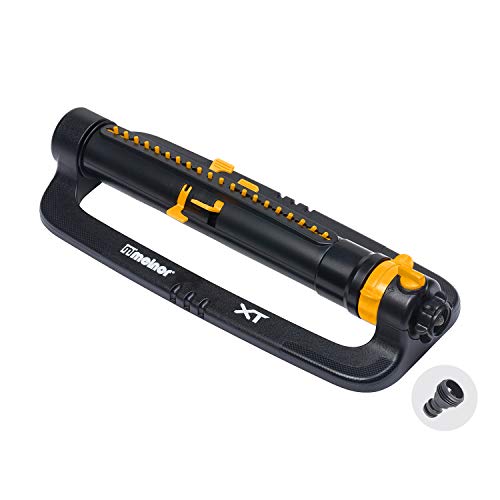
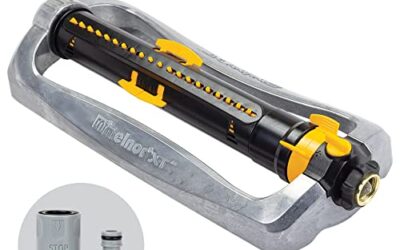
The Melnor XT Turbo is the strongest all-round coverage pick here because it combines a large stated area with the controls needed to use it on a real lawn. The listing states adjustable coverage up to 4,500 square feet, driven by a turbo motor through an oscillating bar, and describes three-way adjustment: twin touch controls set the width and the range of the pattern, so you can pull the sides in to clear a path or fence and shorten the throw to stop at a flower bed, independently. That separation of width and range is what turns a headline figure into a rectangle that actually resembles your lawn.
Oscillators earn their place on rectangular ground. The back-and-forth bar lays an even curtain along a straight edge, corners included, where a circular sprinkler either misses the corners or soaks the street trying to reach them. For the typical front or back lawn — a rectangle with a house on one side and a path on another — a 4,500 square foot oscillator placed centrally will usually need only one or two moves to finish the plot, and the width controls let you water half-lawns along a boundary without overspraying the neighbour.
This bundle version includes Melnor’s QuickConnect adapter set, so the sprinkler snaps on and off the hose end instead of threading each time — a positive connection holds pressure better than a half-tightened thread, which protects throw distance. Keep the filter washer clean, because a partially blocked inlet is a silent coverage killer. Limits are the usual oscillator limits: the pattern is a rectangle, so round areas involve overshoot or a second position, and the stated 4,500 square feet is a maximum at full width and range. On a weak supply the bar still oscillates, but the far corners of the rectangle are the first thing to disappear.
Buy it if: your lawn is a medium to large rectangle and you want one sprinkler whose width and range you can trim precisely to the plot.
Skip it if: your ground is round or very irregular, or your water pressure is low enough that a smaller pattern at full pressure would water more evenly.
2. Melnor 65131AMZ MiniMax Turbo Oscillator — best for smaller and irregular lawns

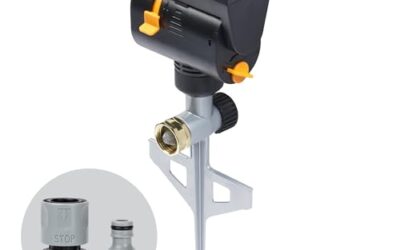
The MiniMax is the interesting coverage story in this line-up: a compact oscillating sprinkler, on a sled base, with a stated coverage of up to 4,000 square feet — close to its full-size sibling — and four-way adjustment. Beyond the width and range controls you would expect, the MiniMax design lets you adjust the direction and flow of the pattern as well, which is what makes a small sprinkler genuinely useful on the awkward plots that full-size oscillators handle badly: the side yard, the L-shaped back lawn, the strip between driveway and fence.
Coverage on small plots is a precision problem, not a power problem. A big sprinkler turned down still throws a coarse pattern and wastes much of it on hard surfaces, while a compact head with fine adjustment can be dialled to a narrow rectangle and left to finish a section evenly. The MiniMax’s stated 4,000 square foot maximum gives it headroom for a medium lawn, but its real value is at the other end of the dial, where shrinking and aiming the pattern keeps water on grass in tight spaces. The sled base slides across turf without digging in, suiting frequent small moves.
The bundle includes a QuickConnect adapter, as with the larger XT, so repositioning is quick. Note that the MiniMax family is sold in several base styles — sled, step spike, and tripod variants exist under different model numbers — so confirm the listing you buy is the 65131AMZ sled-base version described here. Pressure caveats apply with extra force to a compact turbo drive: on a long hose run the achieved rectangle will be smaller than the claim, and if your plot is near 4,000 square feet and open, the larger XT is the safer choice. The MiniMax wins when shape, not size, is the difficulty.
Buy it if: your lawn is small to medium, narrow, or irregular, and fine pattern adjustment matters more than raw throw.
Skip it if: you have one large open rectangle to water in as few positions as possible — the bigger oscillator covers it with fewer moves.
3. Orbit 58214N Brass Impact Sprinkler on Step Spike — best for large open areas

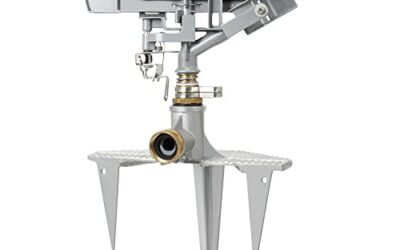
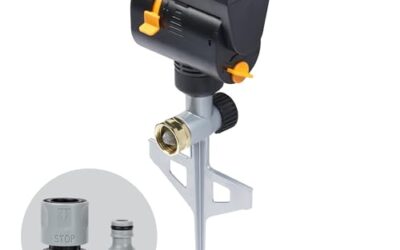
When the ground is large and open, circular throw beats rectangular sweep, and the Orbit 58214N states the biggest coverage in this guide: up to a 90-foot diameter, which the maker equates to 6,360 square feet at a full circle. The head is brass, mounted on a zinc step spike that you push into the ground with your foot, and it is built in the classic impact pattern — the rotating arm that ticks back and forth and has watered large lawns and smallholdings for decades.
The coverage controls are mechanical and effective. Friction collars on the head set the arc anywhere from a part circle to a full 360 degrees, so the same sprinkler can water a corner in a wedge, a boundary in a half circle, or open ground in a full round. A deflector shield shortens the throw when you need a smaller radius, and a diffuser screw breaks up the stream to soften the pattern and bring more water down near the head — impact sprinklers otherwise tend to throw a ring with a dry centre, and the diffuser is the tool that corrects it. The head also has a flow-through outlet, so a second sprinkler can be run in series on the same hose where pressure allows, extending total coverage without a second tap.
Brass construction is a coverage feature over time: impact heads live or die by smooth rotation, and a worn mechanism stalls in the arc and leaves a dry wedge, while a brass head on a metal spike tolerates hard ground and weather better than lightweight plastic. The compromises are shape and noise — a circle suits a small rectangle badly, the mechanism ticks audibly, and the 6,360 square foot figure assumes a full circle at full throw under good pressure; at a half circle it covers half that area, and on a weak supply the radius, and with it the area, shrinks fast.
Buy it if: you water a large, open, roughly round area, want arc control from part circle to full 360 degrees, and value a metal head that survives rough handling.
Skip it if: your lawn is a small rectangle, you water close to walls and paths on every side, or early-morning noise is a problem.
4. Eden 96213 Weighted Essential Oscillating Sprinkler — best simple rectangular coverage
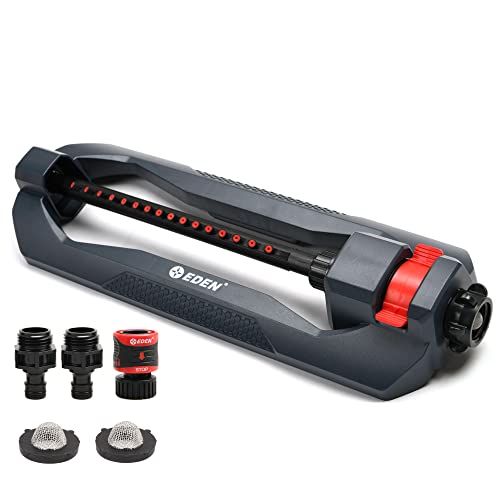
The Eden 96213 is the straightforward option: an oscillating sprinkler with 16 precision nozzles, an adjustable range, and a stated coverage of up to 3,600 square feet. Eden is unusually transparent about that figure, qualifying it as tested at 40 PSI dynamic in wind-free conditions. That honesty is worth rewarding in a category full of bare maximums, because it tells you exactly what to expect: at typical household pressure in calm weather, a rectangle approaching that size is realistic; in wind or on a weak supply, plan on less.
Sixteen nozzles along the bar produce the fan, and the listing describes them as clog-resistant, with stainless steel filter washers included in the bundle to keep grit out of the head in the first place. The base is weighted, which solves the everyday oscillator annoyance of the unit tipping or creeping when the hose is stiff or the pressure surges as the bar changes direction. A sprinkler that stays where you put it delivers the coverage you aimed; one that twists ten degrees waters the driveway instead. The bundle also includes a quick-connect starter set, so the sprinkler can share a hose with other tools without repeated threading.
Adjustment on the 96213 is simpler than on the Melnor XT — range is adjustable, but there is no separate width trimming — so it suits lawns already close to the natural rectangle the bar produces. Treat the 3,600 square foot claim as the ceiling it is stated to be: Eden does not publish the rectangle’s exact dimensions, and a long thin lawn of the same area will need more positions than a squarish one. As with every oscillator here, overlap positions slightly, because the edges of any fan pattern receive less water than the middle.
Buy it if: you want honest, mid-size rectangular coverage up to a stated 3,600 square feet, a weighted base that stays put, and a simple control layout.
Skip it if: you need independent width control, or your lawn is larger than the stated area and you want to minimise repositioning.
Buying guide: matching a sprinkler to your coverage
Measure the lawn, then choose the shape
Start with the plot, not the product. Pace out or measure the length and width of the area you actually water, and note its shape. Rectangles belong to oscillators. Circles and open, irregular ground belong to impact and rotating sprinklers. Then compare your area with the stated coverage, and choose a sprinkler whose maximum comfortably exceeds your plot — a sprinkler running at seventy percent of its pattern usually waters more evenly than one straining at its absolute maximum, and the headroom absorbs a breezy day or a pressure dip.
Read coverage claims like an engineer
Convert diameter claims to area to check them: the area of a circle is roughly 3.14 times the radius squared, so a 90-foot diameter — a 45-foot radius — gives about 6,360 square feet, matching Orbit’s stated pairing. For oscillators, remember the claim assumes full width and full range. If a maker states the pressure behind the figure, as Eden does with 40 PSI, that is a sign the number was measured rather than invented, and a useful benchmark for your own supply.
Use pattern control to protect hard surfaces
Width and range sliders on an oscillator, arc collars and a deflector on an impact head — these keep water off drives, paths, and walls. Overspray is not just wasteful; on a house wall it feeds algae and damp. A sprinkler with slightly less headline coverage and better pattern control is usually the better buy for a lawn hemmed in by hard surfaces.
Plan positions, overlap, and pressure
Few single sprinklers cover a whole lawn from one spot, whatever the box says. Oscillator rectangles should overlap by roughly a quarter of their width, and impact circles should overlap so the weaker centre of one pattern falls inside the stronger mid-range of the next. Coverage is also delivered by your whole setup, not the sprinkler alone: long, narrow hoses and blocked filter washers cost throw distance, so use the shortest, widest hose that reaches and clean the inlet filter at the start of the season.
Affiliate disclosure: This article contains affiliate links. If you buy through links on this page, we may earn a commission at no extra cost to you. Stated coverage figures are the manufacturers’ claims and real coverage varies with water pressure, wind and pattern settings; check the listing before you buy.
Frequently asked questions
What does “covers up to 4,500 square feet” actually mean?
It is the maximum area the maker states the sprinkler can reach at its widest pattern under favourable pressure. Your real covered area will be smaller if you narrow the pattern, your pressure is modest, or it is windy. Treat it as a ceiling for comparison, not a promise.
Is an oscillating or an impact sprinkler better for coverage?
Neither is universally better. Oscillators cover rectangles efficiently, including corners. Impact sprinklers cover large circles and reach further in one position. Match pattern shape to lawn shape first.
Why does my sprinkler cover less than the box says?
Usually low pressure at the end of a long hose, a clogged inlet filter, wind, or pattern settings narrower than maximum. Check the filter and hose first.
How much overlap do I need between positions?
A practical rule is to overlap oscillator rectangles by about a quarter of their width, and to place impact sprinklers so each circle reaches roughly the previous sprinkler’s position. Edges and centres of patterns receive less water, and overlap is what evens that out.
Can I run two sprinklers on one hose for more coverage?
Sometimes. A flow-through head like the Orbit can feed a second sprinkler in series, but throw depends on pressure. If either pattern collapses, run them one at a time.