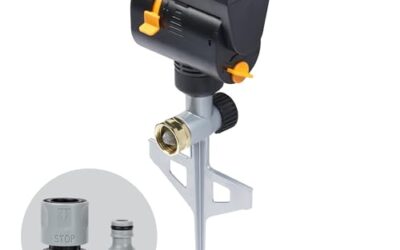
Key takeaways
- Four lawn and garden sprinklers built to keep moving on weak water pressure, with the minimum PSI, flow and coverage figures that matter most.
Weak water pressure changes the sprinkler decision completely. A head that throws a fine arc on a strong town supply can dribble, stall mid-sweep or leave dry rings when the tap runs low, which is the daily reality for homes on wells, long hose runs and upper-floor or rural supplies. The real choice is not which sprinkler covers the most ground on paper, but which drive design still turns, sweeps or spins when pressure and flow are both modest.
This guide is for well owners, gardeners at the end of long hoses and anyone whose current sprinkler barely moves. Every pick below was chosen from its Amazon listing title and specification block, with weight given to published minimum pressure figures, low-flow operation and drive types that keep working when the supply is weak.
Quick Picks
As an Amazon Associate we earn from qualifying purchases.
| Product | Best for | Key spec from title |
|---|---|---|
| Dramm ColorStorm Spinning Sprinkler 15074 | Wells and very weak taps | Runs on pressure down to 20 PSI |
| Melnor XT Turbo Oscillating Sprinkler 65074-AMZ | Rectangular lawns | 20 nozzles, up to 4,500 sq ft coverage |
| Eden 95124 Adjustable 4-Way Mini Turbo Oscillating Sprinkler | Narrow beds and small yards | Turbo motor builds internal pressure |
| Orbit H2O-6 Gear Drive Sprinkler 58573N | Medium lawns, quiet running | Six spray patterns on a spike base |
How to Choose
Minimum Pressure the Drive Needs
Every sprinkler drive has a floor below which it stops moving, and that floor is the first figure to check on a weak supply. Spinning heads and turbo oscillating motors sit at the friendly end of the scale: the Dramm spinning model in this guide is listed as running on pressure down to 20 PSI, and Melnor describes its turbo drive as keeping a smooth sweep even at low water pressure. Impact heads and large rotors usually need far more push to cycle, so a model with a published low minimum, or a drive described as working at low pressure, deserves priority over headline coverage numbers.
Flow Matters as Much as Pressure
Pressure readings alone can mislead, because a sprinkler also needs enough water volume moving through the hose to keep its pattern full. A well pump may show a healthy gauge figure yet deliver few gallons per minute once the hose, bends and fittings take their share. Listings that publish a low working flow, such as the Dramm figure of 3 gallons per minute, tell you the head was designed for thin supplies. Match that thinking to your own setup: shorter, wider hoses preserve flow, and a sprinkler that sips rather than gulps keeps its sweep even when a second tap opens indoors.
Pattern Shape for Your Yard
Low pressure shrinks every pattern, so buy the shape your yard actually needs rather than the largest circle on the box. Oscillating models lay a rectangle that suits lawns and vegetable plots, and their width and range controls let you trim the pattern back to what your supply can fill. Spinning heads throw a round, rain-like pattern that flatters beds and small round lawns. Gear drive heads sit between the two, offering several patterns from one spike. Choosing the right shape means the reduced throw at low pressure still lands on grass instead of paths and fences.
Build, Base and Upkeep
A sprinkler that works hard on little pressure earns a durable build, because it will run for long sessions to deliver enough water. Metal bodies and brass or precision nozzles resist the wear that grit in well water causes, and a weighted or spiked base keeps the head planted when the hose tugs. Upkeep matters just as much: inlet screens and cleanable nozzles protect small passages from sand and scale, the two things most likely to strangle an already weak flow. A model you can flush and clear in minutes will hold its pattern far longer between deep cleans.
The 4 Best Options
Dramm ColorStorm Spinning Sprinkler 15074

This is the pick for the weakest supplies in the guide. Dramm lists the ColorStorm spinning head as working on low water pressures and flows down to 20 PSI and 3 gallons per minute, figures aimed squarely at well systems and low-flow taps. With no gears to push, the spinning head turns freely and breaks water into fine droplets across a circle up to 38 feet wide, which suits small lawns, beds and newly seeded patches that want gentle watering. The heavy stationary base keeps it planted, and the molded hook makes storage simple between sessions.
Specs
- Brand: Dramm
- Model: 15074
- Type: Spinning sprinkler
- Works on pressure down to 20 PSI and flow down to 3 gallons per minute
- Coverage: Up to 38 feet in diameter
- Maximum pressure: 90 PSI
- Maximum flow rate: 3.5 gallons per minute
- Base: Heavy-duty stationary base with molded storage hook
- Colours: Six options, including green, red and blue
Best for: Homes on wells or weak taps with small round lawns and beds.
Watch out for: The fixed circular pattern cannot be trimmed into a rectangle, so edges near paths get some overspray.
ASIN: B006L90F72
Melnor XT Turbo Oscillating Sprinkler 65074-AMZ
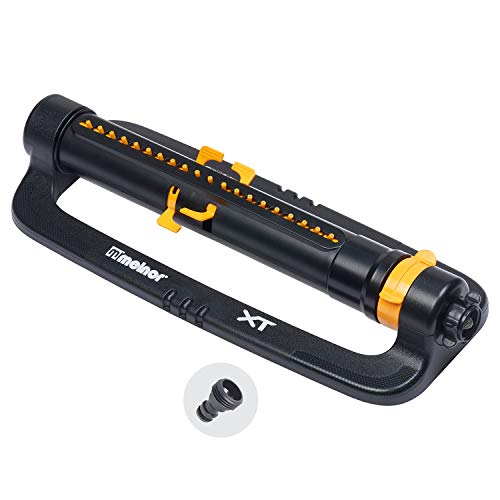
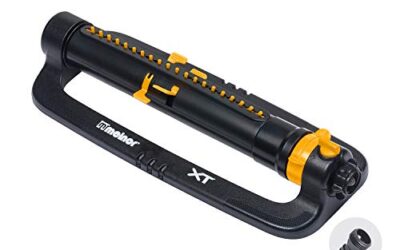
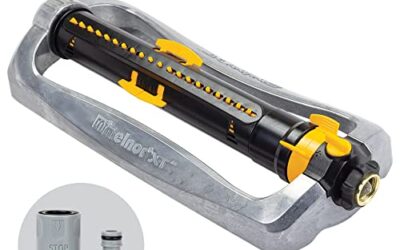
For a rectangular lawn on a soft supply, this Melnor is the natural fit. Its listing highlights an Infinity turbo drive that keeps oscillation smooth and consistent even at low water pressure, which is exactly where ordinary oscillating bars slow down and stall at the ends of the sweep. Twenty precision rubber nozzles lay an even curtain across up to 4,500 square feet, and the 2-way adjustment lets you set both the width and the range so a weak supply only has to fill the pattern you actually need rather than the largest one the bar can draw.
Specs
- Brand: Melnor
- Model: 65074-AMZ
- Type: Oscillating sprinkler with turbo drive
- Nozzles: 20 precision rubber nozzles
- Coverage: Up to 4,500 sq ft
- Adjustment: 2-way, for width and range
- Material: ABS body
- Maximum pressure: 80 PSI
- Dimensions: 17.16 x 6.65 x 3.14 inches
Best for: Rectangular lawns and vegetable plots on supplies that make ordinary oscillators stall.
Watch out for: The plastic body is lighter than metal rivals, so it can shift on uneven ground if the hose pulls.
ASIN: B07P9FH2FL
Eden 95124 Adjustable 4-Way Mini Turbo Oscillating Sprinkler

Eden built this compact oscillator around the low-pressure problem. The listing explains that its turbo-drive motor builds up internal pressure to maximise performance at both low and high water pressures, so the sweep keeps moving when the tap is weak. Four-way adjustment covers width, length, flow and angle, and the head rotates through a full circle of spray direction, which makes it easy to water a narrow bed or an L-shaped corner without dragging the hose around. Coverage reaches up to 4,069 square feet, and the heavy weight base holds the unit steady while the flow control dial fine-tunes the pattern.
Specs
- Brand: Eden
- Model: 95124
- Type: Mini turbo oscillating sprinkler
- Coverage: Up to 4,069 sq ft
- Adjustment: Width, length, flow and spray angle
- Spray direction: Rotates 360 degrees
- Flow control: Integrated dial for micro-adjustments
- Base: Heavy weight base
- Maximum pressure: 125 PSI
Best for: Narrow beds, side yards and small lawns where aim matters more than raw reach.
Watch out for: The compact head covers less ground per placement than full-size oscillators, so bigger lawns need more moves.
ASIN: B09NP74D4V
Orbit H2O-6 Gear Drive Sprinkler 58573N

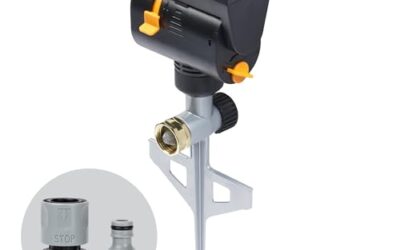
A gear drive is the classic answer when pressure is modest but the lawn is not small, because the mechanism turns slowly and steadily instead of demanding a hard jet. The Orbit H2O-6 sits on a metal T-spike with a flow-through base, so you can push it into turf and even run another head further down the line. Six spray patterns, from full circles to flat and shower settings, cover up to 5,026 square feet, and easy adjust tabs set the arc without tools. The listing also notes whisper-quiet running, a genuine comfort for early morning watering near bedrooms.
Specs
- Brand: Orbit
- Model: 58573N
- Type: Gear drive sprinkler on metal T-spike
- Spray patterns: Six selectable patterns
- Coverage: Up to 5,026 sq ft
- Arc: Adjustable up to a full 360 degrees
- Base: Flow-through spike, allows heads to run in series
- Maximum pressure: 65 PSI
- Running note: Whisper-quiet gear drive operation
Best for: Medium lawns on modest pressure where quiet running and pattern choice matter.
Watch out for: Throw distance still shrinks as pressure falls, so the largest patterns need the strongest supply you can give them.
ASIN: B000FJX4IQ
Which One Fits Your Situation
A Well Pump Feeding One Small Lawn
Choose the Dramm spinning sprinkler. Its published floor of 20 PSI and 3 gallons per minute is the lowest in this guide, so it keeps turning when a well pump cycles and flow dips. The round pattern suits a compact lawn, the fine droplets suit new seed, and the heavy base stays put on soft ground. Run it in longer, calmer sessions rather than expecting a fast soak.
A Long Hose Run to the Back Garden
Pick the Eden 95124. Pressure fades with every extra metre of hose, and this head answers by building internal pressure with its turbo motor, while the flow dial lets you trim demand to what the run can deliver. Its rotating spray direction also helps at the far end of a garden, where repositioning the hose is awkward and aiming the head is far easier.
Rectangular Turf That Needs Even Edges
Take the Melnor XT Turbo. The oscillating curtain matches straight lawn edges, the width and range controls keep water off paths, and the turbo drive holds an even sweep at pressures where a plain bar would pause at each end. Set the pattern slightly smaller than the lawn and let longer run time, not a bigger pattern, deliver the depth your grass needs.
A Bigger Lawn on a Modest Town Supply
Go with the Orbit H2O-6. The gear drive turns steadily on moderate flow, the six patterns let you match circles and part-circles to an awkward plot, and the flow-through spike makes it simple to add a second head later. It is also the quietest style here, which suits early watering before the household wakes and other taps begin competing for pressure.
Common Mistakes
- Buying by maximum coverage alone, when that figure assumes strong pressure your tap cannot deliver.
- Choosing an impact sprinkler for a weak supply, then finding the arm will not cycle at low pressure.
- Running two hungry heads on one hose and wondering why both patterns collapse.
- Ignoring inlet screens, so grit from a well slowly chokes an already thin flow.
- Setting the widest pattern on day one instead of trimming the pattern to what the supply can fill evenly.
Frequently Asked Questions
How low can pressure go before a sprinkler stops moving?
It depends on the drive. The Dramm spinning head in this guide is listed as working down to 20 PSI with 3 gallons per minute of flow, and turbo oscillating models are described as keeping their sweep at low pressure. Below a head’s working floor it will dribble or stall, so the published minimum is the figure to trust.
Why does my current sprinkler barely sweep on my well system?
Wells deliver pressure in cycles and often modest flow, and many sprinklers are built around stronger town supplies. Their drives pause at the ends of each sweep when the push fades. A turbo oscillating, gear drive or spinning head is designed to keep moving through those dips, which is why drive type matters more than coverage here.
Can two sprinklers run on one hose at low pressure?
Usually not well. Each head takes a share of the flow, and on a weak supply both patterns shrink and may stop moving altogether. The Orbit H2O-6 has a flow-through spike for running heads in series, but even then, one head at a time, moved between zones, gives far more even watering on a thin supply.
Do spinning sprinklers water as evenly as oscillating models?
They water differently rather than worse. A spinning head lays a round pattern of fine droplets that suits beds, small lawns and new seed, while an oscillator lays a rectangle that suits turf edges. At low pressure both patterns shrink, so evenness comes from matching the shape to the space and running the head long enough.