Key takeaways
- Find the best sprinklers impact pop up heads for buried lines: true impact-drive pop-ups for dirty water, wide spacing, slopes and hose-fed installs.
Impact pop-up sprinklers are a narrow corner of the irrigation market. Most pop-up heads sold today turn with an enclosed gear drive or throw a fixed spray fan, while a true impact pop-up hides in a buried canister, rises under pressure, and rotates because a spring-loaded arm keeps striking the body and nudging it around. That open mechanism is exactly why the type survives: grit, sand, and mineral-heavy well water that choke fine gear trains pass through an impact head with far less drama, and there are no tiny internal passages to plug.


The trade-off is choice. Only a handful of genuine in-ground impact pop-ups remain in production, and they come from two makers, Rain Bird and Orbit. This guide covers the verifiable Amazon listings for buried impact-drive pop-up heads and bodies only. Hose-end impact sprinklers on spikes, tripod models, gear-drive rotors, and fixed spray heads were all left out on purpose, because none of them is the product this keyword describes. A fifth pick, the check-valve Maxi-Paw, is sold on Amazon as an IrriFix 4-pack of heads rather than in a single retail box, and it earns its place here on the strength of its Seal-A-Matic valve rather than being padded in with a rotor that does not belong here.
As an Amazon Associate, we earn from qualifying purchases.
Quick answer
The Rain Bird AG-5 is the top pick: a full-size pop-up impact head in a buried canister, with an adjustable 20 to 360 degree pattern, a 24 to 45 foot throw, and a straight-through flow path built for hard, dirty, or reclaimed water. For wider spacing, the Orbit 55201 Pulse XL covers up to 45 feet between heads, and the Orbit 55200 Pulse suits tighter layouts.
Rain Bird AG-5 All Gallonage Pop-Up Impact Sprinkler
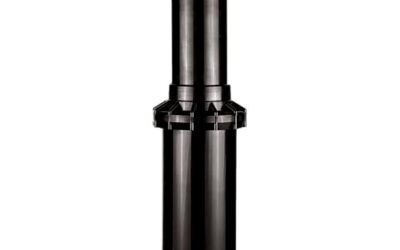
The AG-5 is the classic buried impact head and the safest default for a piped in-ground system. It sits in a closed canister below grade, pops up when the zone pressurizes, and drives itself around with the familiar clicking impact arm. Rain Bird lists it for hard, dirty, and reclaimed water, which is the main reason to choose an impact head over a gear rotor in the first place: the flow path is open, the nozzle orifice is large, and sediment has very little to lodge against.
Pattern control is mechanical and simple. A trip lever and friction collars set anything from a 20 degree wedge to a full 360 degree circle, and the diffuser screw breaks up the stream to pull the radius in for closer watering. The listing describes the head as an in-ground pop-up supplied with nozzles, so flow can be matched to the zone by swapping the nozzle rather than replacing the whole head.
| Key specs | Rain Bird AG-5 |
|---|---|
| Drive type | Impact arm, pop-up canister body |
| Spray distance | 24 to 45 feet |
| Pattern | Adjustable 20 to 360 degrees |
| Inlet | 1/2 inch |
| Body material | Plastic |
| Water fit | Hard, dirty, or reclaimed water |
Choose the AG-5 when a zone runs on well water, pond water, or a reclaimed supply, or when an older impact zone needs a like-for-like replacement head. Its limits are the limits of the type: it needs reasonable pressure to keep the arm cycling, and the audible clicking carries on quiet nights.
Orbit 55201 Pulse XL Pop-Up Impact Sprinkler
The Pulse XL is Orbit’s larger canister impact head, aimed at broad lawn zones where heads sit far apart. Orbit rates it for spacing up to 45 feet, the widest layout figure in this group, and the 3 inch pop-up riser clears medium grass so the stream is not clipped by turf at the edge of the canister. The pattern adjusts from 20 to 360 degrees, and the radius can be trimmed back by roughly a quarter of full throw for corners and edges.
Connection flexibility is the other reason to pick it. The canister accepts both 1/2 inch and 3/4 inch inlets, which helps when a retrofit zone mixes pipe sizes or when a deep-buried lateral needs the larger thread. The listing describes a male connection on the canister, so plan the swing joint or riser fitting accordingly.
| Key specs | Orbit 55201 Pulse XL |
|---|---|
| Drive type | Impact, pop-up canister body |
| Spacing | Up to 45 feet between heads |
| Pattern | Adjustable 20 to 360 degrees |
| Pop-up height | 3 inch riser |
| Inlet | 1/2 inch and 3/4 inch options |
| Body material | ABS plastic with stainless steel parts |
Pick the Pulse XL for new layouts with wide head spacing, or for replacing a worn large-canister impact head where the existing hole and lateral already suit a bigger body. On small zones its throw is more than the layout can use, and dialing the radius down hard wastes the evenness the long stream provides.
Orbit 55200 Pulse Pop-Up Impact Sprinkler Head
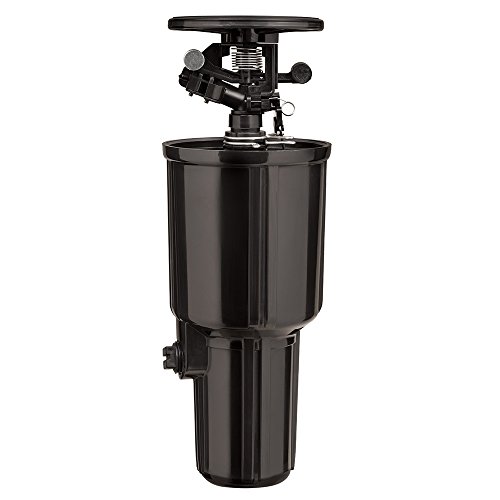
The standard Pulse is the smaller sibling: a compact canister impact head with a throw of up to 35 feet and the same 20 to 360 degree pattern adjustment. It ships as a complete buried unit, with the impact head, canister, and lid in the box, and connects through a 1/2 inch inlet. For a single failed head in an older impact zone, that completeness matters, because the whole assembly swaps as one piece.
Orbit describes a large nozzle orifice that resists clogging, which puts this head in the same dirty-water conversation as the Rain Bird models, if on a smaller scale. The 3 inch riser clears typical lawn turf, and the ABS body keeps the unit light enough for shallow trenches and hand digging.
| Key specs | Orbit 55200 Pulse |
|---|---|
| Drive type | Impact, pop-up canister body |
| Spray distance | Up to 35 feet |
| Pattern | Adjustable 20 to 360 degrees |
| Pop-up height | 3 inch riser |
| Inlet | 1/2 inch |
| In the box | Impact head, canister, lid |
This is the sensible pick for tighter residential layouts, patch repairs, and zones where heads sit 20 to 30 feet apart. It is not the head for a wide-open field layout, and like every impact model here it wants a zone valve and lateral sized to keep pressure steady at the nozzle.
Rain Bird LG3HE In-Ground Impact Sprinkler with Click-N-Go Hose Connect
The LG3HE takes the Mini-Paw impact mechanism and packages it for a hose-fed install. Instead of tying into a buried lateral and zone valve, the canister drops into a single small hole, sits flush with the soil, and connects to a garden hose through Rain Bird’s Click-N-Go quick fitting. No trenching, no manifold, and the head still pops up to water and retracts out of sight afterward, so the lawn can be mowed over it.
Inside, it is the same low-gallonage Mini-Paw design used in piped systems: a double-weighted arm for slower rotation and longer throw, a grit-proof bearing, and a stainless steel retract spring. Rain Bird rates coverage at up to 5,200 square feet from one head, with spacing of 26 to 41 feet where several are chained, an operating range of 25 to 50 psi, and a 3 gallon per minute nozzle fitted. The pattern adjusts between full circle and part circle down to a 20 degree wedge.
| Key specs | Rain Bird LG3HE |
|---|---|
| Drive type | Impact arm, pop-up canister body |
| Coverage | Up to 5,200 square feet per head |
| Pattern | Full circle or part circle, 20 to 360 degrees |
| Operating pressure | 25 to 50 psi |
| Connection | Click-N-Go garden hose fitting |
| Flow | 3 gallons per minute nozzle |
Choose the LG3HE when the goal is one stubborn dry area, a rental property, or a lawn with no irrigation pipework at all. The compromise is control: a hose-fed head runs when someone connects it or pairs it with a hose-end timer, and it cannot match the zoning precision of a valved system.
Rain Bird 2045A-SAM Maxi-Paw with Seal-A-Matic Check Valve
The fifth slot in this category belongs, on paper, to the check-valve version of the Maxi-Paw. On sloped ground, ordinary pop-up heads drain the lateral through the lowest head every time the zone shuts off, leaving a puddle at the bottom of the hill and an air-filled pipe at the top. The 2045A-SAM answers that with a Seal-A-Matic check valve inside the same Maxi-Paw impact canister, holding water in the line between cycles. A non-potable variant with a purple cap exists for reclaimed water systems, and irrigation suppliers stock both.
On Amazon, the SAM version is sold by IrriFix as a 4-pack of 2045A-SAM Maxi-Paw heads, which suits slope work well: a sloped zone usually has several low heads draining at once, so replacing them as a matched set makes practical sense. Check the listing carefully before ordering, because the standard 2045A shares the same canister and only the SAM version carries the Seal-A-Matic valve. For a single full-size Rain Bird head without a check valve, the AG-5 above remains the default.
How to choose
Begin with water quality, because it decides whether an impact head makes sense at all. Impact drives tolerate grit, sand, and mineral content that wear or jam gear rotors, so well water, pond water, and reclaimed supplies point here first. On clean municipal water, a modern gear rotor is quieter and easier to fine-tune, and this category becomes a replacement-parts decision instead.
Match the head to the layout next. Measure the spacing the zone needs: the Orbit 55201 and the Rain Bird AG-5 both reach the mid-40 foot range, the Orbit 55200 suits spacing in the 20 to 35 foot band, and the LG3HE covers a single hose-fed area rather than a piped grid. Oversizing throw and then crushing it down with the diffuser screw gives poor close-in watering, so pick the head whose natural radius fits the lawn.
Check the inlet and the canister before ordering. Piped heads here use 1/2 inch threads, with the Pulse XL adding a 3/4 inch option; a mismatch means extra fittings or a swing joint rebuild. Confirm the canister diameter against the hole an old head leaves behind, since these bodies are larger than slim spray bodies. Finally, think about drainage: on any slope, low-head drainage after each cycle wastes water and erodes soil, which is exactly the problem the check-valve class covered above exists to solve.
Who should skip
Skip this category if your water is clean and your priority is quiet, precise watering: gear-drive rotors rotate almost silently, hold an arc setting more exactly, and come in far more sizes. Skip it if your pressure is very low, because an impact arm needs enough energy to keep cycling and will stall or dribble where a low-flow spray head still works. Skip it if you need matched precipitation across mixed head types on one zone, since impact nozzles follow their own flow curve. And skip the hose-fed LG3HE if you want true automation, because a buried valve system is the right tool for that job.
Frequently Asked Questions
Why choose an impact pop-up over a gear-drive rotor?
The impact mechanism has an open, straight-through flow path and a large nozzle orifice, so sand, grit, and mineral-heavy water pass through instead of grinding inside a sealed gear train. That makes impact pop-ups the durable choice for wells, ponds, and reclaimed water. The costs are noise, a less exact arc, and a much smaller range of models to choose from.
Can these heads replace old impact heads in an existing zone?
Usually, yes. The piped models here use common 1/2 inch inlets, and the Pulse XL adds a 3/4 inch option, so most swap onto existing laterals with a swing joint or riser. Measure the old canister hole before ordering, because impact bodies are wide, and keep nozzle flow close to the head being replaced so the zone stays balanced.
What pressure do pop-up impact sprinklers need?
Plan on roughly 25 psi at the head as a working floor. The LG3HE is rated for 25 to 50 psi, and the full-size heads are built for the same general band found in residential systems. Below that range the arm may fail to cycle and the stream collapses close to the head; far above it, the stream mists and coverage turns uneven.
Do impact pop-up sprinklers need much maintenance?
Very little, and most of it is rinsing. The inlet screen catches larger debris and can be washed out when a head weakens, and the nozzle twists out by hand for cleaning or swapping. Before winter in cold regions, drain the lines as you would for any buried head, and check in spring that each canister still pops up and retracts freely.
Final verdict
True in-ground impact pop-ups are a small, stable category, and the Rain Bird AG-5 is its reference point: full-size throw, simple mechanical adjustment, and a flow path built for dirty water. The Orbit 55201 Pulse XL matches it on spacing with friendlier inlet options, the Orbit 55200 Pulse covers compact layouts and repairs, and the Rain Bird LG3HE brings the same mechanism to lawns with no pipework at all. The check-valve Maxi-Paw, sold on Amazon as an IrriFix 4-pack, covers slopes and low-head drainage rather than being replaced with a product that does not fit the keyword.
Product and ASIN Reference
| Product | ASIN |
|---|---|
| Rain Bird AG-5 All Gallonage Pop-Up Impact Sprinkler | B011TMU58E |
| Orbit 55201 Pulse XL Pop-Up Impact Sprinkler | B079NP7T6R |
| Orbit 55200 Pulse Pop-Up Impact Sprinkler Head | B01KVMOTJE |
| Rain Bird LG3HE In-Ground Impact Sprinkler with Click-N-Go Hose Connect | B07HKTDV5K |
| Rain Bird 2045A-SAM Maxi-Paw (IrriFix 4-Pack) | B07PWDM3MY |