Our Short List of 3
All 3 Picks at a Glance
| Product | Specs | Action |
|---|---|---|
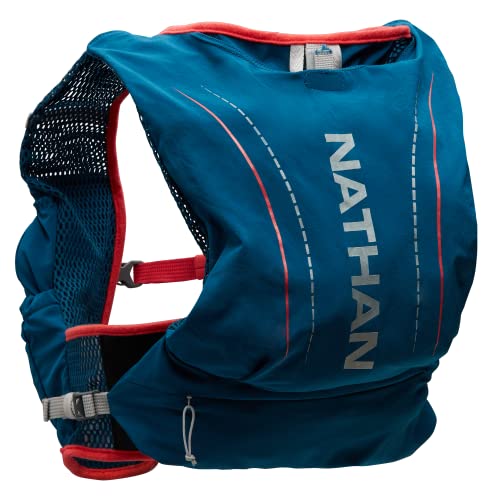 Nathan VaporAir Lite 4 Liter Vest | Check price on Amazon | |
 Nathan Pinnacle 12L Race Vest | Check price on Amazon | |
 Salomon Active Skin 8 | Check price on Amazon |
Key takeaways
- Five verified trail running hydration vests compared by storage volume, bladder and flask setup, pocket layout and fit adjustment.
Disclosure: As an Amazon Associate, we earn from qualifying purchases.
Our top pick: Nathan Pinnacle Pro Hydration Vest 12L. Runner-up: Nathan VaporAir Lite 4 Liter Vest.
A hydration pack for trail running has to carry water, fuel and a spare layer while staying quiet against the body over uneven ground. A vest that bounces, chafes or runs dry halfway up a climb is worse than no vest at all, so the details that matter are storage volume, how the water is carried, how the fit adjusts, and how much the empty vest weighs. The five vests in this guide are all running vests or running hydration packs, and each one was checked against a real Amazon US listing with a verified ASIN. Four are current Nathan models and one is a Salomon vest, because those are the trail running vests whose Amazon US listings could be verified for this guide. Every pick here is a vest made for running: there are no hiking backpacks, no handheld bottles and no reservoirs sold on their own.
Quick Picks
- Nathan Pinnacle Pro Hydration Vest 12L — Best overall: 12L of storage, a 1.6L insulated bladder and an 8.8 oz build with pole keepers.
- Nathan VaporAir Lite 4 Liter Vest — Runner-up: the largest bladder in this guide at 2L, in a compact 4L vest with front bottle pockets.
- Nathan Pinnacle Breeze Hydration Vest 4L — Best flask setup: two 14 oz Hydrapak flasks included, with six pockets and reflective details.
- Nathan Pinnacle 12L Race Vest — Best for long days: 12L of storage, a 1.6L bladder and water-resistant pockets.
- Salomon Active Skin 8 — Best middle size: 8L of storage, two 500 ml soft flasks included and reservoir compatibility.
Nathan Pinnacle Pro Hydration Vest 12L
OUR TOP PICK
The Pinnacle Pro is the most complete vest in this guide, and the one to start with for long trail runs where water, food, poles and a layer all have to come along. As stated on the listing, it has 12L of storage and includes a 1.6L insulated bladder, which helps keep water cooler on warm days than an uninsulated reservoir. Despite that capacity, the listing puts the vest at a lightweight 8.8 oz, with a breathable mesh build, so it carries its size well when the storage is only partly filled.
The fit and pocket details are what separate it from a basic vest. The listing records six power-mesh pockets for gels, bars and small essentials, a large zippered diagonal pocket for items that must stay secure, and four pole keepers for stowing trekking poles on runnable sections. Fit is handled by Quick-Fit micro size adjustments and sternum slider cords, which let the wearer fine-tune the vest as the bladder empties and the load shifts during a run. The listing gives the sport type as Running and Hiking, and the vest is at its best on the running side of that pairing: long trail outings, mountain routes and ultra-distance training where 12L of organised storage earns its place.
The pocket layout has a practical side worth noting. Power-mesh pockets stretch around soft items, so gels, bars and wrappers can be carried within reach and eaten on the move rather than at a stop, while the zippered diagonal pocket is the place for anything that must not bounce out on a descent. The breathable mesh body also suits the vest to warm-weather use, where a heavier pack fabric would hold heat against the back over a long climb.
Specs
– Model: Nathan Pinnacle Pro Hydration Vest 12L
– Storage: 12L
– Hydration: 1.6L insulated bladder included
– Weight: 8.8 oz, as stated on the listing
– Pockets: 6 power-mesh pockets, plus a large zippered diagonal pocket
– Fit: Quick-Fit micro size adjustments and sternum slider cords
– Pole storage: four pole keepers
Pros
– Largest storage in this guide, shared only with the Pinnacle 12L below
– Insulated 1.6L bladder included
– Light 8.8 oz build for a 12L vest
– Pole keepers and a zippered pocket for secure items
Cons
– More vest than a short run needs
– Bladder-only hydration, so topping up means opening the pack rather than swapping a front flask
Nathan VaporAir Lite 4 Liter Vest
The VaporAir Lite is the runner-up, and the simplest formula in this guide: a compact 4 litre vest built around the largest bladder here. As stated on the listing, the 2L bladder is included, which gives this small vest more water capacity than either of the 12L Nathan models above and below. For a runner whose main problem is carrying enough water on a hot route, that trade of storage for fluid makes sense.
The listing also records front water-bottle pockets, so a bottle can ride up front alongside the bladder supply, and describes the material as soft and breathable, which matters on a vest worn against a thin running top for hours. There is less room for clothing and food than in the 12L vests, so this is a vest for runs where the route is known, the weather is settled and water is the priority. Choose the VaporAir Lite when the run is measured in a few hours rather than a full day, and when a 2L bladder covers the distance between refill points without needing a jacket, poles and a full food supply in the pack as well.
Specs
– Model: Nathan VaporAir Lite 4 Liter Vest and Hydration Pack
– Storage: 4 litres
– Hydration: 2L bladder included
– Front storage: water-bottle pockets
– Material: soft, breathable material, as stated on the listing
– Sport type: Running, as stated on the listing
Pros
– Largest bladder in this guide at 2L, included
– Front bottle pockets add a second way to carry water
– Compact 4L body suits shorter, faster runs
Cons
– Least storage in this guide, so layers and food space are limited
– No pole storage is recorded on the listing checked for this guide
Nathan Pinnacle Breeze Hydration Vest 4L
The Pinnacle Breeze takes the other route to hydration: no bladder at all, and two soft flasks carried up front instead. As stated on the listing, the vest has 4L of storage and includes two 14 oz Hydrapak flasks, which sit in front pockets where they can be pulled out, refilled and put back without taking the vest off. That front-flask layout is popular with trail runners who refill often and want to see at a glance how much water is left.
For a 4L vest, the pocket count is generous: the listing records six pockets, along with Quick-Fit size adjustment and reflective details for runs that start or finish in low light. The listing describes the build as lightweight and aimed at long-distance and trail runners, and the Breeze suits that brief well, provided the route has regular refill points, because the two included flasks hold less water in total than the bladder vests in this guide. The crawled listing copy for this guide was the S–M size in the Pinnacle Breeze / Electric Blue colourway, so check the size and colour options on the product page when ordering.
Specs
– Model: Nathan Pinnacle Breeze Unisex Hydration Vest 4L
– Storage: 4L
– Hydration: two 14 oz Hydrapak soft flasks included
– Pockets: 6
– Fit: Quick-Fit size adjustment
– Details: reflective elements, as stated on the listing
Pros
– Flasks included, carried up front for quick refills
– Six pockets is generous for a 4L vest
– Reflective details for low-light running
Cons
– No bladder included, and the flasks hold less water than the bladder vests here
– 4L of storage limits what can be carried on long mountain days
Nathan Pinnacle 12L Race Vest
The men’s Pinnacle 12L is the second big-capacity vest in this guide, built for race days and long outings where a runner carries mandatory kit as well as water. As stated on the listing, it is a 12L pack with a 1.6L water bladder included, water-resistant pockets and a lightweight, moisture-wicking build. The water-resistant pockets are the detail that separates it from the Pinnacle Pro above: on a wet mountain day, keeping a phone, map or food dry inside the vest is worth having.
Against the Pinnacle Pro, the trade is straightforward. The Pro is lighter on the recorded figures, adds an insulated bladder and pole keepers, and adjusts with the Quick-Fit system; the Pinnacle 12L answers with water-resistant storage and a race-vest layout aimed at men. A runner choosing between them should decide which problem is more likely on their routes: heat and pole carrying point to the Pro, while rain and exposed mountain weather point to the water-resistant pockets of this vest. One point needs care when ordering: sizes of this vest are listed separately, and the listing checked for this guide was the XL size in Vapor Grey / Ribbon Red, with model number 40240N-60290-XL recorded for that variant. Other sizes carry their own listings, so confirm the size on the product page before ordering rather than assuming one page covers every size.
Specs
– Model: Nathan Pinnacle 12L Race Vest Hydration Pack, men’s
– Storage: 12L
– Hydration: 1.6L water bladder included
– Pockets: water-resistant pockets, as stated on the listing
– Build: lightweight, moisture-wicking, as stated on the listing
– Size note: the listing checked was the XL size; other sizes are listed separately
Pros
– 12L of storage for race kit and long days
– Water-resistant pockets for wet conditions
– Bladder included
Cons
– Men’s-specific fit, so it will not suit every runner
– Sizes are listed separately, so the correct size page must be chosen when ordering
Salomon Active Skin 8
The Active Skin 8 is the middle option in this guide: bigger than the 4L vests, smaller than the 12L pair, and the only non-Nathan pick. As stated in the listing copy, it has 8L of storage volume and includes two 500 ml soft flasks, with a SensiFit-style precision fit intended to hold the vest steady without restricting breathing. The copy also describes it as reservoir-compatible, with a 1.5L bladder size recorded as compatible, so a runner who already owns a reservoir can add it for longer outings; no reservoir is listed as included.
The recorded weight is approximately 7.4 oz for the vest excluding flasks, which is light for an 8L vest, and the size range runs from XS to XL. One caution applies to this pick more than the others: some of the figures for this vest rest on secondary listing copy rather than the US product page checked for the Nathan models, so confirm the size, colour and included items on the live product page before ordering. With that check done, the Active Skin 8 is a sensible middle path for runners who find 4L too tight and 12L more pack than their routes need.
Specs
– Model: Salomon Active Skin 8 Unisex Running Hydration Vest
– Storage: 8L
– Hydration: two 500 ml soft flasks included; reservoir-compatible
– Fit: SensiFit-style precision fit, as described in the listing copy
– Weight: approximately 7.4 oz excluding flasks, as stated in the listing copy
– Sizes: XS to XL
Pros
– Middle capacity between the 4L and 12L vests in this guide
– Soft flasks included, with the option to add a reservoir
– Wide size range, from XS to XL
Cons
– The two flasks hold 1 litre in total unless a reservoir is added
– Some recorded figures rest on secondary listing copy, so details should be confirmed on the live product page
How to Choose
Start with storage volume, because it decides which of these vests can do the job at all. A 4L vest like the VaporAir Lite or the Pinnacle Breeze carries water, a phone, keys and a few gels, and suits runs of a few hours in settled weather. An 8L vest like the Active Skin 8 adds room for a light layer and more food. A 12L vest, either the Pinnacle Pro or the Pinnacle 12L, is the class for long mountain days, ultra-distance training and races with mandatory kit lists, where a jacket, poles and a full day of food all have to fit.
Next, choose the hydration format. A bladder carries more water in one place and keeps the front of the vest free for pockets: the VaporAir Lite holds 2L, and both 12L Nathan vests hold 1.6L. Soft flasks, as on the Pinnacle Breeze and the Active Skin 8, are quicker to refill at taps and aid points, make it easy to see how much water remains, and let one flask hold water while the other holds an electrolyte drink. Runners who refill often usually prefer flasks; runners who cross long dry sections usually prefer the biggest bladder they can get.
Then look at fit adjustment, because a loaded vest that moves will rub over distance. The Pinnacle Pro and Pinnacle Breeze use Nathan’s Quick-Fit adjustment, the Pro adding sternum slider cords, while the Active Skin 8 relies on its SensiFit-style construction. Whichever vest is chosen, it should sit high and snug, with the load carried on the upper back and chest rather than hanging from the shoulders, and it should be tried loaded, not empty, before a long run.
Weight is worth a thought as well, because a vest is carried for every step of the run. The two recorded figures in this guide are 8.8 oz for the Pinnacle Pro and approximately 7.4 oz for the Active Skin 8 excluding its flasks; the listings checked for the other three vests did not record a directly comparable weight figure, so check the product page if empty weight is a deciding factor. In practice, the water itself outweighs any of these vests once the bladder or flasks are full, which is another reason to size the vest to the route rather than buying the largest one by default.
Finally, match the extras to the route. Pole keepers matter on mountain routes and are recorded only on the Pinnacle Pro here. Water-resistant pockets matter in wet climates and point to the Pinnacle 12L. Reflective details matter for dawn and dusk starts and are recorded on the Pinnacle Breeze. A vest with the right extras for the actual route beats a larger vest bought just in case.
FAQs
How much water should a trail running vest carry?
It depends on the distance between refill points, the temperature and how much the individual runner drinks. The vests in this guide carry between 1 litre in the Active Skin 8’s two flasks and 2L in the VaporAir Lite’s bladder. For routes with regular taps or aid points, flask capacity is usually enough; for long, dry sections, choose the largest bladder and fill it fully at every chance.
Is a bladder or soft flasks better for trail running?
Neither is better for every runner. Bladders carry more water and keep it in one reservoir, but refilling means opening the pack. Soft flasks sit up front, refill in seconds and show how much is left, but hold less per flask. The Pinnacle Breeze and Active Skin 8 use flasks, the other three vests here use bladders, and the Active Skin 8 can also take a reservoir, which makes it the flexible middle option.
How should a hydration vest fit?
Snug, high and stable. The vest should not bounce when the runner jogs on the spot fully loaded, the straps should adjust without digging in, and breathing should stay unrestricted. Use the maker’s size guide, measure the chest as directed, and remember that sizes of some vests, including the Pinnacle 12L in this guide, are listed separately, so the size shown on the product page is the size that will arrive.
Conclusion
For most trail runners, the Nathan Pinnacle Pro is the top pick: 12L of storage, an insulated 1.6L bladder, pole keepers and a light 8.8 oz build cover everything from long training runs to mountain races. The VaporAir Lite is the runner-up for runners who want the biggest bladder in the smallest vest. The Pinnacle Breeze suits flask fans who refill often, the Pinnacle 12L adds water-resistant pockets for wet race days, and the Salomon Active Skin 8 is the middle-size option with flask and reservoir flexibility. Before ordering, confirm the size on the product page, and match the vest’s capacity to the longest run it will actually be used for.