Our Short List of 3
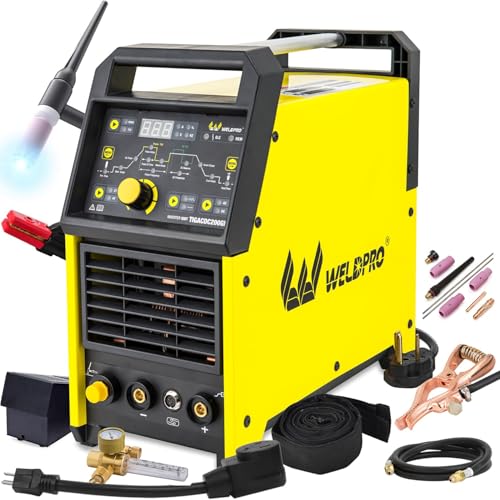
- Best for: Home shops that weld aluminum and steel with one machine
- Output: 200A TIG and stick
- Processes: AC TIG, DC TIG, AC pulse TIG, DC pulse TIG, stick (5 in 1)
- Pulse frequency: 0.5 to 200 Hz, adjustable
- Input: 110/220V dual voltage with automatic detection

- Best for: Shops running long beads on thick aluminum and steel plate
- Output: 250A TIG (5 to 250A range), AC/DC TIG and stick
- Pulse: fully adjustable, with memory function for saved settings
- Included per listing: SSC rocker-style foot pedal, flow meter, gas hose, ground clamp, Tig20 water-cooled torch
- Input: dual voltage, NEMA 6-50 plug
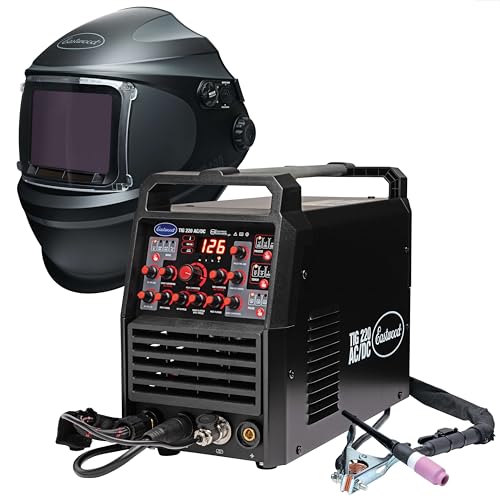
- Best for: Restoration and garage fabrication with one complete kit
- Output: 220A TIG maximum; 10 to 220A on 240V, 10 to 140A on 120V
- Processes: AC/DC TIG, stick and pulse TIG
- Input: 120V or 240V dual voltage
- Included per listing: WP-17F flex-head torch with gas lens kit, foot pedal, auto-darkening helmet
All 5 Picks at a Glance
| Product | Specs | Action |
|---|---|---|
| Weldpro TIG200GD 200A AC/DC TIG Welder |
| Check price on Amazon |
| Weldpro Digital TIG ACDC 250GD |
| Check price on Amazon |
| Eastwood TIG 220 AC/DC TIG Welder |
| Check price on Amazon |
 AHP AlphaTIG 203Xi |
| Check price on Amazon |
 Everlast PowerTIG 185DV |
| Check price on Amazon |
Key takeaways
- Five pulse TIG welders whose Amazon listings include a foot pedal in the box, compared on amperage, pulse range, input voltage and included torch gear.
A pulse TIG machine earns its place on thin aluminum and stainless work, where a steady arc overheats the edges before the puddle settles. The harder buying decision is the pedal. Plenty of pulse TIG welders carry only a pedal socket, and the pedal itself is a separate purchase with a brand-specific plug. This shortlist only includes machines whose own Amazon listing puts a foot pedal in the box, so the amperage control you expect arrives with the welder.
The five machines below suit home fabricators, restoration shops and small production benches. Each one was picked from its Amazon listing title, process list and included components: pulse modes where the listing states them, the pedal named among the included parts, and figures such as amperage range, input voltage and pulse frequency taken from that same listing.
Quick Picks
As an Amazon Associate we earn from qualifying purchases
| Product | Best for | Key spec from title |
|---|---|---|
| Weldpro TIG200GD 200A AC/DC TIG Welder | Aluminum and steel in a home shop | 200A with AC and DC pulse modes |
| Weldpro Digital TIG ACDC 250GD | Thick aluminum and long shop beads | 250A with pulse memory function |
| Eastwood TIG 220 AC/DC TIG Welder | Restoration work with a complete kit | 220A on 120V or 240V input |
| AHP AlphaTIG 203Xi | A long warranty and simple controls | Pulse TIG on 110/220V, 3-year warranty |
| Everlast PowerTIG 185DV | Portable AC/DC work at lower amperage | 185A pedal package, dual voltage |
How to Choose
Pulse range and what it actually changes
Pulse TIG alternates between a peak current that melts the joint and a background current that lets the puddle cool between pulses. A wide adjustable range, such as the 0.5 to 200 Hz span listed on the Weldpro 200A machine, lets you slow the pulse down for visible dime stacking on stainless or speed it up to stiffen the arc on thin sheet. Machines with only two preset pulse rates still control heat, but they give you far less room to match the pulse to the material thickness in front of you.
AC output for aluminum, DC for steel and stainless
Aluminum needs AC output so the arc can break up the oxide layer while you weld; steel and stainless run on DC. Every machine in this roundup lists both AC and DC TIG, which matters if your bench sees mixed work. Check the listing for the AC controls that shape that output: adjustable AC balance shifts the split between cleaning and penetration, and AC frequency narrows or widens the arc cone. A machine with pulse on both AC and DC gives you heat control on aluminum as well as on thin steel.
Pedal style and plug compatibility
A foot pedal is only useful if it modulates amperage smoothly rather than acting as a simple on and off switch. Rocker-style pedals, like the SSC unit packed with the Weldpro 250GD, are the pattern most welders prefer for fine control. Pedal plugs are brand specific: pin counts and wiring differ between makers, so a spare pedal bought later has to match the exact model. That is the practical reason this roundup only counts machines whose listing names a pedal in the included components, not machines with a pedal socket alone.
Input voltage, duty cycle and weight
Dual-voltage machines run on a household circuit for light work and unlock full amperage on a 240V line; the Eastwood TIG 220 lists 10 to 140A on 120V against 10 to 220A on 240V. Duty cycle tells you how long the machine holds that output, and it falls as amperage rises, so read the figure at the amperage you actually use. Weight decides whether the welder lives on a cart: this group runs from the 40 lb Everlast to the 92 lb Weldpro 250GD, which is a fixed-bench machine.
The 5 Best Options
Weldpro TIG200GD 200A AC/DC TIG Welder
- Best for: Home shops that weld aluminum and steel with one machine
- Output: 200A TIG and stick
- Processes: AC TIG, DC TIG, AC pulse TIG, DC pulse TIG, stick (5 in 1)
- Pulse frequency: 0.5 to 200 Hz, adjustable
- Input: 110/220V dual voltage with automatic detection
Home shops that weld aluminum and steel with one machine
Full output runs at a 40 percent duty cycle, so long beads at 200A need pauses
This is the most complete mid-size package in the group. The listing covers five processes in one case: AC TIG, DC TIG, AC pulse TIG, DC pulse TIG and stick, all fed by automatic 110V and 220V detection, so the machine moves between a home garage and a shop line without rewiring. The pedal is a rocker style unit named in the included components, alongside the CK17 torch, flow meter and gas hose. Digital controls expose start and end amps, upslope, downslope and a fully adjustable pulse, which suits welders who switch between aluminum parts and steel repair work in the same week.
Weldpro Digital TIG ACDC 250GD
- Best for: Shops running long beads on thick aluminum and steel plate
- Output: 250A TIG (5 to 250A range), AC/DC TIG and stick
- Pulse: fully adjustable, with memory function for saved settings
- Included per listing: SSC rocker-style foot pedal, flow meter, gas hose, ground clamp, Tig20 water-cooled torch
- Input: dual voltage, NEMA 6-50 plug
Shops running long beads on thick aluminum and steel plate
The water cooler the torch needs is a separate purchase, and at 92 lb this machine stays on a cart
The 250GD is the heavy shop option here, built around a 250-amp output and a memory function that stores the settings you dial in for repeat jobs. Its listing pairs the machine with a Tig20 water-cooled torch, which points it at longer runs on thicker aluminum where an air-cooled torch would overheat. The included SSC rocker-style foot pedal gives progressive amperage control rather than a simple switch action. Digital adjustment covers start and end amps, upslope, downslope, pulse, AC balance and AC frequency, so the arc can be shaped closely for cast parts, plate and tubing across a production bench.
Eastwood TIG 220 AC/DC TIG Welder
- Best for: Restoration and garage fabrication with one complete kit
- Output: 220A TIG maximum; 10 to 220A on 240V, 10 to 140A on 120V
- Processes: AC/DC TIG, stick and pulse TIG
- Input: 120V or 240V dual voltage
- Included per listing: WP-17F flex-head torch with gas lens kit, foot pedal, auto-darkening helmet
Restoration and garage fabrication with one complete kit
The listing names no gas regulator among the included accessories, so budget for one separately
Eastwood packages the TIG 220 as a complete station rather than a bare power source. The listing includes a WP-17F flex-head torch with a gas lens kit, a foot pedal and an auto-darkening helmet, so a restorer setting up a first dedicated TIG bench has the core gear in one box. Output reaches 220A on a 240V line and 140A on a household circuit, and the listing states it welds material a quarter inch thick and beyond. Adjustable AC waveform, balance and frequency sit alongside start and end amperage controls, which helps when alternating between aluminum brackets and stainless exhaust parts.
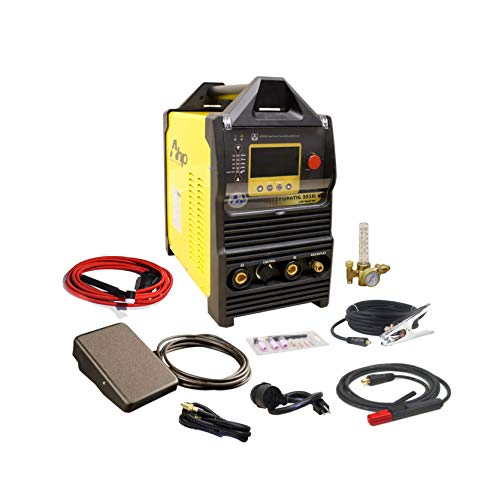
AHP AlphaTIG 203Xi
- Best for: Welders who want pedal control, pulse and a long warranty without menu depth
- Output: 200A on 240V, 150A on 120V
- Processes: AC/DC TIG with pulse, plus stick
- Input: 110/220V dual voltage
- Included per listing: NOVA foot pedal in the standard package
Welders who want pedal control, pulse and a long warranty without menu depth
Confirm the revision and the exact pedal in the box before ordering, since AHP also lists a separate wireless pedal bundle
The 203Xi is the straightforward dual-voltage choice in this group. Its listing title states pulse TIG, 110/220V operation and a three-year warranty, and the standard package includes a NOVA foot pedal, so pedal control is part of the machine rather than an accessory hunt. Output is 200A on a 240V circuit and 150A on 120V, which covers the quarter-inch aluminum and three-eighths-inch steel work the model is aimed at. The 2024 revision listed here uses HV start, an electronic arc start that avoids the point-gap upkeep of older high-frequency designs, keeping setup simple for occasional welders.
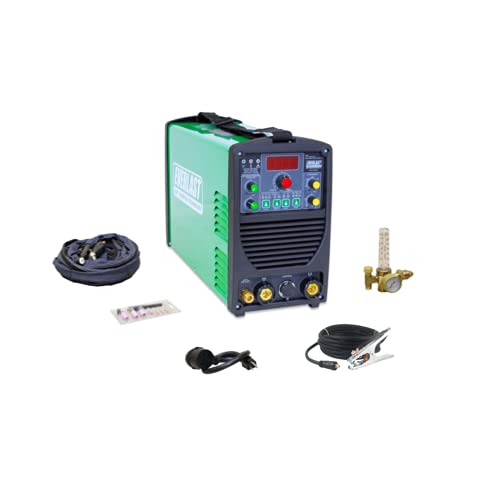
Everlast PowerTIG 185DV
- Best for: Portable AC/DC work and thinner material at moderate amperage
- Output: 185A AC/DC TIG, plus stick
- Pulse: two preset rates, 1 and 50 Hz
- Input: 110/220V dual voltage
- Included per listing: foot pedal package, 17-series air-cooled TIG torch, argon regulator
Portable AC/DC work and thinner material at moderate amperage
The two fixed pulse rates cannot be fine-tuned the way a fully adjustable pulse range can
The 185DV is the lightest machine in this roundup at 40 lb, and its listing is sold as a pedal package, with the foot pedal included for linear amperage control. Output tops out at 185A on a 240V circuit, which is enough for aluminum up to an eighth of an inch and general steel fabrication. The pulse function works differently here: instead of a continuous frequency range, the machine gives two preset pulse rates, 1 and 50 pulses per second. That simpler scheme suits buyers who want heat control on thin material without a deep parameter menu to learn before the first bead.
Which One Fits Your Situation
You weld thin aluminum panels, tanks and tubing
Pick the Weldpro TIG200GD. Its pulse adjusts across a 0.5 to 200 Hz range, so you can slow the pulse to keep a narrow heat band on thin aluminum sheet, and AC balance control helps manage the cleaning action on older castings. The included rocker pedal lets you back the amperage off as a corner heats up, which is where thin panels usually blow through.
Your bench runs long beads on thick plate
The Weldpro 250GD fits this work. The 250-amp ceiling and the water-cooled Tig20 torch in this listing are aimed at sustained runs that would overheat an air-cooled setup, and the memory function recalls the settings for a repeat job without dialing everything in again. Plan on adding the separate water cooler and a fixed spot on the bench, since the machine weighs 92 lb.
You are setting up a first TIG station at home
The Eastwood TIG 220 removes most of the accessory guesswork: torch, gas lens kit, foot pedal and helmet are all in the box per the listing. It runs on a household 120V circuit at up to 140A while you learn, then moves to 240V for the full 220A later. Add an argon regulator and cylinder, and the station is complete.
You carry the welder between sites with different outlets
Take the Everlast PowerTIG 185DV. At 40 lb it is the easiest machine here to load into a truck, and dual-voltage input means it runs on whatever circuit the site has. The pedal package is included, so heat control travels with the machine. The trade is output: 185A handles repair work and thinner stock, but it is not the pick for heavy plate.
Common Mistakes
- Assuming a pedal socket means a pedal is in the box; on many pulse TIG listings the pedal is a separate purchase, so check the included components line.
- Buying a replacement pedal by plug shape alone; pin counts and wiring differ between brands, and a pedal wired for one maker will not control another.
- Running a 250-amp machine at full output on a household circuit; full amperage needs the 240V line and the plug type the listing specifies.
- Setting pulse parameters before AC balance and frequency on aluminum; the AC controls shape the arc first, and pulse fine-tunes heat after that.
- Judging duty cycle by the headline amperage; the figure drops as output rises, so compare machines at the amperage your work actually uses.
Frequently Asked Questions
Does every pulse TIG welder include a foot pedal?
No. Many pulse TIG welders provide only a pedal socket, and the pedal is bought separately with a plug wired for that brand. Every machine in this roundup was chosen because its Amazon listing names a foot pedal among the included components or sells the unit as a pedal package, so check that included components line on any other model you consider.
Can I use the foot pedal and pulse at the same time?
Yes. The pedal sets the working amperage in real time while the pulse function cycles the output between peak and background current inside that range. On machines with adjustable pulse, you set frequency and pulse width on the panel, then use the pedal to raise or lower overall heat as the joint warms up during the bead.
What pulse frequency should I start with on thin stainless?
A slow pulse, around 1 to 2 pulses per second, gives a visible rhythm that helps time filler dabs and keeps heat out of thin stainless. Faster settings stiffen the arc and narrow the bead for very thin sheet. Machines differ here: the Weldpro 200A adjusts from 0.5 to 200 Hz, while the Everlast 185DV gives fixed 1 and 50 Hz presets.
Will a foot pedal from another brand fit my welder?
Usually not. Pedal plugs use different pin counts, such as five-pin and seven-pin patterns, and the internal wiring and resistance values vary between makers. A pedal also has to match the amperage range the machine expects. Buy the pedal listed for your exact model, or pick a welder like the ones above whose listing already includes the matching pedal.