Key takeaways
- The best circular sprinklers compared: impact, tripod and spinning models with full and part-circle patterns, listed coverage diameters and base types.
As an Amazon Associate, we earn from qualifying purchases made through links on this page.
A circular sprinkler throws water in a round pattern from a single central point, which makes it the natural fit for round lawns, circular flower beds, newly seeded patches and any open area that is roughly as wide as it is long. Instead of sweeping a fan back and forth the way an oscillating model does, a circular sprinkler rotates a jet, a set of spinning arms or a gear-driven stream around its own axis, so the water lands in a disc shape with the sprinkler at the centre.
That shape is the whole point of this category, and it is also the limit. A circle leaves the corners of a square lawn dry, and a full circle centred near a path or a wall will water the path and the wall as happily as the grass. The picks below are all above-ground, hose-end circular sprinklers: impact models that can be trimmed to a part circle, and spinning models that water a fixed full circle gently. Every diameter and coverage figure here is the manufacturer’s published figure for that model, and each assumes your tap pressure sits inside the model’s stated operating range. Lower pressure always means a smaller circle.
What to look for in a circular sprinkler
Drive type decides the pattern and the noise. Impact sprinklers use a spring-loaded arm that strikes the stream and nudges the head around in steps. They throw the farthest of any hose-end type, they tolerate gritty well or pond water because the flow path is straight through, and they make the familiar clicking sound as they work. Spinning and whirling sprinklers send water through angled arms or a spinning head, so the rotation is continuous and quiet, the droplets are finer, and the throw is shorter. Gear-drive rotors sit between the two: a sealed turbine turns the head slowly and silently, usually with several selectable spray patterns. This guide covers impact and spinning models, because those are the types sold specifically as circular sprinklers for hose-end use.
Full circle versus part circle. A fixed full-circle model is the simplest thing in the category: connect the hose, open the tap, and it waters a disc. That simplicity is a real limitation near boundaries. Impact heads solve it with trip collars or adjustment rings that stop the head at a set point and send it back, so the same head can water anything from a narrow wedge to a complete circle. If the sprinkler will sit in the middle of an open lawn, a fixed circle is fine. If it will sit against a fence, a bed edge or a driveway, part-circle adjustment is the feature that matters most.
Coverage diameter is a pressure-dependent claim. Manufacturers list the largest circle the sprinkler produces at a favourable pressure. An impact head listed at a 90-foot diameter needs strong pressure to get there; on a weak tap the same head may only manage two thirds of that. Match the listed diameter to your space with headroom to spare, and treat the square-foot figure as the area of that best-case circle rather than a promise. Spinning sprinklers sit at the other end of the scale: their circles are small, and some are designed deliberately for low-pressure supplies, which makes them the safer pick for long hose runs and rural taps.
Base type decides where the sprinkler can work. A tripod lifts the head above tall planting and lets the spray clear obstacles, and its height adjusts as crops or ornamentals grow. A step spike anchors the head at ground level in turf or soft soil and is the most stable option in wind, but the low jet can be blocked by the plants around it. A sled or stationary base simply sits on the ground, which suits hard surfaces and small beds, and it is the easiest type to pick up and move. One further detail is worth checking: a flow-through outlet on the base lets you run a second sprinkler from the first, which is how a single tap covers a long strip with two circles.
Materials decide service life. Brass impact heads are the traditional long-life option, and brass, bronze and stainless internals resist the wear that happens at the pivot point where impact heads eventually fail. Zinc heads cost less and are common on tripod models. Polymer spinning heads have fewer moving parts to wear, but the arms and nozzles are more vulnerable to being stepped on or driven over. Whichever type you choose, drain it before the first freeze, because no hose-end sprinkler survives winter with water trapped inside.
The best circular sprinklers
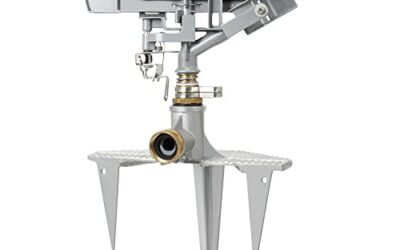
Orbit 56667Z Zinc Impact Sprinkler on Tripod Base

See it on Amazon — ASIN: B004VUA82K
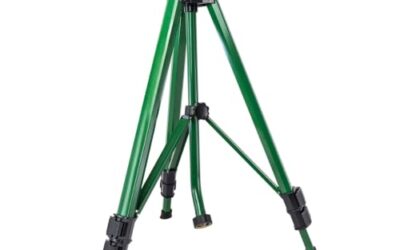
The Orbit 56667Z puts a zinc impact head on a metal tripod that adjusts from 22 to 48 inches tall, and that height is what separates it from every ground-level pick in this guide. Raised on the tripod, the stream clears tall flower beds, vegetable rows and shrubs instead of drilling into the nearest foliage, so the circle the head describes is the circle that actually lands on the ground. Orbit lists coverage of up to a 90-foot diameter, or 6,360 square feet at a full circle, and the head adjusts from a partial section to a full 360-degree rotation using its trip settings, with a deflector shield and an anti-backsplash arm to shape the stream and keep the operator dry while adjusting it.
The all-metal construction covers both the head and the tripod, and the impact mechanism is clog-resistant by design, since the water passes straight through the head; Orbit positions the model for large areas and for use with dirty or reclaimed water. It connects to a standard garden hose at the tripod base. For a big, open lawn with planting in the middle of it, this is the most capable circular pattern in the guide.
The limitations follow from the specs. Zinc is a step down from brass for wear at the pivot, so this head should not be expected to match the service life of an all-brass impact head. The full 90-foot diameter is a maximum that depends on strong tap pressure. A tall tripod is also the least stable base in this group on soft or sloping ground, and it is the bulkiest model here to store.
Best for: large lawns and gardens where the spray has to clear tall plants, beds or crops.
Orbit 58214N Brass Impact Sprinkler on Step Spike

See it on Amazon — ASIN: B0009H53D8
The 58214N pairs a brass impact head with a zinc step spike that presses into turf or soil, which gives it the opposite working style to the tripod model above: low, fixed and anchored. Orbit lists the same headline coverage as its tripod model, up to a 90-foot diameter and 6,360 square feet at a full circle, and the pattern adjusts from a partial section through a full 360-degree circle. A deflector shield and a diffuser screw let you shorten and break up the stream, which is how a head with this much reach gets used on a medium lawn without soaking the fence.
Two details make this model more flexible than it looks. The head has a flow-through outlet, so a second hose and sprinkler can run in series from the same tap, turning one circle into a chain of circles down a long plot. And because the spike holds the head at ground level in the turf, it stays where you set it in wind that would walk a sled base across the lawn. The brass head is the wear-resistant part of the assembly, and it is the part that does the rotating.
The trade-offs are also clear from the spec sheet. A step spike needs ground soft enough to push it into, so it is a poor match for dry, compacted soil or gravel. The low spray height means surrounding planting can shadow parts of the circle. The spike itself is zinc rather than brass, and like every impact head it makes the characteristic clicking noise as it rotates.
Best for: fixed watering points in turf, and for chaining two sprinklers along a large or awkwardly shaped area.
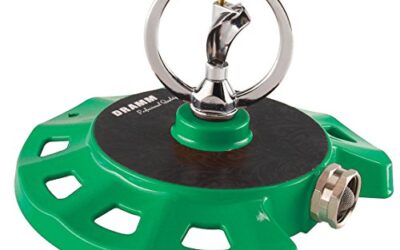
Dramm 15074 ColorStorm Spinning Sprinkler

See it on Amazon — ASIN: B006L90F72
The Dramm ColorStorm Spinning Sprinkler is the gentle option in this guide. Its spinning head throws a full circle up to 38 feet in diameter, covering about 1,100 square feet, and Dramm designed the model specifically to keep working on low water pressure, in the range where impact heads barely turn. The water leaves the head as a fine, even spray rather than a single hard jet, which suits seedlings, new seed and flower beds that a heavy impact stream would batter or wash out.
Construction is a powder-coated metal base with brass parts in the water path, and the model is sold in six colours, which sounds trivial until you have left a green sprinkler in long grass and found it with the mower. The listing gives a maximum pressure of 90 PSI and a maximum flow rate of 3.5 gallons per minute, so it also tolerates a strong municipal supply. There are no patterns to set and nothing to programme: the head spins, the circle forms, and moving the sprinkler is the only adjustment available.
That simplicity defines the limitations. The pattern is a full circle only, with no part-circle setting, so placement has to do all the work of keeping water off paths and walls. The 38-foot maximum diameter is the smallest in this guide, and the circle shrinks further as pressure falls. The spinning element itself is plastic-coated rather than solid metal, which is the part to inspect if the head ever stops turning freely.
Best for: small round beds, new seed and low-pressure taps where an impact sprinkler would stall.
Gilmour Spinning Sprinkler with Stationary Base

See it on Amazon — ASIN: B00002N68H
Gilmour’s spinning sprinkler takes the same whirling approach as the Dramm and scales it up slightly. The listing states coverage of up to 1,963 square feet, which works out to a circle about 50 feet across, with continuous whirling action giving 360-degree circular coverage. The spray is described as gentle and rain-like, and Gilmour positions the model for flower beds and vegetable gardens, where a soft application rate matters more than raw distance.
The stationary base sits flat on the ground rather than spiking into it, so the sprinkler can work on a patio edge, a path-side bed or any spot where pushing a spike in is not an option, and it can be picked up and set down again without tools. The whirling head has no arc settings to drift out of adjustment, and the continuous rotation avoids the pulsing delivery of an impact head, which helps prevent the pooling that a stop-start jet can cause on slow-draining soil.
The limitations are those of the type. The pattern is a fixed full circle with no part-circle option and no distance adjustment beyond what your tap pressure gives you, so the listed coverage is a ceiling rather than a setting. The construction is polymer rather than metal, so it should be stored out of the sun and off the drive. It also sits low, and tall growth around a bed will intercept the outer part of the circle.
Best for: flower beds and vegetable gardens that need a soft, even circle of water from a base that just sits in place.
Comparison table
| Sprinkler | Drive type | Max circle diameter | Pattern adjustment | Base type |
|---|---|---|---|---|
| Orbit 56667Z | Impact | Up to 90 ft (6,360 sq ft) | Part circle to full 360 degrees | Metal tripod, 22–48 in |
| Orbit 58214N | Impact | Up to 90 ft (6,360 sq ft) | Part circle to full 360 degrees | Zinc step spike |
| Dramm 15074 ColorStorm | Spinning | Up to 38 ft (1,100 sq ft) | Full circle only | Powder-coated metal base |
| Gilmour Spinning Sprinkler | Spinning (whirling) | About 50 ft (1,963 sq ft) | Full circle only | Stationary base |
Frequently asked questions
What is the difference between a circular sprinkler and an oscillating sprinkler?
An oscillating sprinkler sweeps a fan of jets back and forth, which lays water in a rectangle and suits square or oblong lawns. A circular sprinkler rotates around a central point and lays water in a disc, which suits round beds and open areas that are about as wide as they are long. Neither shape is better in general; the right choice is the one that matches the shape of the ground, because the wrong shape wastes water on the corners it cannot reach or the edges it overshoots.
Can a circular sprinkler water only part of a circle?
Impact models can. Their heads carry trip collars or adjustment rings that stop the rotation at a chosen point and reverse it, so the watered area becomes a wedge or a half circle instead of a full disc. Spinning and whirling models generally cannot; they water a fixed full circle, and the only way to keep water off a path is to move the sprinkler or reduce the pressure. Check for part-circle adjustment before buying if the sprinkler will sit near a boundary.
Why is my circular sprinkler’s circle smaller than the listed diameter?
The listed diameter is measured at a favourable pressure inside the manufacturer’s stated operating range. Long hose runs, partly closed taps, shared household demand and low municipal pressure all shrink the circle, and impact heads lose distance fastest because a single jet has to carry the whole flow. Move the sprinkler closer to the tap, use a shorter or wider hose, and water when other taps in the house are idle. If the supply is permanently weak, a spinning sprinkler designed for low pressure will usually give a more honest circle than an impact head working below its range.
Can I run two circular sprinklers from one tap?
Yes, if the first sprinkler has a flow-through outlet, as the Orbit 58214N does: the second hose connects to that outlet and feeds the next sprinkler in series. Expect the second sprinkler’s circle to be smaller than the first, because it is fed with whatever pressure remains after the first head has taken its share. Space the two circles so their edges overlap slightly at the reduced diameter rather than at the listed maximum.
Do circular sprinklers work on uneven or sloping ground?
They work, but the circle distorts. On a slope the downhill side throws farther and the uphill side falls short, and the water that lands tends to run toward the low side. A spike or tripod base keeps the head level and in place, which helps more than the drive type does. Shorter, repeated sessions give the soil time to absorb water on a slope where one long session would run off.
Conclusion
Choose by shape first and by pressure second. For a large open lawn, an impact head gives the widest circle and the only real part-circle control in this category: the Orbit 56667Z on its tripod if the spray has to clear planting, or the Orbit 58214N on its spike if the watering point is fixed in turf or you want to chain a second sprinkler behind it. For small round beds, new seed and weak taps, the spinning models are the honest fit, with the Dramm 15074 built for low pressure and the Gilmour covering a slightly larger circle from a base that simply sits on the ground. Whichever you pick, compare the listed diameter with your space, and remember the figure on the box is the circle you get on a good day at the tap.