Key takeaways
- Compare five gear-drive rotors with true 3/4-inch inlets by spray radius, arc range and nozzle setup, from Hunter, Rain Bird, Orbit and K-Rain picks.
The inlet size is the least glamorous line on a sprinkler box and the one that decides whether an install takes ten minutes or a trip back to the store. A sprinkler with a 3/4-inch inlet threads directly onto the 3/4-inch risers and lateral lines used in most residential and light commercial rotor zones, with no reducing bushings, no adapters and no weak points added to the line. It also passes the flow that long-throw rotors need: a head throwing water 40 or 50 feet moves far more water than a small spray head, and the wider inlet is what lets it do that without choking.


This guide compares five gear-drive rotors that all carry a genuine 3/4-inch female inlet according to their listings. They cover the main buying situations: a proven all-round replacement, a simple-adjust homeowner model, a nozzle-rich Orbit, a drop-in K-Rain that fits rival cans, and a contractor-size 20-pack of a professional Rain Bird rotor. Every specification below, including inlet size and spray radius, comes from the listing data for the exact model named.
As an Amazon Associate, we earn from qualifying purchases.
Quick Picks
| Product | Best for | Key point |
|---|---|---|
| Hunter PGP-ADJ | The default replacement rotor for mixed lawn zones | 22 to 52 ft radius and a preinstalled 3.0 GPM nozzle |
| Rain Bird 42SA+ | Homeowners who want simple top adjustment | 26 to 38 ft radius with Rain Curtain nozzle technology |
| Orbit Voyager II 55662 | Slopes and clay soil that punish runoff | Low precipitation rate and a nine-nozzle rack in the box |
| K-Rain RPS75 | Drop-in swaps into Hunter PGP and PGP Ultra cans | 22 to 51 ft radius with a full nozzle tree included |
| Rain Bird 5004PC (20-pack) | Whole-system installs and contractor work | Pro-series rotor with 25 to 50 ft radius, bought in bulk |
How to Choose
Confirm the inlet, not the family name. Rotor ranges mix inlet sizes inside the same brand. Within Rain Bird’s simple-adjust line, for example, the 32SA uses a 1/2-inch inlet while the 42SA+ uses a 3/4-inch inlet, and both look nearly identical on a shelf. Read the inlet line of the exact model, and match it to the riser or fitting already in the ground. All five rotors in this guide list a 3/4-inch inlet.
Match radius to head spacing. Rotors are laid out head-to-head, meaning each head should reach the next one. A zone spaced at 35 feet needs rotors whose listed radius covers 35 feet at your working pressure, not just at the top of a test bench range. The picks here span 22 to 52 feet depending on model and nozzle, so measure your spacing before choosing rather than after digging.
Check the arc range against your corners. Every rotor here adjusts from 40 to 360 degrees, which covers part-circle edges and full-circle open areas in one head. If a zone includes tight corners below 40 degrees, none of these will trim that small, and a dedicated spray head zone is the better tool for that strip.
Look at what nozzle arrives fitted. The Hunter PGP-ADJ and Rain Bird 42SA+ arrive with a 3.0 GPM nozzle preinstalled, ready to run. The Orbit and K-Rain include racks or trees of alternative nozzles for tuning flow per head. The Rain Bird 5004PC 20-pack includes nozzle racks but the rotors are not preloaded, which suits planned installs and slows down a quick single-head swap.
Mind the pressure window. Each listing states an operating or maximum pressure. The K-Rain RPS75 tops out at 70 PSI while the Hunter and Orbit list maximums of 100 PSI. On high-pressure supplies, a rotor run beyond its range mists instead of throwing, wasting water at any inlet size.
Best Options
Hunter PGP-ADJ
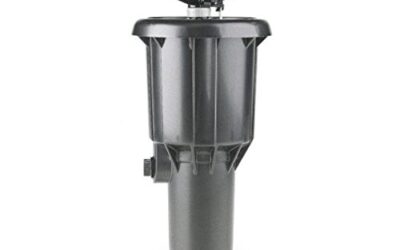
The PGP-ADJ is the rotor that much of the industry is measured against, and it remains the safest single recommendation for a 3/4-inch inlet zone. Its arc adjusts from 40 to 360 degrees, the listed spray radius runs from 22 to 52 feet, and it arrives with a 3.0 GPM nozzle already fitted, plus an adjustment tool in the box for setting arc and radius from the top.
The flow range of 0.5 to 14.1 GPM gives zone designers room to mix nozzle sizes across a line while keeping precipitation even. A 4-inch pop-up clears typical lawn height, and the water-lubricated gear drive keeps rotation quiet and smooth. For a like-for-like replacement of a worn rotor on a 3/4-inch line, this is the head that asks the fewest questions.
Specs
- Inlet 3/4-inch female NPT; spray radius 22 to 52 ft; arc adjustable 40 to 360 degrees; 4-inch pop-up; preinstalled 3.0 GPM nozzle; flow range 0.5 to 14.1 GPM; operating pressure 20 to 100 PSI, with 25 to 70 PSI recommended; adjustment tool included
Best for: Replacing worn rotors across mixed part-circle and full-circle lawn zones
Watch out for: Optional nozzles for fine-tuning are sold separately, and the wide 22 ft minimum radius is too much throw for narrow strips
Rain Bird 42SA+
The 42SA+ is Rain Bird’s homeowner-grade answer to the same job: a gear-drive rotor with a 3/4-inch female bottom inlet, a true 4-inch pop-up and adjustment that needs nothing more than a flat-head screwdriver at the top of the head. Its listed throw of 26 to 38 feet, delivered through a preinstalled 3.0 GPM nozzle at common residential pressures of 45 to 55 PSI, fits the medium lawn zones most houses actually have.
Rain Curtain nozzle technology is the differentiator here, producing larger droplets that resist wind drift and gentle close-in watering that does not wash out seed near the head. A heavier-duty build than the smaller 32SA and a self-cleaning action at pop-down round out a design aimed at people who want to set a rotor once and forget it.
Specs
- Inlet 3/4-inch female threaded bottom inlet; spray radius 26 to 38 ft; arc adjustable 40 to 360 degrees; 4-inch pop-up; preinstalled 3.0 GPM nozzle; listed throw at 45 to 55 PSI residential pressure; water-lubricated gear drive; Rain Curtain nozzle
Best for: Medium residential lawns where simple adjustment and wind-resistant droplets matter
Watch out for: Do not confuse it with the 32SA, which looks similar but has a 1/2-inch inlet and a shorter throw; additional nozzle packs are a separate purchase
Orbit Voyager II 55662

The Voyager II is built around water behaviour rather than raw reach. Its preinstalled 3 GPM nozzle applies water at a low precipitation rate, listed at 0.24 inches per hour at 35 ft spacing, which lets slopes and clay soils absorb water instead of shedding it into the street. The box adds a nozzle rack with nine further nozzles across standard, low-angle and pasture options, so one head design can serve an entire varied system.
The inlet is a 3/4-inch female pipe thread, the arc adjusts from 40 to 360 degrees, and the radius can be trimmed down from the top with the included key. A built-in filter guards the nozzle against dirty water, and the body uses high-impact ABS with stainless steel internals. Orbit also positions it as a drop-in replacement for gear-drive rotors from other major brands, which the standard inlet size supports.
Specs
- Inlet 3/4-inch female pipe thread; spray distance 25 to 52 ft per the listing specification table; arc adjustable 40 to 360 degrees; 4-inch pop-up; preinstalled 3 GPM nozzle plus a rack of nine additional nozzles; maximum pressure 100 PSI; maximum flow 9 GPM; built-in filter; adjustment key included
Best for: Sloped or clay-soil lawns where a low precipitation rate prevents runoff and puddling
Watch out for: One Amazon listing under a similar Voyager name covers the earlier Voyager generation, so check the model number 55662 and Voyager II branding on the listing before ordering
K-Rain RPS75

The RPS75 exists for one very practical situation: a failed Hunter rotor in a buried can you do not want to dig out. K-Rain designs this gear-drive rotor so its riser drops into existing PGP and PGP Ultra cans, and its 3/4-inch female NPT inlet matches the fittings those systems already use. The arc adjusts from 40 to 360 degrees and the listed radius runs from 22 to 51 feet depending on nozzle and pressure.
A full nozzle tree and an adjustment tool come in the box, so tuning each head to its position needs no extra purchase. The listing caps pressure at 70 PSI and flow at 8.3 GPM, a narrower window than the Hunter, which is worth checking on high-pressure supplies. For maintenance crews and homeowners standardising on one spare head, the cross-brand fit is the whole argument.
Specs
- Inlet 3/4-inch female NPT; spray radius 22 to 51 ft depending on nozzle and pressure; arc adjustable 40 to 360 degrees; maximum pressure 70 PSI; maximum flow 8.3 GPM; nozzle tree and adjustment tool included; riser fits PGP and PGP Ultra cans
Best for: Drop-in replacement of Hunter PGP rotors without digging out the buried can
Watch out for: The 70 PSI maximum is lower than some rivals, and the arc sets from a fixed side stop, so orientation at install decides where the pattern begins
Rain Bird 5004PC (20-Pack)

The 5004PC is the professional 5000 Series rotor, and this listing sells it the way installers buy it: a case of 20 rotors with 20 nozzle racks and two adjustment tools. Each rotor carries a 3/4-inch inlet, a 4-inch pop-up and a listed radius of 25 to 50 feet, with part-circle adjustment from 40 to 360 degrees and reversing full-circle operation in the same head.
Rain Curtain nozzles deliver the even pattern the series is known for, and buying by the case keeps every head on a new system identical, which simplifies nozzle planning and spares. The trade-off is preparation: the rotors ship without nozzles preloaded, so each head needs its nozzle fitted during install, a small cost across 20 heads that buys exact per-position tuning.
Specs
- Inlet 3/4-inch female pipe thread; spray radius 25 to 50 ft; arc adjustable 40 to 360 degrees with reversing full-circle operation; 4-inch pop-up; case of 20 rotors with 20 nozzle racks and 2 adjustment tools; nozzles not preinstalled; Rain Curtain nozzle technology; gear drive
Best for: New whole-system installs and contractors who want one uniform professional rotor
Watch out for: A 20-pack is far more than a single-head repair needs, and every rotor needs a nozzle fitted before first run since none arrive preloaded
Which One Fits
- Choose the Hunter PGP-ADJ if you want the proven all-round rotor with the widest listed radius range and a nozzle already fitted.
- Choose the Rain Bird 42SA+ if your zones are medium-sized and you value screwdriver-simple adjustment and wind-resistant droplets.
- Choose the Orbit Voyager II 55662 if runoff on slopes or clay is your main problem and you want a full nozzle rack in the box.
- Choose the K-Rain RPS75 if you are swapping failed Hunter PGP heads and want to reuse the cans already in the ground.
- Choose the Rain Bird 5004PC 20-pack if you are building or re-heading a whole system and want uniform professional rotors in bulk.
Common Mistakes
Assuming the range shares one inlet size. Sibling models differ: the Rain Bird 32SA is a 1/2-inch inlet head while the 42SA+ is 3/4-inch, and spray bodies in the same catalogues are usually 1/2-inch too. Ordering by brand and shape alone is how the wrong head arrives.
Reducing a 3/4-inch line down to a smaller head. A bushing lets a 1/2-inch head fit a 3/4-inch riser, but it also throttles the flow the rotor was sized for and adds a leak point. When the line is 3/4-inch, buy the 3/4-inch inlet head.
Spacing heads to the brochure maximum. Listed radius is measured at favourable pressure with the largest nozzle. Space heads to the middle of the listed range for your nozzle, or dry rings appear between heads within a season.
Skipping the nozzle check in the box. Some rotors arrive with a nozzle fitted and some, like the 5004PC case, arrive with racks only. Confirm what is included so the first run is not delayed by a missing part you assumed was inside.
FAQ
What does a 3/4-inch inlet actually change compared with 1/2-inch?
Two things: fit and flow. The head threads straight onto 3/4-inch risers and fittings with no adapter, and the wider passage supports the higher flow rates that long-throw rotors use. On short spray heads the smaller inlet is fine, which is why most spray bodies are 1/2-inch and most mid-range rotors are 3/4-inch.
Can I mix 3/4-inch inlet rotors from different brands on one zone?
Yes, provided the nozzles are chosen so each head applies a similar precipitation rate. The five rotors here all share the 3/4-inch inlet and similar radius ranges, and the K-Rain RPS75 is even shaped to reuse Hunter cans. Match nozzle flow to radius position by position rather than fitting the same nozzle everywhere by default.
Are these sprinklers hose-end models or in-ground heads?
All five are in-ground pop-up rotors for piped irrigation systems, not hose-end sprinklers. The 3/4-inch figure is the threaded inlet at the base of the head, which connects to the buried lateral line or a riser, rather than a garden hose coupling.
What if my existing heads turn out to have 1/2-inch inlets?
Then none of these is a direct swap, and forcing the issue with adapters costs flow. Measure one removed head before ordering a set: the inlet is the threaded opening at the base. If it measures as a 1/2-inch fitting, shop the 1/2-inch rotor lines instead, such as the Rain Bird 32SA class.
Final Verdict
For most 3/4-inch systems the Hunter PGP-ADJ is the head to buy first: the widest listed radius range here, a nozzle fitted and ready, and an inlet that matches the line you already own. The Rain Bird 42SA+ suits homeowners who prize simple adjustment, the Orbit Voyager II earns its place on slopes, the K-Rain RPS75 solves the buried-can problem, and the 5004PC case equips whole installs. Check the inlet line of the exact model, space to the realistic radius, and a 3/4-inch rotor zone will run for years with little attention.